Letters to Notify a Bank and Others of a Death
Five editable letters to tell a bank, a utility, a pension plan, the credit bureaus and a landlord about a death.
- Word
Included in The Executor Kit ($39), with 7 other files.
Instant download. One payment. 14-day refunds.
What this is for
Many organizations can be told about a death by phone or through an online form. Some still want it in writing, and a letter is useful even when it is not required: it gives the organization everything in one go, it leaves you with a dated copy, and it saves you finding the right words from scratch each time. Writing the same news again and again is tiring, and it is one of the tasks family members most often ask for help with.
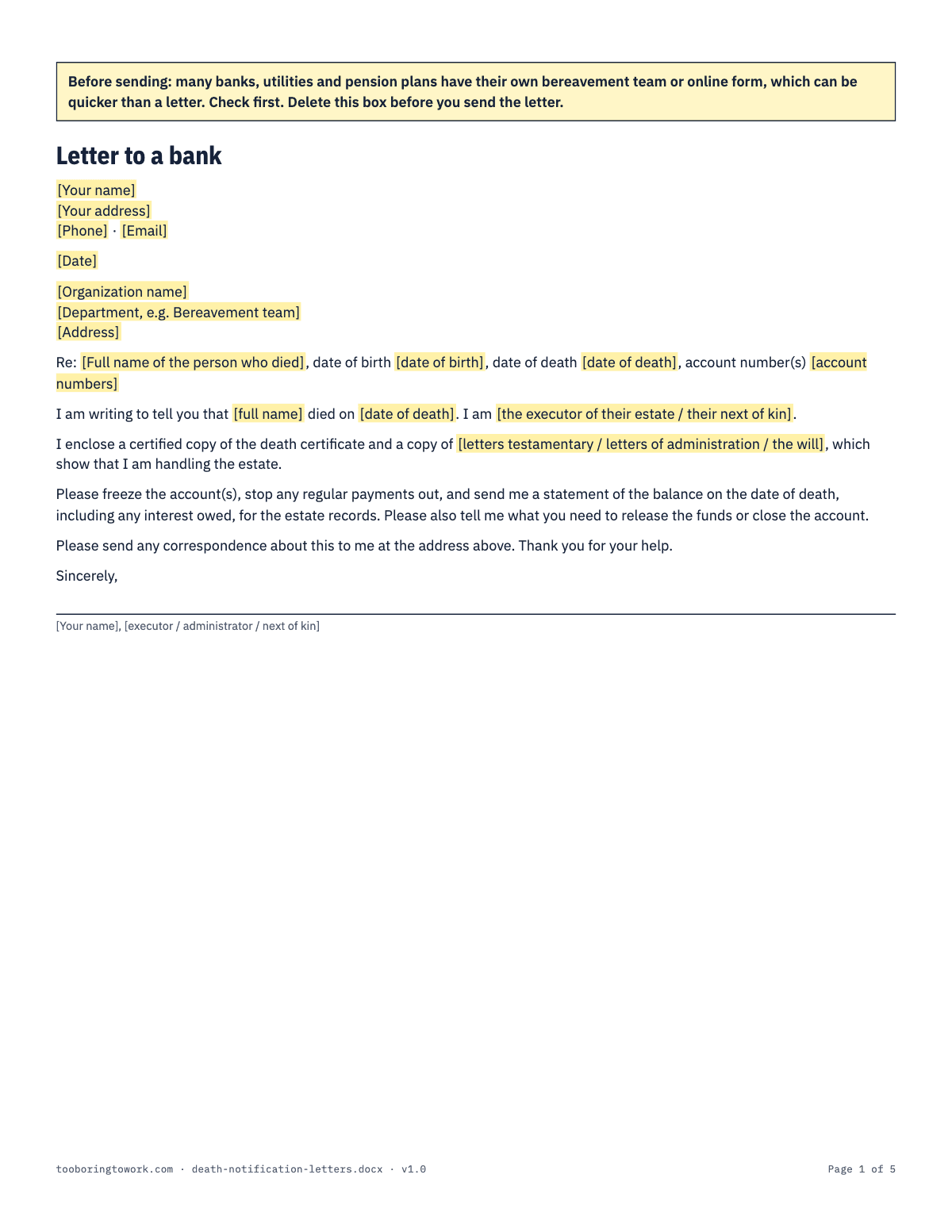
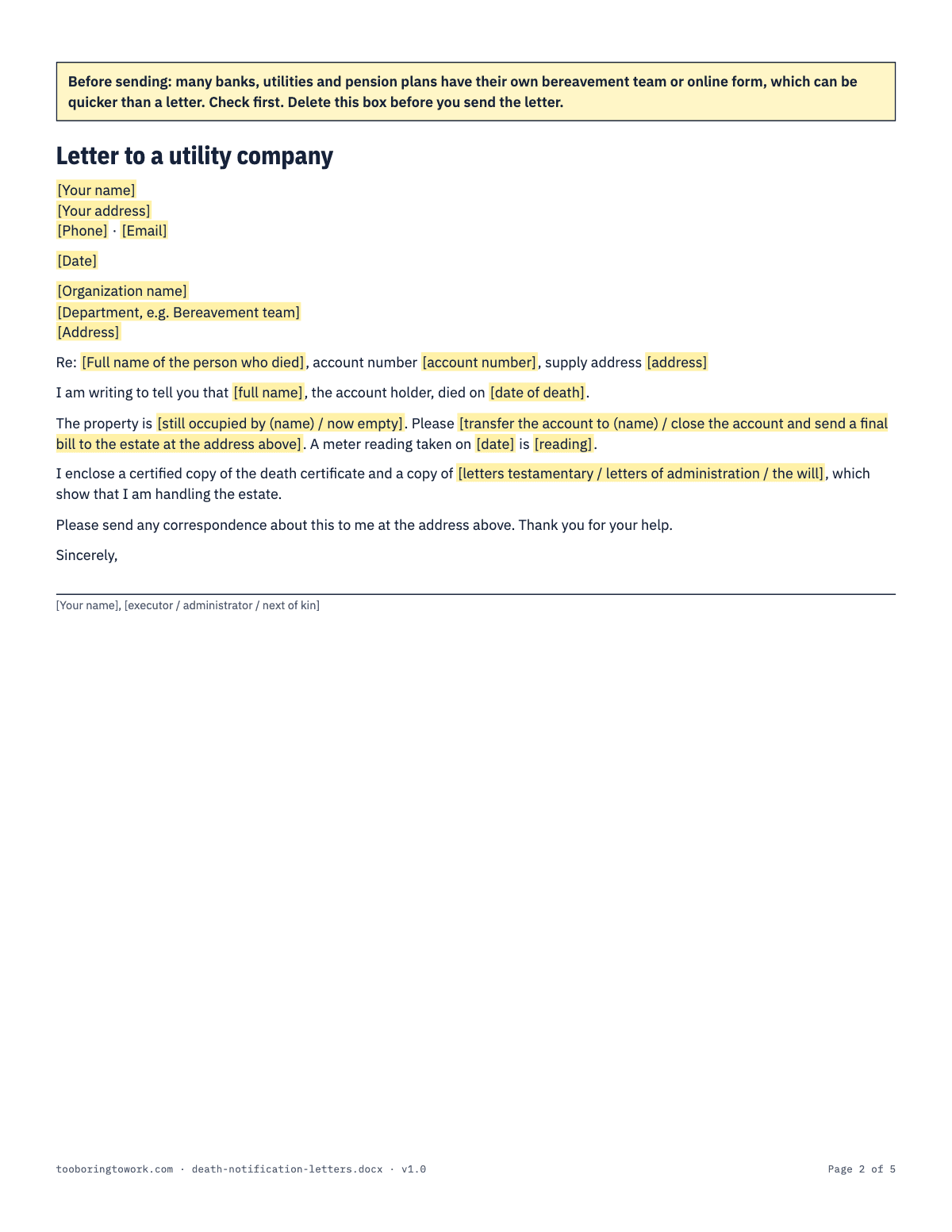
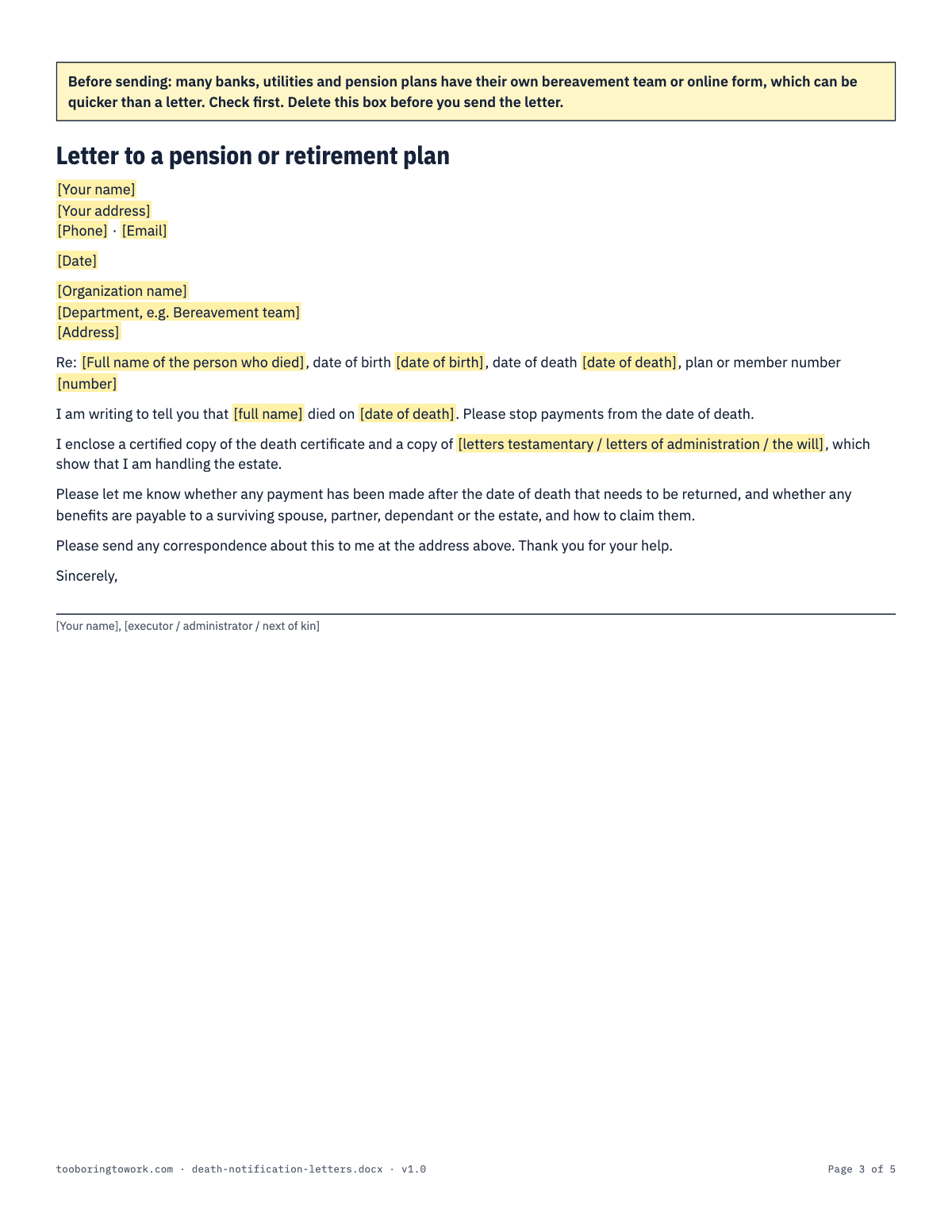
This Word document holds five letters: to a bank, a utility company, a pension or retirement plan, the credit bureaus, and a landlord. Each letter starts with your name and address, the date, and the organization’s name, department and address. A “Re:” line gives the name of the person who died and the details the organization will use to find the account. The body says plainly what has happened, what you are enclosing, and what you would like them to do, and ends with your name and your role: executor, administrator or next of kin.
Everything you need to change is in square brackets and highlighted, such as [full name], [date of death] and [account number]. Each letter also begins with a short boxed note reminding you that many banks, utilities and pension plans have their own bereavement team or online form, which can be quicker than a letter. Check that first, and delete the box before you send anything.
How to fill it in
- Open the document in Word, Google Docs, Pages or LibreOffice and save a copy for each organization you are writing to, so the original stays blank.
- Read the boxed note at the top. Look up whether the organization has a bereavement team, a specific address for estate matters, or an online form. If it has a form, you may not need the letter at all. If it has a bereavement address, use it in the address block.
- Fill in every highlighted field. Use the full legal name of the person who died, their date of birth and date of death, and the account, plan, member or supply number from a recent statement. For the credit bureaus letter, the Re: line also asks for their Social Security number and last address.
- Choose the right wording in the brackets and delete the rest. The proof paragraph, for example, offers [letters testamentary / letters of administration / the will]; keep only the document you are actually enclosing. If you have not yet been appointed by the probate court, say you are next of kin and send the death certificate for now.
- In the bank letter, the request is to freeze the accounts, stop regular payments out, and send a statement of the balance on the date of death, including interest owed. In the utility letter, say whether the property is still occupied or empty, whether to transfer or close the account, and add a meter reading with its date.
- In the pension or retirement plan letter, you ask the plan to stop payments from the date of death, tell you if anything paid afterwards needs to be returned, and explain any benefits for a surviving spouse, dependant or the estate. The landlord letter asks to discuss ending the tenancy, the notice period, collecting belongings and returning the deposit.
- The credit bureaus letter asks each bureau to add a deceased marker and send a copy of the credit report. The IRS advises sending the bureaus a copy of the death certificate and asking for a deceased alert. Send a copy of this letter to each of Equifax, Experian and TransUnion.
- Delete the boxed note, sign the letter, and make a copy for yourself. Enclose copies of documents, not originals. Record the date you sent it and what you enclosed in the Documents sent column of the who to notify list.
A filled-in example
| Letter | Sent to | Date sent | Enclosed | Reply / next step |
|---|---|---|---|---|
| Bank | Bereavement team, Lakeside Savings | 06/03 | Certified death certificate, copy of letters testamentary | Accounts frozen. Balance letter received 06/17. |
| Utility company | Northgate Power, customer service | 06/03 | Copy of death certificate | Closed; final bill sent to Grace at her address. |
| Pension or retirement plan | Plan administrator | 06/05 | Certified death certificate, copy of letters testamentary | June payment to be returned. Survivor benefit form sent to his wife, Joan. |
| Credit bureaus | Equifax, Experian, TransUnion | 06/05 | Copy of death certificate, copy of letters testamentary | Equifax and Experian confirmed. Waiting on TransUnion. |
| Landlord | Mr. Alvarez, property manager | 06/06 | Copy of death certificate | No reply after two weeks. Called 06/20; walkthrough booked for 06/27. |
Common mistakes
- Sending original documents. Banks and plans generally need a certified copy of the death certificate, and a copy of your letters testamentary is often enough. Keep the original will and your originals safe unless an organization explains why it needs one, and ask for anything you post to be returned.
- Leaving a bracket in the letter. Proofread each page before signing, ideally with a relative or friend looking over your shoulder; a stray [account number] makes the letter seem unfinished and may delay a reply.
- Asking a bank to close an account in the first letter. The template asks for the account to be frozen and for a date-of-death balance. Closing it is a later decision, once you know what comes in and goes out of it.
- Offering to pay a debt in the letter. The letters tell organizations about the death; they do not accept any debt. Debts are generally paid from the estate, and you are not personally responsible unless you shared them.
- Not keeping a copy. A dated copy of each letter, filed with the reply, is often the fastest answer when an organization says it never heard from you.
What the rules say
The IRS advises sending the credit bureaus a copy of the death certificate, asking for a deceased alert on the person’s credit reports, and keeping personal details out of the obituary.
Source: IRS, Identity theft guide for individualsBeing reviewed
A person’s debts are generally paid from what they leave behind (their estate). You are not responsible for them unless you shared the debt, for example as a co-signer or joint account holder, or another exception applies.
Source: CFPB, Does a person’s debt go away when they die?Being reviewed
Certified copies of a death certificate come from the vital records office of the state where the death happened. You can order them online, by mail or in person; at first, only certain close relatives can get copies.
Source: USAGov, How to get a certified copy of a death certificateBeing reviewed
Equifax says a spouse or authorized representative can mail a copy of the death certificate, the person’s details and their own ID to Equifax Information Services LLC, P.O. Box 105139, Atlanta, GA 30348-5139, and Equifax will tell the other two bureaus.
Source: Equifax, Contacting credit bureaus after a relative’s deathBeing reviewed
Experian says you can report a death by uploading or mailing a copy of the death certificate to Experian, P.O. Box 4500, Allen, TX 75013.
Source: Experian, How to report a relative’s death to credit bureausBeing reviewed
Last reviewed September 29, 2026. We link to official sources; your local rules may differ, so check them.
Questions
- How do I write a letter to notify a bank of a death?
- Say who died and when, give the account numbers, explain your role (executor or next of kin), and list what you are enclosing. Ask the bank to freeze the accounts, stop regular payments, and send a statement of the balance on the date of death. The bank letter in this template follows that order.
- What documents should I send with a death notification letter?
- Usually a certified copy of the death certificate and, once you have them, a copy of your letters testamentary or letters of administration. Certified death certificates come from the state vital records office. Organizations sometimes return certified copies if you ask.
- How do I notify the credit bureaus of a death?
- Write to each bureau with a copy of the death certificate and ask for a deceased alert. Equifax says it will notify the other two bureaus when a spouse or representative writes to it at its Atlanta P.O. box; Experian accepts letters to its Allen, Texas address. Many executors write to all three to be sure.
- Can I notify organizations if I am not yet the executor?
- Yes, as next of kin you can tell most organizations about the death and ask them to freeze accounts. Anything that moves money, such as releasing funds or closing an account, usually has to wait until the probate court has appointed an executor or administrator.
- Should I send letters by certified mail?
- It is not required, but many executors use certified mail for banks, the credit bureaus and anything time-sensitive, because the mailing receipt, and an optional return receipt, prove when it was delivered. Whatever you choose, keep a copy of the letter and note the date sent.