Executor Checklist Spreadsheet: Estate Task Tracker
The steps of settling an estate in order, with an owner, status and due date for each, and overall progress. Easy to share with family.
- Excel
- Works in Google Sheets
Included in The Executor Kit ($39), with 7 other files.
Instant download. One payment. 14-day refunds.
What this is for
Settling an estate usually takes months, sometimes longer, and it happens in stages: finding the will, going to the probate court, dealing with the IRS, paying bills, and finally passing on what is left. Along the way, family members ask what is happening, and it is easy to lose track of which step you are on. A shared list with names and dates makes those conversations easier and keeps the work from resting on one person’s memory.
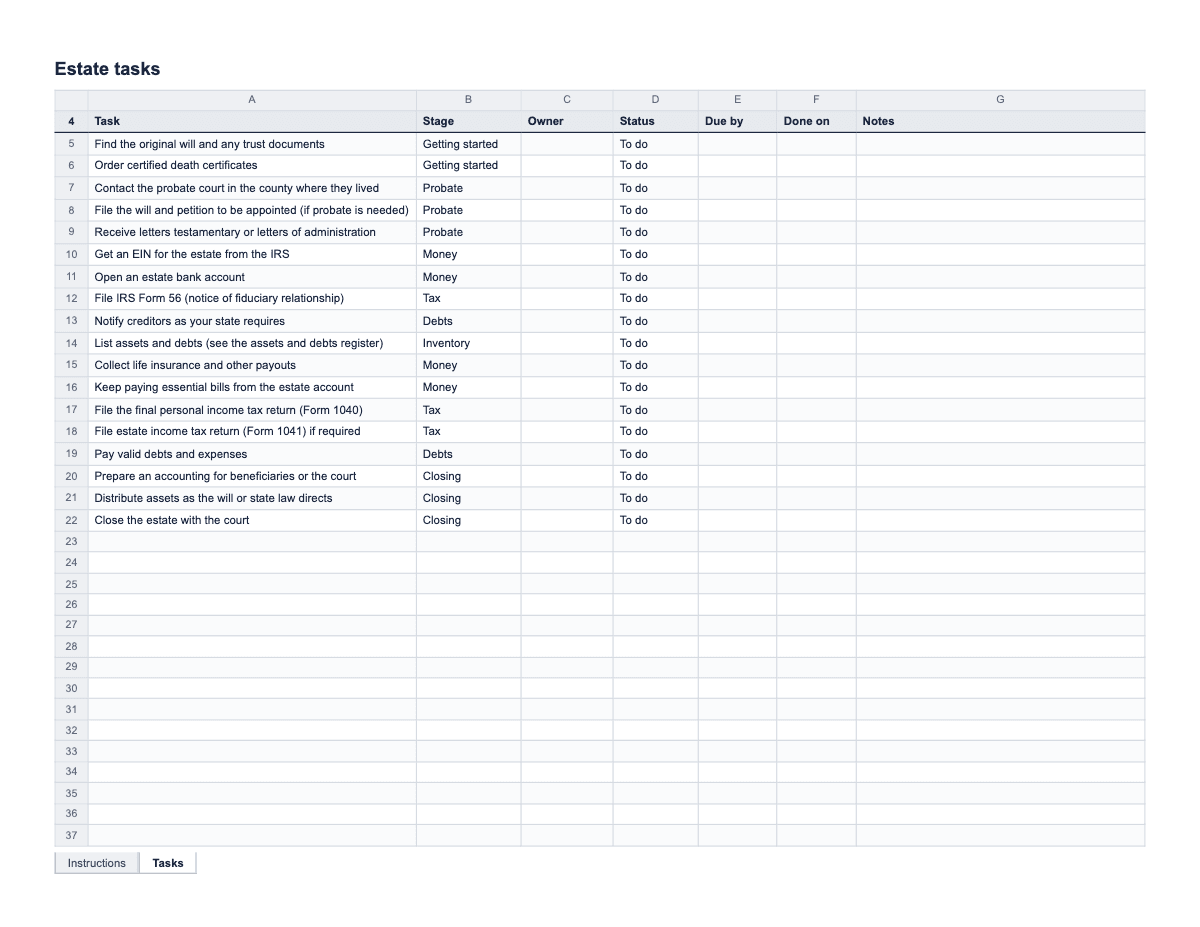
This spreadsheet has one main tab, Tasks, with eighteen common steps already listed in a rough order. Each is grouped by Stage: Getting started, Probate, Money, Tax, Debts, Inventory and Closing. Next to each task are columns for Owner, Status, Due by, Done on and Notes. A Progress figure at the top shows the share of tasks finished, counting both Done and Not needed.
Not every estate needs every step. Some small estates may not need a full probate process at all, depending on your state, and some never have enough income to require an estate tax return. The list is a starting point, not a legal checklist; rules for wills and estates are set by state probate courts, not federal law. It opens in Excel, Google Sheets, Numbers and LibreOffice.
How to fill it in
- Open the file and read the first tab, which explains the columns and how to upload the tracker to Google Sheets and share it with family.
- Go to the Tasks tab. Read through the eighteen steps and set anything that clearly does not apply to Not needed in the Status dropdown. If you are unsure whether a step applies, leave it as To do and add a question in Notes.
- Put a name in Owner for every task you keep. It can be the executor, a sibling, or the attorney’s office. When one person owns a task, nobody assumes someone else is doing it.
- Contact the probate court in the county where the person lived early on. Ask what it needs to open the estate, whether a simpler process might apply, and roughly how long each stage takes there. Write what they tell you in Notes, then fill in Due by dates you can realistically meet.
- Once you are appointed, the IRS describes getting an EIN for the estate as the first thing to do; it is free. With the EIN you can open an estate bank account and file Form 56 to tell the IRS you are acting for the estate. Each of these has its own row.
- As things move along, change Status: In progress when you have started, Waiting when you are depending on someone else, and Done when it is finished. Enter the date in Done on. A task with a Due by date in the past that is not finished turns amber, so overdue items are easy to spot.
- Use Notes for reference numbers, who you spoke to, and what the next step is. The inventory row points to the estate inventory spreadsheet, where you record assets and debts in detail; payments you make belong in the executor expense log.
- Add your own rows at the bottom for anything specific to this estate, such as selling a car or clearing a storage unit, and choose Other as the Stage if none of the stages fit.
A filled-in example
| Task | Stage | Owner | Status | Due by | Done on | Notes |
|---|---|---|---|---|---|---|
| Find the original will and any trust documents | Getting started | Lisa | Done | 04/05 | 04/02 | Original in the fireproof box. No trust. |
| Receive letters testamentary or letters of administration | Probate | Lisa | Done | 05/15 | 05/09 | Ordered 5 certified copies from the clerk. |
| Get an EIN for the estate from the IRS | Money | Lisa | Done | 05/20 | 05/12 | Applied online; confirmation letter filed. |
| Notify creditors as your state requires | Debts | Lisa | In progress | 05/25 | Missed first date; attorney’s office confirmed the process and is placing the notice this week. | |
| Collect life insurance and other payouts | Money | Sam | Waiting | 06/15 | Claim form sent 05/20. Claim no. LF-30918. | |
| File estate income tax return (Form 1041) if required | Tax | Lisa | To do | Ask the accountant whether estate income will reach the filing threshold. |
Common mistakes
- Paying debts before you know the full picture. It is natural to want bills settled quickly, but the order in which debts are paid can matter, and the estate may not cover all of them. List everything first, then pay valid debts from the estate account.
- Handing out belongings or money early. Even when everyone agrees, distributing before debts, taxes and court requirements are dealt with can leave the executor personally in a difficult spot. The Distribute row sits near the end on purpose.
- Mixing estate money with your own. Once you have an EIN, open an estate account and run everything through it. It keeps the accounting you give beneficiaries simple and clear.
- Keeping the tracker to yourself. Families often worry when they cannot see progress. A shared copy in Google Sheets answers most questions before they are asked.
- Forgetting the person’s own final tax return. It is separate from the estate’s return and is easy to miss while the probate work is going on.
What the rules say
Wills and estates are handled by probate courts, which are state and territory courts, not federal ones.
Source: USAGov, Federal, state, territory, county, and municipal courtsBeing reviewed
An estate needs its own tax ID number (an EIN) before it files an income tax return. The IRS calls applying for one the first thing a personal representative should do; it is free at IRS.gov/EIN.
Source: IRS Publication 559, Survivors, Executors, and AdministratorsBeing reviewed
An executor tells the IRS that they are acting for the estate by filing Form 56, Notice Concerning Fiduciary Relationship.
Source: IRS, About Form 56Being reviewed
The surviving spouse or representative files the person’s final federal tax return, usually due April 15 of the year after the death. On a paper return, write "deceased", the person’s name and the date of death across the top.
Source: IRS, Filing a final federal tax return for someone who has diedBeing reviewed
An estate must file an income tax return on Form 1041 for any tax year in which its gross income is $600 or more.
Source: IRS Publication 559, Survivors, Executors, and AdministratorsBeing reviewed
Last reviewed September 29, 2026. We link to official sources; your local rules may differ, so check them.
Questions
- What are the steps to settle an estate?
- Broadly: find the will, open the estate with the probate court, get appointed, get an EIN and open an estate account, list assets and debts, notify creditors, pay valid debts and taxes, account to the beneficiaries, distribute what is left and close the estate. The details depend on your state, so ask the probate court in the county where they lived.
- How long does it take to settle an estate?
- It varies a great deal by state, by county and by how complicated the estate is. There is no single timeline. The court clerk can usually tell you what is typical there, and the Due by column lets you plan around what they say.
- Does an estate need its own tax ID?
- An estate needs its own EIN before it files an income tax return, and banks usually ask for one to open an estate account. It is free from the IRS.
- When is the final tax return due for someone who died?
- The person’s final federal return is usually due April 15 of the year after the death. The estate may also have to file its own return, Form 1041, for any year its gross income is $600 or more. This is not tax advice; an accountant can confirm what applies.
- Do I need a probate attorney?
- Not always. Many executors handle small, simple estates themselves. If there is real estate in more than one state, a business, a disagreement among family, or significant tax to consider, a probate attorney is often worth it. You can list them as the Owner for the tasks they take on.