Estate Inventory Spreadsheet: Assets and Debts
Everything the person owned and owed, with values at the date of death, how each was held, and totals worked out.
- Excel
- Works in Google Sheets
Included in The Executor Kit ($39), with 7 other files.
Instant download. One payment. 14-day refunds.
What this is for
Before an executor can pay debts or pass anything on, they need to know what the person owned and what they owed on the day they died. That sounds simple, but the information is usually scattered: statements in a drawer, a retirement account nobody mentioned, a car loan paid by automatic transfer. The probate court in the county where they lived may ask for an inventory, and beneficiaries will want an accounting at the end. Both are much easier to produce from one register kept up as you go.
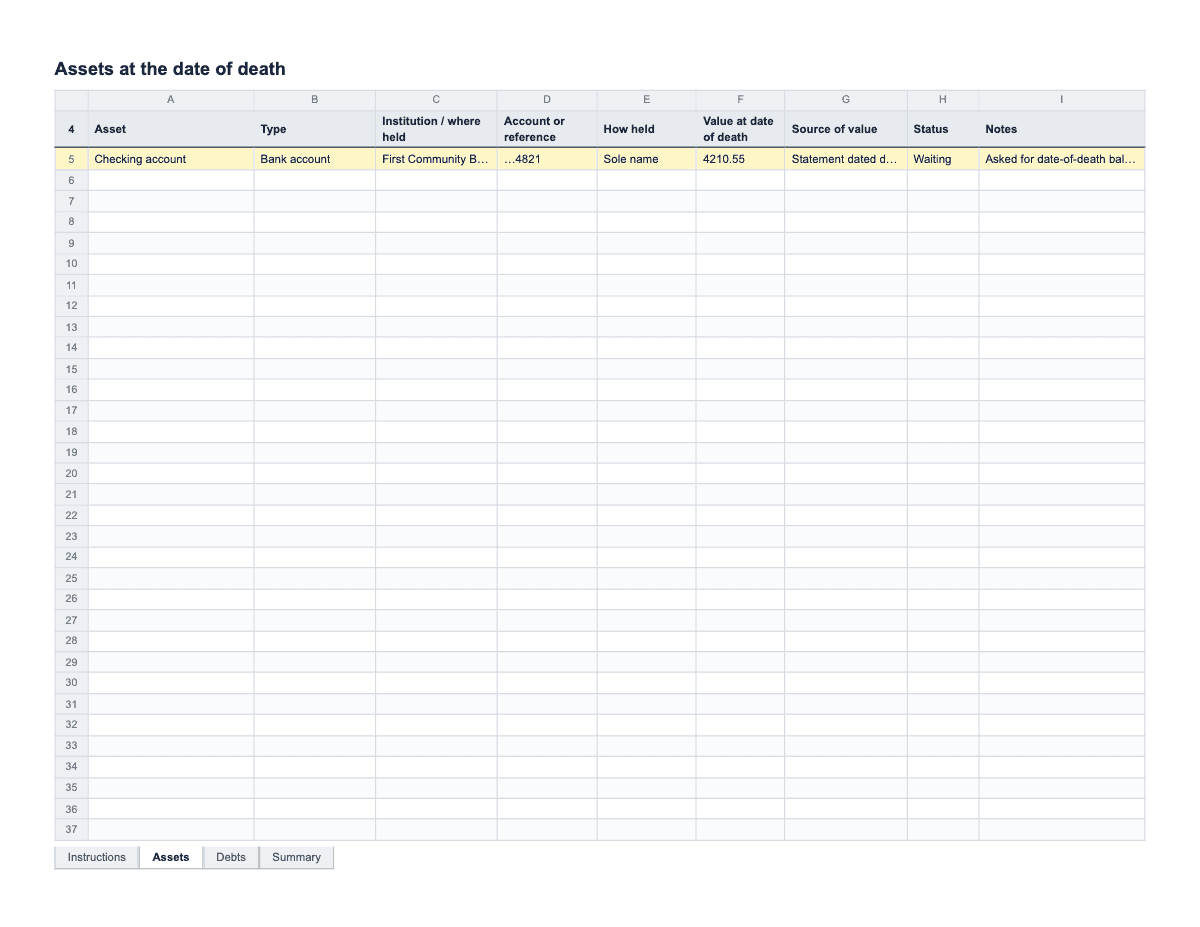
This spreadsheet has three tabs. Assets has a row for each thing they owned, with columns for Asset, Type, Institution / where held, Account or reference, How held, Value at date of death, Source of value, Status and Notes. Debts does the same for what they owed: Owed to, Type, Account or reference, Joint or guaranteed by someone?, Balance at date of death, Status and Notes. Summary adds everything up by asset type and shows total assets, total debts and the net figure.
The How held column matters more than it looks. Accounts held jointly, or with a named beneficiary, or inside a trust, may pass directly to someone rather than through the estate. The spreadsheet does not decide that for you; it makes sure you ask the question for every item. Rules on this are set by state law, so check each one with the institution or a probate attorney.
How to fill it in
- Open the file and delete the EXAMPLE row on the Assets tab and the one on the Debts tab. The instructions tab explains how to upload the file to Google Sheets if you want to share it.
- Gather what you have: recent bank and card statements, the last tax return, insurance policies, property tax bills, retirement and brokerage statements. The important documents locator is a good way to find them first.
- On Assets, add one row per account, property or item of value. Choose a Type from the dropdown: Real estate, Bank account, Retirement account, Brokerage / investments, Life insurance, Vehicle, Personal property, Business interest, Money owed to them, or Other.
- For How held, choose Sole name, Joint, Beneficiary named, In a trust, or Not sure. When in doubt, pick Not sure and ask the institution. That one column often explains why some assets never reach the estate account.
- Enter the Value at date of death, not today’s value. For bank accounts, ask for a letter showing the balance on the date of death. For a house or car, note in Source of value whether the figure came from an appraisal, a tax assessment or an estimate you will replace later.
- On Debts, add each thing they owed: mortgage, credit cards, car loan, medical bills, taxes, utilities, and the funeral if it has not been paid. If someone else shared the debt or guaranteed it, set Joint or guaranteed by someone? to Joint or Guarantor; the row turns amber as a reminder that another person may be involved.
- Update Status as you go. For assets, use the same dropdown as the other files (To do through Done). For debts, the choices are Not yet told, Told, Claim received, Paid and Disputed.
- Check the Summary tab. It totals assets by type and shows the net figure. Share it with a probate attorney or accountant if the estate is large, has a business, or includes property in more than one state.
A filled-in example
| Item | Type | How held / joint? | Value or balance at date of death | Source of value | Status | Notes |
|---|---|---|---|---|---|---|
| Checking account …4821 | Bank account | Sole name | $4,210.55 | Bank letter, date-of-death balance | Done | Moved to estate account 06/02. |
| Savings account …1077 | Bank account | Joint | $12,400.00 | Statement | Not needed | Joint with her sister Irene. Bank confirmed it passes to Irene directly. |
| House, 14 Maple St | Real estate | Sole name | $238,000.00 | Appraisal, 05/20 | In progress | Listed for sale after court approval. |
| IRA | Retirement account | Beneficiary named | $61,300.00 | Quarterly statement | Waiting | Beneficiary: James. Claim form sent. |
| Card company …9912 | Credit card (debt) | No | $1,284.10 | Final statement | Told | Account frozen; will pay from estate once claim arrives. |
Common mistakes
- Using today’s value instead of the value on the date of death. Balances and markets move. Ask each institution for the figure on the date of death and note where it came from.
- Assuming everything goes through the estate. Joint accounts, life insurance and retirement accounts with a named beneficiary often pass outside it. Listing them anyway, with the right How held choice, gives the full picture without mixing them into the estate total by mistake.
- Paying debts from your own money. A person’s debts are generally paid from their estate. Family members are not usually responsible unless they shared the debt. Record the debt here and let the estate deal with it.
- Closing accounts before they are listed. A closed account can be hard to trace later. Write it down, freeze it, and get the date-of-death balance before anything else.
- Leaving out small things. A security deposit, a tax refund or a final paycheck all belong under Money owed to them.
What the rules say
A person’s debts are generally paid from what they leave behind (their estate). You are not responsible for them unless you shared the debt, for example as a co-signer or joint account holder, or another exception applies.
Source: CFPB, Does a person’s debt go away when they die?Being reviewed
Federal estate tax only applies to large estates: the basic exclusion amount is $15,000,000 for people who die in 2026.
Source: IRS, Estate taxBeing reviewed
Wills and estates are handled by probate courts, which are state and territory courts, not federal ones.
Source: USAGov, Federal, state, territory, county, and municipal courtsBeing reviewed
Last reviewed September 29, 2026. We link to official sources; your local rules may differ, so check them.
Questions
- What should be in an estate inventory?
- Everything the person owned at death, with its value on that date, and everything they owed. That includes real estate, bank and retirement accounts, investments, vehicles, valuable personal property, business interests and money owed to them. Your state and the probate court decide the exact form the court wants; this spreadsheet gathers the information behind it.
- Do I have to pay the deceased person’s credit card debt?
- Generally not. The CFPB says debts are paid from what the person leaves behind, and you are not responsible unless you shared the debt, for example as a co-signer or joint account holder, or another exception applies. Exceptions depend on your state, so ask a probate attorney if you are unsure.
- Will the estate have to pay federal estate tax?
- Most do not. Federal estate tax only applies to large estates; the basic exclusion amount is $15,000,000 for people who die in 2026. This is not tax advice: state tax rules are separate, so ask an accountant or attorney what applies where the person lived.
- How do I find out what someone owned?
- Start with their mail, bank statements and last tax return, which often show interest, dividends and retirement accounts. Look at automatic payments on their statements. Their credit report, which you can ask the bureaus for, can show loans and cards you did not know about.
- What is the difference between an asset in the estate and one outside it?
- Assets in the person’s sole name, with no beneficiary, usually go through probate and are shared out under the will or state law. Joint accounts, trusts and accounts with a named beneficiary may pass directly to someone else. The How held column helps you sort them; the institution or an attorney can confirm each one.