What to Do When Someone Dies: A First-Week Checklist
What usually needs doing in the first days after someone dies, in a sensible order, on one printable page.
- PDF · Letter
Free · PDF
What this is for
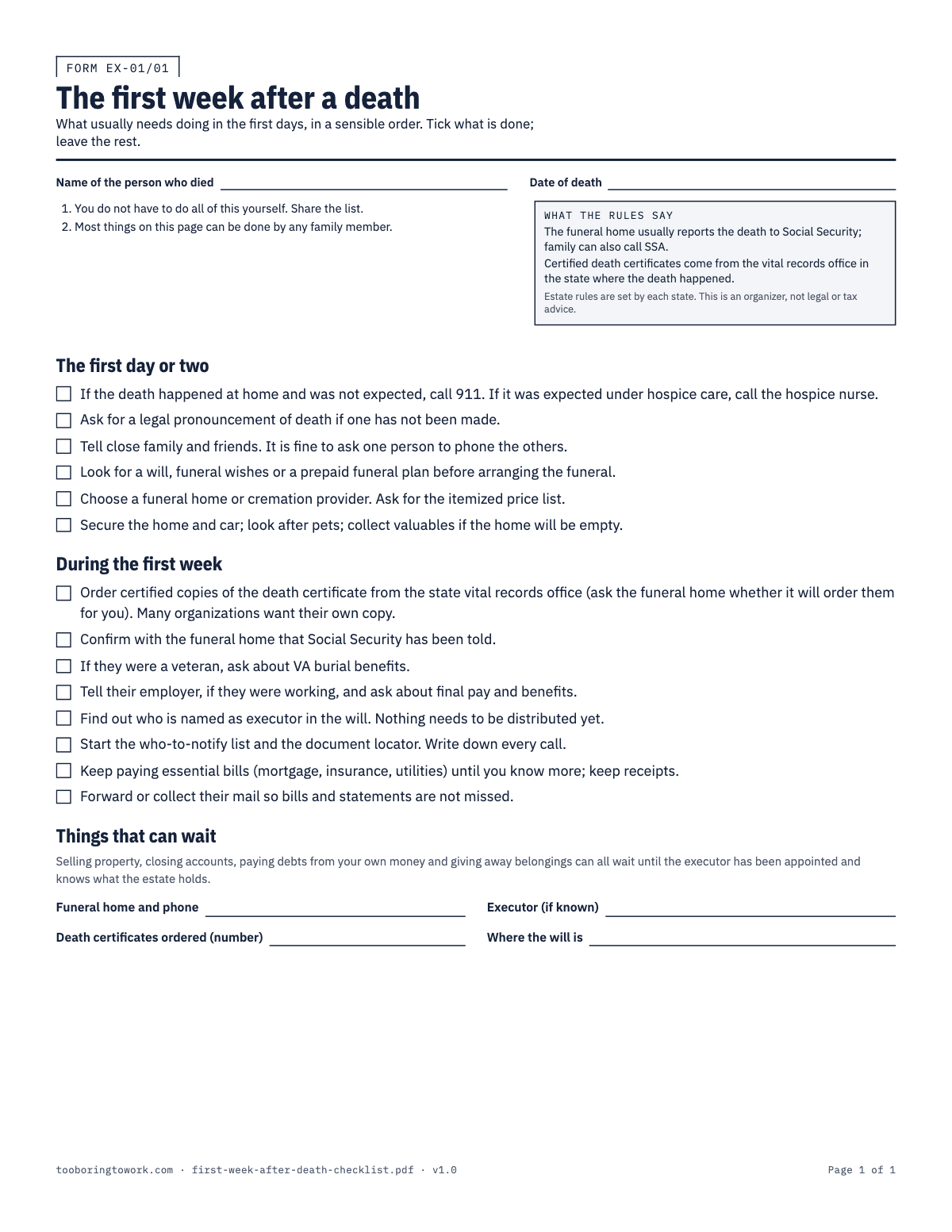
When someone dies, a lot of small, practical things need attention in the same few days, usually while you are tired and upset. Most of them are not urgent in the way they feel. A few are. This checklist separates the two, so you can see what to do first, what belongs later in the week, and what can safely wait until you have more information and more energy.
It is one Letter-size page. At the top there is space for the name of the person who died and the date of death, and a short box with the two official points most families need early on: who reports the death to Social Security, and where certified death certificates come from. Below that are three sections: The first day or two, During the first week, and Things that can wait. At the bottom are four boxes to fill in: the funeral home and its phone number, the executor (if known), how many death certificates you ordered, and where the will is.
Nothing on the page asks you to make legal decisions. Almost every item can be done by any close family member or friend, not only the person named as executor. If there is more than one of you, print a copy for each person, or keep one on the kitchen table and let people add their initials next to what they have taken on.
How to fill it in
- Print the page and write the name of the person who died and the date of death at the top. Having those two things written down helps more than you might expect: you will be asked for them on almost every call.
- Start with The first day or two. If the death happened at home and was not expected, the first step on the sheet is to call 911. If it was expected under hospice care, call the hospice nurse instead. Ask for a legal pronouncement of death if one has not been made.
- Tell close family and friends. The sheet says so plainly: it is fine to ask one person to phone the others. You do not have to make every call yourself.
- Before you choose a funeral home or cremation provider, look for a will, written funeral wishes or a prepaid funeral plan. Then contact a provider and ask for the itemized price list. Under the FTC Funeral Rule you are entitled to one, and you can choose only the goods and services you want.
- Make the home and car safe, look after any pets, and collect valuables if the house will be empty for a while.
- Move on to During the first week. Order certified copies of the death certificate from the state vital records office, or ask the funeral home whether it will order them for you. Write the number you ordered in the box at the bottom.
- Check with the funeral home that Social Security has been told. If they were a veteran, ask about VA burial benefits. If they were working, contact their employer about final pay and benefits.
- Find out who is named as executor in the will and write it in the box. Nothing needs to be handed out to anyone yet. Keep paying essential bills such as the mortgage, insurance and utilities until you know more, keep the receipts, and have their mail forwarded or collected so bills and statements are not missed.
- Start a record of every call. The who to notify list and the important documents locator are made for this, and the sheet points to both.
- Read the Things that can wait box before you do anything final. Tick what is done, leave the rest, and put the page somewhere you will see it tomorrow.
A filled-in example
| Section | Item | Done | Who | Notes |
|---|---|---|---|---|
| First day or two | Called the hospice nurse | ✓ | Daniel | Nurse came at 6:15 am and confirmed the death. |
| First day or two | Told close family and friends | ✓ | Anna | Anna phoned Uncle Pete; he told the cousins. |
| First day or two | Looked for will and funeral wishes | ✓ | Daniel | Will in the filing cabinet, top drawer. Wishes: cremation, no viewing. |
| First week | Ordered death certificates | ✓ | Funeral home | 8 certified copies ordered through the funeral home. |
| First week | Confirmed Social Security was told | ✓ | Daniel | Funeral director reported it on Tuesday. |
| Can wait | Close her checking account | Left open for now. Bank has frozen it; asked for a date-of-death balance first. |
Common mistakes
- Trying to do everything in the first two days. Very little is truly urgent once the death has been confirmed and a funeral home is involved. Rest when you can; the list will still be there.
- Closing a bank account before you know what is in it or what is paid from it. Automatic payments for the mortgage or insurance may stop, and you lose an easy view of recent bills. Ask the bank to freeze it instead, and decide later.
- Paying their debts from your own money. A person’s debts are generally paid from their estate, not by family. Wait until the executor knows what the estate holds.
- Giving away belongings, even small ones, before the estate is settled. It can cause hurt feelings later, and some items may be needed to pay debts or may be left to someone specific in the will.
- Not writing down who you spoke to. Two weeks from now you will not remember which bank said what. A short note of the date, the name and any reference number saves a second call.
What the rules say
You can give the person’s Social Security number to the funeral director so they can report the death to Social Security, or call Social Security at 1-800-772-1213. Social Security only takes reports of a death by phone or in person.
Source: USAGov, Report the death of a Social Security or Medicare beneficiaryBeing reviewed
Certified copies of a death certificate come from the vital records office of the state where the death happened. You can order them online, by mail or in person; at first, only certain close relatives can get copies.
Source: USAGov, How to get a certified copy of a death certificateBeing reviewed
Under the FTC Funeral Rule, funeral providers must give you an itemized price list to keep and give prices by phone, and you can choose only the goods and services you want.
Source: FTC, The FTC Funeral RuleBeing reviewed
Eligible veterans may qualify for burial in a VA national cemetery, a headstone or marker, a Presidential Memorial Certificate and a burial allowance. To schedule a burial, call 800-535-1117.
Source: VA, Burials and memorialsBeing reviewed
A person’s debts are generally paid from what they leave behind (their estate). You are not responsible for them unless you shared the debt, for example as a co-signer or joint account holder, or another exception applies.
Source: CFPB, Does a person’s debt go away when they die?Being reviewed
Social Security cannot pay benefits for the month a person dies, so the payment received the following month must be returned. For example, if the person died in July, the August payment must be returned.
Source: USAGov, Report the death of a Social Security or Medicare beneficiaryBeing reviewed
Wills and estates are handled by probate courts, which are state and territory courts, not federal ones.
Source: USAGov, Federal, state, territory, county, and municipal courtsBeing reviewed
The appointed executor or administrator can change the mailing address of someone who has died, in person at a Post Office, with proof of their authority; a death certificate alone is not enough.
Source: USPS, How to stop or forward mail for the deceasedBeing reviewed
Last reviewed September 29, 2026. We link to official sources; your local rules may differ, so check them.
Questions
- What is the first thing to do when someone dies?
- Make sure the death is confirmed. If it happened at home and was not expected, call 911. If the person was in hospice care, call the hospice nurse. After that, tell close family and take a breath: most other things can happen over the following days.
- Who reports the death to Social Security?
- Usually the funeral home, using the person’s Social Security number. You can also call Social Security at 1-800-772-1213; it only takes reports of a death by phone or in person. If they received benefits, the payment for the month of death must be returned.
- How many death certificates do I need?
- There is no official number. In practice, many families order several, because banks, insurers and pension plans often want a certified copy of their own, and some keep it. Certified copies come from the vital records office in the state where the death happened; you can order more later if you run short.
- Do I have to pay for the funeral myself?
- Someone usually has to sign the funeral home’s contract, and that person may be asked to pay up front. Whether that money is paid back from the estate, and in what order, depends on state law, so keep every receipt. A probate attorney can tell you how it works where the person lived.
- What should I not do in the first week?
- Avoid anything that is hard to undo: selling property, closing accounts, paying debts from your own money, or giving away belongings. These can all wait until the executor has been appointed and knows what the estate holds.
- Do I need to be the executor to use this checklist?
- No. Most items can be done by anyone close to the person. Some later steps, such as changing their mailing address, need the appointed executor with proof of authority, and the estate task tracker covers that longer stretch.