Who to Notify When Someone Dies
A list of the organizations that usually need to be told, with a record of each call: date, reference number and next step.
- PDF · Letter
- Excel
- Works in Google Sheets
Free · PDF + Excel
What this is for
After a death, a surprising number of organizations need to be told: government agencies, banks, insurers, utilities, doctors, the post office. Each one wants slightly different paperwork, and many of them will give you a reference number and ask you to call back. Without a record, it is easy to phone the same company twice.
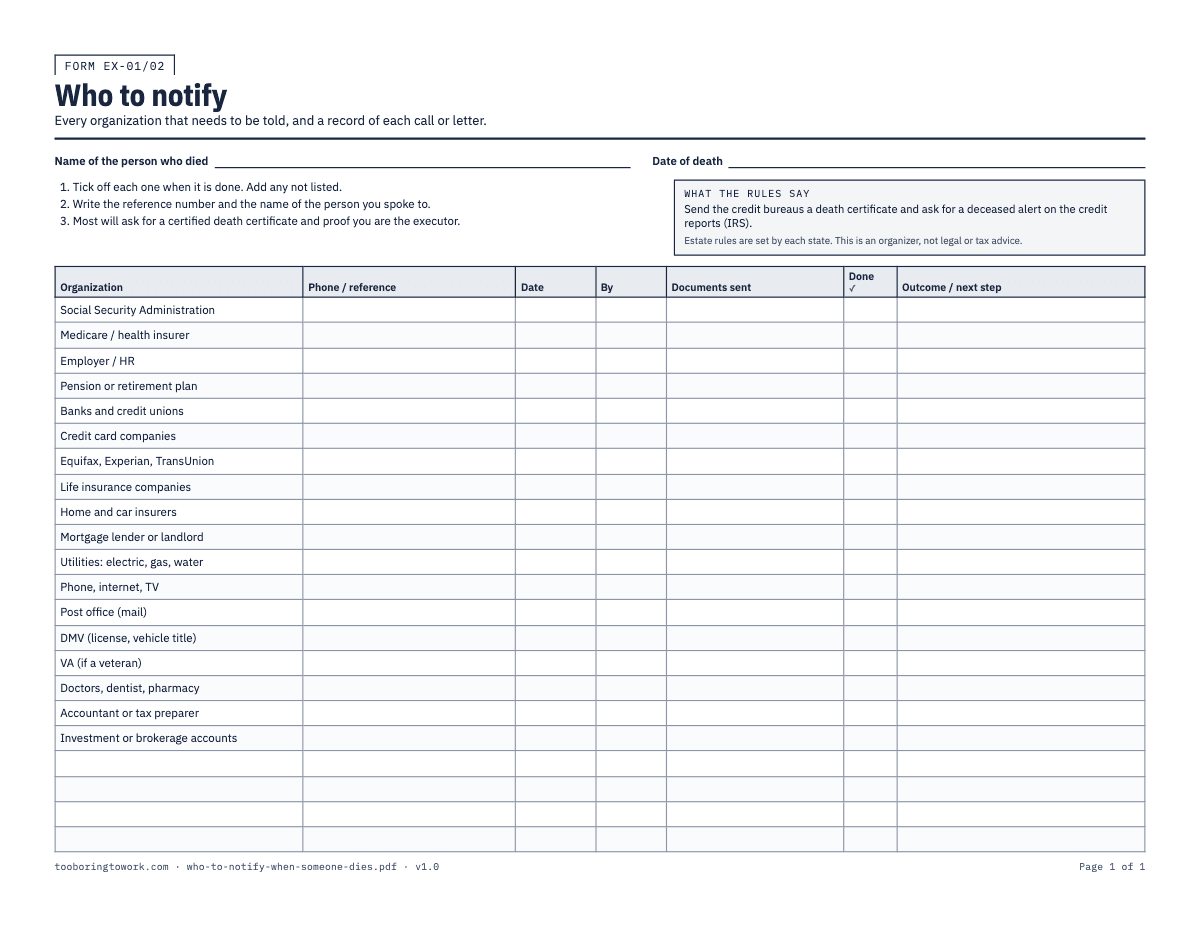
This list gives you one place for all of it. The printable PDF is a single landscape Letter page with eighteen organizations already filled in, from the Social Security Administration and Medicare to the DMV, the VA and the person’s accountant, plus a few blank rows. For each one there are columns for Phone / reference, Date, By (the initials of whoever made contact), Documents sent, a Done tick box and Outcome / next step.
The Excel version has the same list on a tab called Notify, with more room and a few things paper cannot do. Each organization has a Type from a dropdown (Government, Bank, Credit bureau, Home and so on), a Status dropdown (To do, In progress, Waiting, Done, Not needed) that turns green or amber, and counts at the top showing how many are finished and how many are still to do. It opens in Google Sheets, so several family members can work from the same list without doubling up.
How to fill it in
- Write the name of the person who died and the date of death at the top of the PDF. In the spreadsheet, start on the Notify tab; the instructions tab explains the columns and how to share the file in Google Sheets.
- Read down the pre-filled list and cross out, or set to Not needed, anything that does not apply. Not everyone had a mortgage, a pension plan or a military record. Then add rows for anything missing: a club, a church, a charity they gave to monthly, an alumni association.
- Start with the organizations that affect money coming in or going out: Social Security, their bank, any pension or retirement plan, and their employer. The funeral home usually reports the death to Social Security, which in most cases passes it on to Medicare, so the first job there is often just to confirm it was done.
- Before each call, have the account number to hand and write it in Phone / reference (the Excel file has a separate Account or reference number column). After the call, write the date, your initials in By, and what happens next in Outcome / next step.
- Use Documents sent every time you post or upload something. Most organizations ask for a certified death certificate and proof that you are the executor, such as letters testamentary. Knowing exactly who has which copy helps you decide how many more certificates to order.
- For the credit bureaus, the IRS advises sending a copy of the death certificate and asking for a deceased alert on their credit reports. Equifax says it will pass the notice to the other two bureaus if you write to it by mail; Experian also accepts an upload or a letter.
- For their mail, the post office will only change the address when the appointed executor brings proof of authority in person. Until then, a family member can collect it from the home.
- Tick Done (or set Status to Done) only when nothing more is needed from that organization. If you are waiting on a form or a final statement, use Waiting so it stays visible. For organizations that need a written notice, the death notification letters give you a starting point.
A filled-in example
| Organization | Phone / reference | Date | By | Documents sent | Done | Outcome / next step |
|---|---|---|---|---|---|---|
| Social Security Administration | Via funeral home | 03/10 | MR | None | ✓ | Funeral director confirmed the report on 03/10. |
| First Community Bank | Checking …4821 | 03/12 | MR | Certified death certificate | Account frozen. Date-of-death balance letter to follow in 10 days. | |
| Riverside Electric | Acct 55012 | 03/12 | LR | None yet | Keeping power on while the house is empty. Will move to estate later. | |
| Machinists pension plan | Member 20-7713 | 03/14 | MR | Death certificate, will | March payment arrived after death; plan will take it back from the account. Asked about survivor benefit. | |
| Equifax | P.O. Box, Atlanta | 03/16 | MR | Copy of certificate, my ID | ✓ | Letter sent by certified mail; they notify Experian and TransUnion. |
Common mistakes
- Sending original documents. Keep the original will and your letters testamentary safe, and send certified or plain copies unless an organization explains why it needs an original.
- Not keeping a call log. Reference numbers, names and promised call-backs are hard to remember after the fifth phone queue of the day. Writing them in the same row each time means anyone in the family can pick up where you left off.
- Closing a bank account on the first call. Ask for it to be frozen and for a statement of the balance on the date of death. Direct debits, deposits and refunds may still need to pass through it, and you will want the full picture before deciding anything.
- Agreeing to pay a debt over the phone. Collectors and customer service staff sometimes ask family members to settle an account. You are generally not responsible unless you shared the debt; note the call and say the executor will be in touch.
- Posting full personal details in the obituary. The IRS suggests keeping them out, because details like date of birth can be used to open accounts in the person’s name.
What the rules say
You can give the person’s Social Security number to the funeral director so they can report the death to Social Security, or call Social Security at 1-800-772-1213. Social Security only takes reports of a death by phone or in person.
Source: USAGov, Report the death of a Social Security or Medicare beneficiaryBeing reviewed
The IRS advises sending the credit bureaus a copy of the death certificate, asking for a deceased alert on the person’s credit reports, and keeping personal details out of the obituary.
Source: IRS, Identity theft guide for individualsBeing reviewed
The appointed executor or administrator can change the mailing address of someone who has died, in person at a Post Office, with proof of their authority; a death certificate alone is not enough.
Source: USPS, How to stop or forward mail for the deceasedBeing reviewed
In most cases the funeral home reports the death to Social Security, which tells Medicare. You can also call Social Security at 1-800-772-1213 (TTY 1-800-325-0778).
Source: Medicare.gov, Report a deathBeing reviewed
Equifax says a spouse or authorized representative can mail a copy of the death certificate, the person’s details and their own ID to Equifax Information Services LLC, P.O. Box 105139, Atlanta, GA 30348-5139, and Equifax will tell the other two bureaus.
Source: Equifax, Contacting credit bureaus after a relative’s deathBeing reviewed
Experian says you can report a death by uploading or mailing a copy of the death certificate to Experian, P.O. Box 4500, Allen, TX 75013.
Source: Experian, How to report a relative’s death to credit bureausBeing reviewed
A person’s debts are generally paid from what they leave behind (their estate). You are not responsible for them unless you shared the debt, for example as a co-signer or joint account holder, or another exception applies.
Source: CFPB, Does a person’s debt go away when they die?Being reviewed
USAGov lists these steps after a death: notify government agencies and businesses, find benefits you may be eligible for, report the death to Social Security and Medicare, get certified death certificates, and look into veterans burial and survivor benefits.
Source: USAGov, Dealing with the death of a loved oneBeing reviewed
Certified copies of a death certificate come from the vital records office of the state where the death happened. You can order them online, by mail or in person; at first, only certain close relatives can get copies.
Source: USAGov, How to get a certified copy of a death certificateBeing reviewed
Last reviewed September 29, 2026. We link to official sources; your local rules may differ, so check them.
Questions
- Who do I need to notify when someone dies?
- Usually Social Security, Medicare or their health insurer, their employer, banks and credit card companies, the three credit bureaus, insurers, their mortgage lender or landlord, utilities, the post office, the DMV and, if they served, the VA. USAGov keeps a longer list of agencies to notify. This template starts with eighteen and leaves room for more.
- Does the funeral home notify Social Security?
- In most cases, yes. You can give the funeral director the person’s Social Security number and they will report the death. If you need to do it yourself, Social Security takes reports only by phone or in person.
- How do I notify the credit bureaus of a death?
- Send each bureau a copy of the death certificate and ask for a deceased alert, as the IRS advises. Equifax says it will tell the other two when you write to it. Asking for a copy of the credit report can also show accounts you did not know about.
- How many death certificates will I need?
- No official number exists. Count how many organizations on this list are likely to want a certified copy of their own, and order a few more than that; copies come from the state vital records office, and you can order more later.
- Do I have to notify everyone in the first week?
- No. Social Security, their bank and anyone paying them money are worth doing early. Utilities, memberships and online accounts can wait a few weeks, and some need the executor to be appointed first. The accounts to close list helps with the smaller subscriptions later.
- Can I use the spreadsheet with my siblings?
- Yes. Upload it to Google Sheets and share it. Each person adds their initials in Contacted by so everyone can see who is handling which call, and the count at the top shows how much is left.