Estate Valuation Spreadsheet for Probate
Everything the person owned and owed at the date of death, how each was held, and the totals you need for probate and Inheritance Tax.
- Excel
- Works in Google Sheets
Included in The Executor Kit (UK) (£32), with 7 other files.
Instant download. One payment. 14-day refunds.
What this is for
Before an executor can apply for probate, work out whether Inheritance Tax is due or share anything out, they need to know what the estate is worth. That means a list of everything the person owned and everything they owed, each with its value on the date they died. Gathering those figures takes weeks: balance letters from banks, a pension statement, a house valuation, a final credit card bill. This register gives each figure a row as it arrives, notes where it came from, and adds it all up.
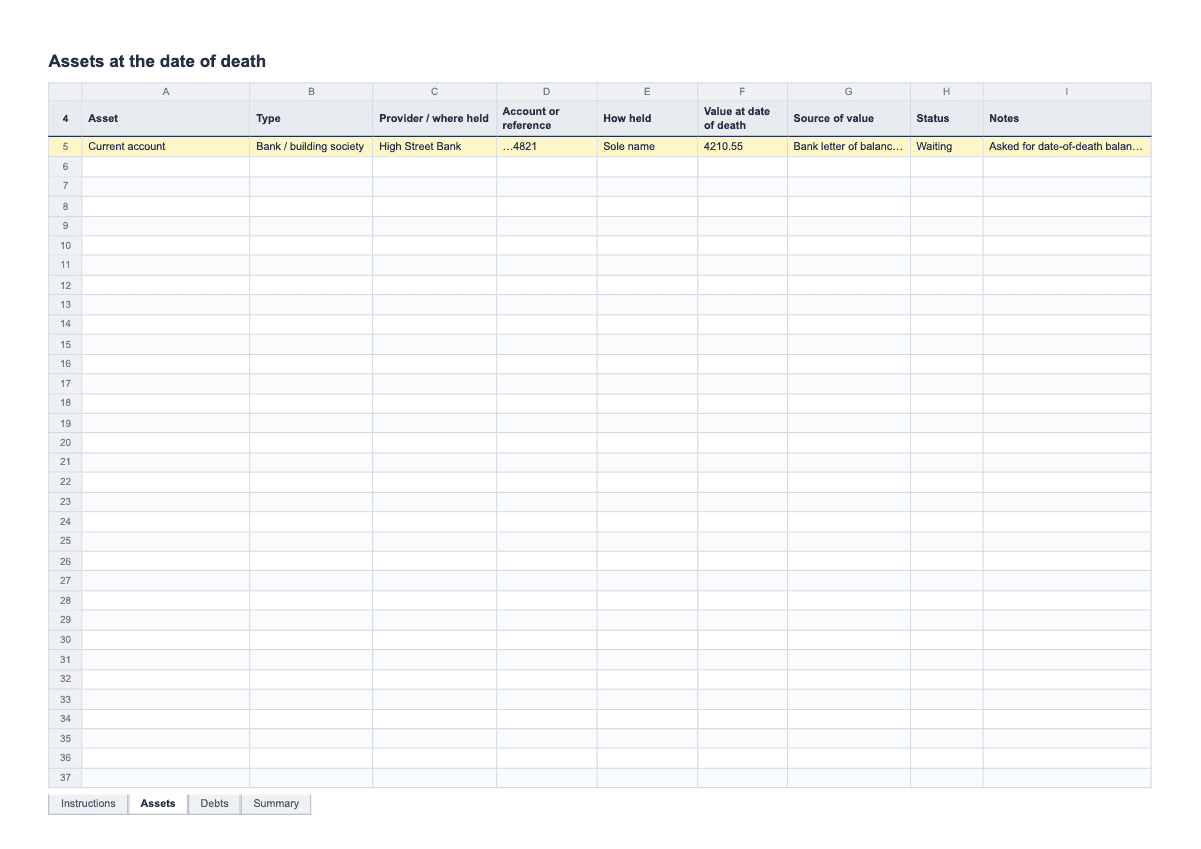
The workbook has three tabs. Assets has one row per item, with columns for Asset, Type, Provider / where held, Account or reference, How held, Value at date of death, Source of value, Status and Notes, and a Total assets figure at the top. Debts has one row per amount owed, with Owed to, Type, Account or reference, a column asking whether the debt was joint or guaranteed by someone, Balance at date of death, Status and Notes, with Total debts at the top. The Summary tab totals the assets by type, counts them, and shows the net figure: assets minus debts.
The How held column matters more than it looks. Jointly owned accounts, and pensions or policies with a nominated beneficiary, may pass straight to someone rather than through the estate, and probate may not be needed if the person only had savings or owned things jointly. Check each one with the provider. This register is a way of keeping figures together; it is not legal or tax advice, and a solicitor or accountant is worth asking if the estate is near the Inheritance Tax threshold or includes a business.
How to fill it in
- Open the workbook and delete the EXAMPLE rows on the Assets and Debts tabs before you enter anything real.
- On Assets, add a row for each thing the person owned: the house or flat, each bank and building society account, pensions, investments and ISAs, Premium Bonds, life insurance, a car, valuable belongings, any business interest and any money owed to them. The document locator helps you find the statements to work from.
- Choose a Type from the dropdown for each row. The Summary tab uses these types to total everything, so pick the closest one rather than typing your own.
- Set How held to Sole name, Joint, Nominated beneficiary, In a trust or Not sure. Use Not sure until the provider has told you. Joint and nominated items often need different paperwork from assets in the person’s sole name.
- Enter the Value at date of death, not today’s value. Ask each bank or provider for a letter giving the balance on the date of death, including any interest owed. For a property, a valuation from an estate agent or surveyor is a common starting point. Write where the figure came from in Source of value, such as "bank letter" or "agent valuation, 2 agents".
- On Debts, add each amount owed: mortgage, credit cards, car finance, loans, council tax, anything owed to HMRC, final utility bills and funeral costs. Set the joint or guaranteed column to No, Joint, Guarantor or Not sure. Joint and Guarantor rows turn amber, because the other person on the debt may have to deal with it too.
- Use Status on each tab to track progress. On Debts it runs from Not yet told, through Told and Claim received, to Paid or Disputed. Do not pay debts until you know the full picture; the estate pays its debts before anything is shared out.
- Check the Summary tab. Total assets less total debts gives the net figure. Compare it with the Inheritance Tax nil-rate band and read HMRC’s guidance, or ask a professional, if you are close to it.
- Update the register as final figures arrive. It becomes the basis of the estate accounts you give the beneficiaries at the end.
A filled-in example
| Item | Type | How held / joint? | Value or balance at date of death | Source of value | Status | Notes |
|---|---|---|---|---|---|---|
| Current account | Bank / building society | Sole name | £3,862.40 | Bank letter of balance at death | Done | Account frozen. Letter filed. |
| Premium Bonds | Premium Bonds | Sole name | £12,000.00 | Holding statement | Waiting | Claim form sent with death certificate copy. |
| Workplace pension | Pension | Nominated beneficiary | Not yet known | Scheme letter | Waiting | Scheme says it will deal with the nominee directly. Listed so nothing is missed; asked a solicitor how it affects the totals. |
| Credit card | Credit card | No | £640.15 | Final statement | Told | Interest stopped. Pay once probate is granted. |
| Car finance | Car finance | Guarantor | £2,310.00 | Settlement letter | Disputed | Uncle Keith was guarantor. David asked the lender to write to both; waiting for reply before paying anything. |
Common mistakes
- Using today’s figures. Values should be those on the date of death. Ask for date-of-death balance letters rather than reading the latest online balance.
- Paying debts from your own pocket to get them out of the way. The debts belong to the estate, and the executor pays them from the estate before sharing it out. If you do pay something yourself, log it so you are repaid.
- Asking the bank to close a joint account when you meant to report a death. Joint accounts may pass to the surviving holder, who may rely on them for bills.
- Leaving out small things: a dormant savings account, a refund owed to them, a few Premium Bonds. They affect the totals and the estate accounts.
- Guessing a value without writing down the source. When figures are questioned later, "agent valuation, March" is far easier to defend than a round number.
What the rules say
The Inheritance Tax nil-rate band is £325,000 and the residence nil-rate band is £175,000; the government has said both stay at these levels up to the 2030 to 2031 tax year.
Source: GOV.UK, Inheritance Tax: thresholdsBeing reviewed
The executor must pay the debts and taxes of the person who died from the estate before sharing it out. If money is handed out too early and a debt then cannot be paid, the executor may have to pay it.
Source: GOV.UK, Settling debts and taxesBeing reviewed
Probate is the legal right to deal with someone’s money, property and possessions after they die. Executors named in the will apply, or the closest relative if there is no will. It may not be needed if the person only had savings, or if things were owned jointly.
Source: GOV.UK, Applying for probateBeing reviewed
Debts are paid from the estate. You are only responsible for them if you had a joint loan or agreement or guaranteed a loan; you are not automatically responsible for a spouse’s or partner’s debts.
Source: nidirect, Debt when someone diesBeing reviewed
In Scotland, "confirmation" is when a court confirms who is dealing with the finances of someone who has died. It is needed before you can take over bank accounts in their sole name.
Source: mygov.scot, Help after the death of a partnerBeing reviewed
Last reviewed 29 September 2026. We link to official sources; your local rules may differ, so check them.
Questions
- How do I value an estate for probate?
- List every asset and debt with its value on the date of death, using balance letters, statements and valuations. Add up the assets, take away the debts, and keep a note of where each figure came from. HMRC’s guidance on GOV.UK explains how to report the value; a solicitor can help if the estate is complicated.
- What is the Inheritance Tax threshold?
- The nil-rate band is £325,000 and the residence nil-rate band is £175,000. The government has said both stay at these levels up to the 2030 to 2031 tax year. Whether any tax is due depends on the whole estate and on how it passes, so check the official guidance.
- Am I responsible for the debts of the person who died?
- Debts are paid from the estate. In Northern Ireland, nidirect says you are only responsible if you had a joint loan or guaranteed one, and not automatically for a partner’s debts. In England and Wales, an executor who shares out money before the debts are paid may have to pay them.
- Should I include jointly owned things?
- Yes, list them, with How held set to Joint. They may pass to the other owner rather than through the estate, but they can still matter for Inheritance Tax and for understanding the full picture. Ask the provider what applies.
- Can I use this in Scotland?
- Yes. The register works the same way, but the court process there is confirmation rather than probate, and the steps and forms differ. Check mygov.scot for the local process.