Executor Expenses Record and Reimbursement Log
Every cost of dealing with the estate, who paid it, and how much is still owed back to anyone who paid from their own pocket.
- Excel
- Works in Google Sheets
Included in The Executor Kit (UK) (£32), with 7 other files.
Instant download. One payment. 14-day refunds.
What this is for
Dealing with an estate costs money, and in the early weeks that money often comes from whoever is nearest: a son paying for death certificates, a sister covering petrol to the house, an executor paying the probate fee on their own card because the bank accounts are frozen. Months later, when the estate accounts are drawn up, those small payments are hard to remember and harder to prove. This log captures each one promptly, including mileage, parking and phone top-ups, together with who paid, whether there is a receipt, and whether it has been repaid.
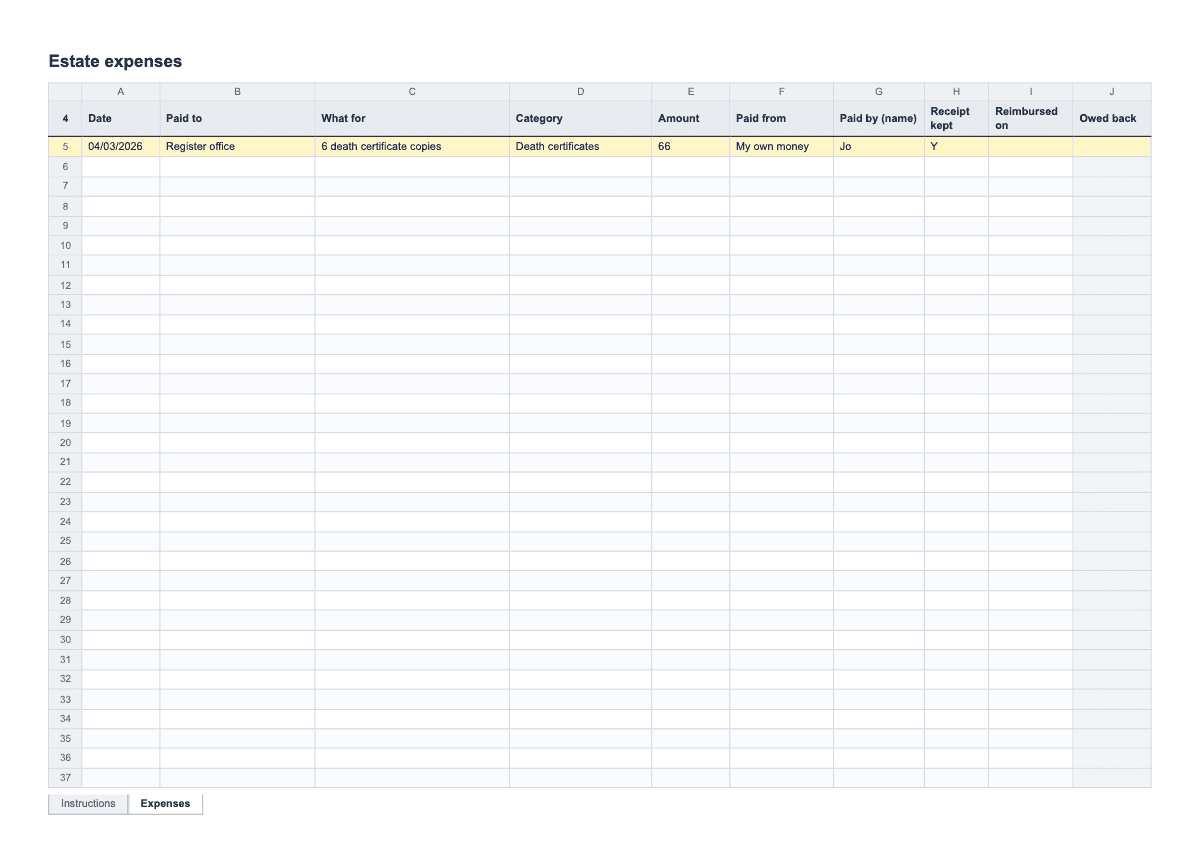
The workbook has one Expenses tab. Each row is a single payment, with columns for Date, Paid to, What for, Category, Amount, Paid from, Paid by (name), Receipt kept, Reimbursed on and Owed back. Category is a dropdown with the usual headings for a UK estate: Funeral, Probate fee, Legal and professional fees, Death certificates, Property upkeep, Utilities and insurance, Travel, Postage and copies, Gazette notice and Other. Paid from offers Estate account, My own money or Someone else. Two totals sit at the top: Total spent, and Owed back to people.
Part of the executor’s role is to pay debts and taxes and then share out the estate as the will or the law sets out, and the beneficiaries are entitled to see how the money was used. A clear record of costs makes the final accounts straightforward. What counts as a proper estate expense can depend on the will and on the circumstances; this log is a record, not legal advice, and a solicitor can tell you if something is unclear.
How to fill it in
- Open the workbook, read the instructions tab once, and delete the EXAMPLE row on the Expenses tab. It shows a set of death certificate copies bought from the register office by a relative.
- Add a row every time money is spent on the estate, on the day if you can. Enter the Date, who you paid in Paid to, and a short description in What for, such as "probate application fee" or "locksmith, new back door lock".
- Pick a Category from the dropdown. Use Gazette notice for the cost of the deceased estates notice, and Probate fee for the application fee. Consistent categories make the totals easy to read and easy to copy into the estate accounts.
- Type the Amount in pounds, then choose Paid from. If it came out of the estate or executor account, choose Estate account. If you paid it yourself, choose My own money. If a relative paid, choose Someone else and write their name in Paid by (name).
- Set Receipt kept to Y or N. Any row marked N turns amber, as a reminder to find the receipt, ask for a copy, or at least write down the card statement line. Keep paper receipts in one envelope or folder, and photograph them as a backup. Emailed invoices can be saved in a dedicated inbox label or a shared cloud folder, named by date.
- Watch the Owed back column. It fills itself in for anything paid from someone’s own money that has not yet been repaid, and the amount turns amber. When the estate pays that person back, type the date in Reimbursed on and the Owed back figure drops to zero.
- Check the two totals at the top from time to time. Owed back to people shows how much the estate must repay before anything is shared out. Total spent is a figure the beneficiaries will ask about.
- When the estate is ready to be closed, use this tab alongside the assets and debts register to prepare the estate accounts. The task list has a row for this step.
A filled-in example
| Date | Paid to | What for | Category | Amount | Paid from | Paid by (name) | Receipt kept | Reimbursed on | Owed back |
|---|---|---|---|---|---|---|---|---|---|
| 09/03/2026 | Register office | Death certificate copies | Death certificates | £62.50 | My own money | Owen | Y | 02/06/2026 | £0.00 |
| 21/03/2026 | Locksmith | New lock, back door of Beryl’s house | Property upkeep | £95.00 | Someone else | Megan | N | £95.00 | |
| 28/03/2026 | Rail operator | Return train to clear Beryl’s kitchen | Travel | £48.20 | My own money | Owen | Y | £48.20 | |
| 04/04/2026 | HM Courts & Tribunals Service | Probate application fee | Probate fee | £526.00 | My own money | Owen | Y | 02/06/2026 | £0.00 |
| 15/06/2026 | The Gazette | Deceased estates notice | Gazette notice | £95.00 | Estate account | Owen | Y |
Common mistakes
- Paying the estate’s debts from your own pocket to get them out of the way. The person’s debts are paid from the estate, not by the executor personally, and paying them yourself can make the accounts muddled. Wait until the estate can pay, and if you do pay, log it.
- Not keeping receipts. A bank statement shows that money left your account but not what it was for. A receipt, even a photographed one, answers questions before they are asked.
- Mixing estate money with your own. Once there is an estate or executor account, pay estate costs from it wherever possible, so the records stay clean.
- Sharing out money before everyone who paid costs has been repaid. The Owed back total should be zero before the final distribution.
- Forgetting small costs such as stamps, photocopies, parking, mileage and household cleaning. Individually small, together they can reach hundreds of pounds across a year, and memory fades quickly.
What the rules say
The person dealing with the estate values it, reports and pays any Inheritance Tax, applies for probate, pays debts and taxes owed, and then shares out the estate as the will or the law sets out.
Source: GOV.UK, Wills, probate and inheritance: if you’re an executorBeing reviewed
A deceased estates notice in The Gazette gives creditors at least two months to come forward and protects the executor from debts they did not know about (Trustee Act 1925, section 27).
Source: The Gazette, Do I need to place a deceased estates notice?Being reviewed
The probate application fee is £526 if the estate is worth more than £5,000; there is no fee if it is £5,000 or less.
Source: GOV.UK, Applying for probate: feesBeing reviewed
Death certificates from the General Register Office cost £12.50 each and are sent 4 days after you apply; you can also order them from the register office where the death was registered.
Source: GOV.UK, Order a birth, death, marriage or civil partnership certificateBeing reviewed
Last reviewed 29 September 2026. We link to official sources; your local rules may differ, so check them.
Questions
- Can an executor claim expenses from the estate?
- Costs of dealing with the estate are commonly repaid from it, but what is reasonable can depend on the will and the circumstances. Keeping a clear log with receipts makes the claim easy to show. If a beneficiary disputes a cost, or you are unsure, ask a solicitor.
- What should go in the estate accounts for expenses?
- Each payment, with its date, amount, what it was for and whether it came from the estate or was repaid to someone. The Category column lets you group costs, such as funeral, probate fee and professional fees, which is how estate accounts often present them.
- How much are death certificates and the probate fee?
- Death certificates from the General Register Office cost £12.50 each. The probate application fee is £526 if the estate is worth more than £5,000, and nothing if it is £5,000 or less.
- Who pays for the funeral?
- Often a family member pays the funeral director first and is repaid from the estate once money is released. Log the payment under Funeral with the name of whoever paid, so it is clear who is owed.
- Is the log still worth keeping if a solicitor handles the estate?
- Yes. Professionals usually invoice separately for their own fees, but they cannot know about the parking, postage or cleaning you paid for personally. Handing them a tidy spreadsheet avoids duplicated effort and may reduce chargeable time spent chasing figures.
- Can several people use the log?
- Yes. Upload it to Google Drive, save it as a Google Sheet and share it. Ask each person to add their own payments and put their name in Paid by (name).