Who to Inform When Someone Dies
The organisations that usually need to be told, which ones Tell Us Once covers, and a record of each call or letter.
- PDF · A4
- Excel
- Works in Google Sheets
Free · PDF + Excel
What this is for
After a death, a surprising number of organisations need to be told: government departments, the bank, the pension provider, the council, the energy supplier, the GP. Each call brings a new reference number, a name, and often a request for a document. Spread over several weeks and several family members, it becomes very hard to remember who has already rung whom. This list keeps all of it in one place, so the same bank is not phoned twice and nothing is left out.
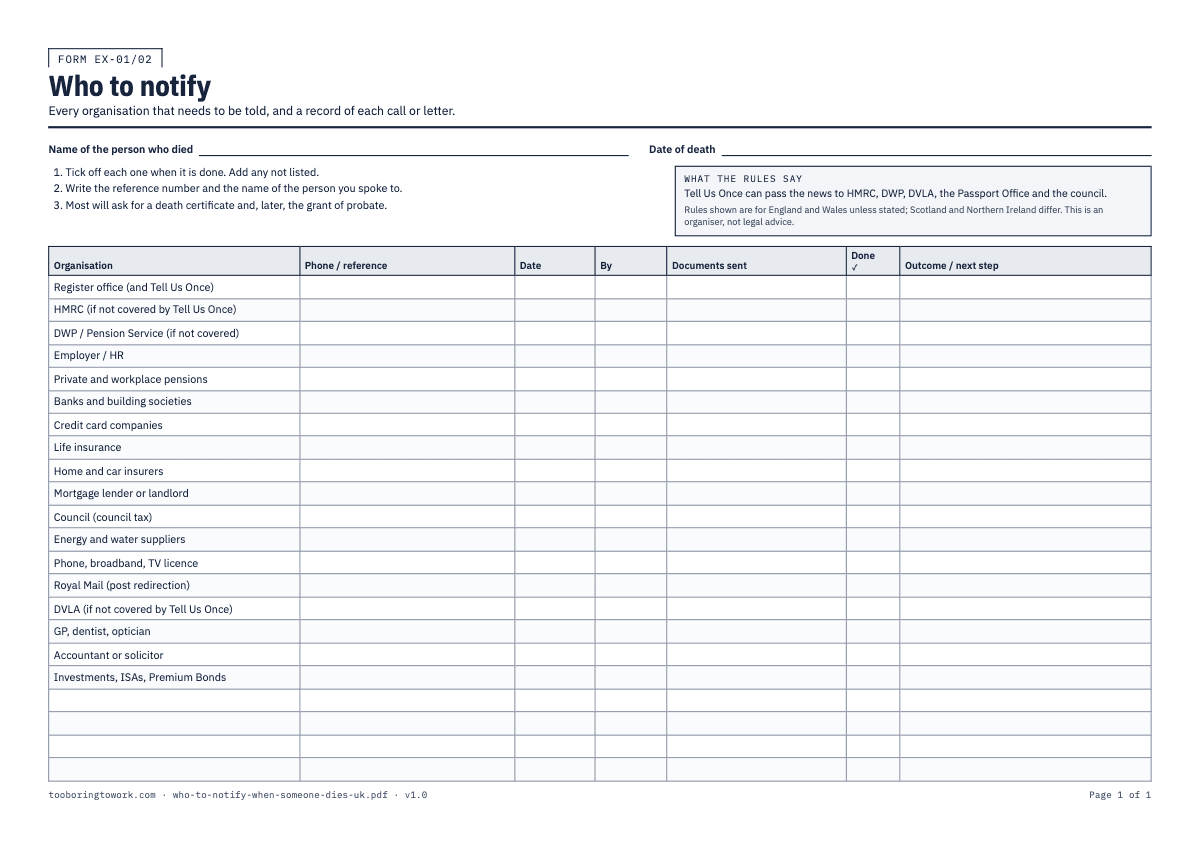
The printable version is an A4 landscape log. Eighteen organisations are already written in the first column, starting with the register office and Tell Us Once, then HMRC, DWP, pensions, banks and building societies, insurers, the council, utilities, Royal Mail, DVLA and the GP, with blank rows for others. For each one there are columns for Phone / reference, Date, By (initials), Documents sent, a Done tick and Outcome / next step. A box at the top notes that Tell Us Once can pass the news to HMRC, DWP, DVLA, the Passport Office and the council, so you can see which rows it may already cover.
The Excel version holds the same list on a Notify tab, with a few more columns and room for many more rows. Type and Status are dropdowns, Waiting rows turn amber and Done rows turn green, and two counts at the top show how many are done and how many are still to do. It opens in Google Sheets, which makes it easy for two or three relatives to work from the same copy. It is a record, not advice; for anything with legal or tax consequences, follow what the organisation or a solicitor tells you.
How to fill it in
- Write the name of the person who died and the date of death in the boxes at the top. You will be asked for both on almost every call.
- Start with the register office row. When you register the death, ask the registrar about Tell Us Once. If you use it, note the date in the log and put "covered by Tell Us Once" in Outcome / next step against HMRC, DWP and DVLA. Those three rows say "if not covered" because you only need to contact them yourself if Tell Us Once did not reach them, or if you live in Northern Ireland, where the service is not available.
- Work through the private organisations next: banks and building societies, credit cards, pensions, life insurance, then home and car insurers. These are never covered by Tell Us Once. Many have a bereavement team or an online form, which is often quicker than the main phone line.
- For every contact, fill in the Phone / reference column with the number you used and any reference they give you. Write the name of the person you spoke to in Outcome / next step, with what they said will happen. Put your initials in By, so others know who to ask.
- In Documents sent, write exactly what you posted or uploaded: "copy of death certificate", "will, copy". Most organisations will want a death certificate now and, later, the grant of probate. Send copies rather than originals unless an organisation insists on seeing an original, and note if they promise to return it.
- Tick Done only when the organisation has confirmed the change in writing or the account is settled. Until then, write the next step and a date to chase.
- Add rows at the bottom for anything not listed: a club, a charity they gave to regularly, a housing association, online accounts. For subscriptions and memberships, the accounts to close list has more detail, including monthly costs.
- In the Excel file, pick a Type and a Status from the dropdowns for each row. The Status list is To do, In progress, Waiting, Done and Not needed. Use Waiting for anything that depends on a reply. The Done and Still to do counts at the top update as you go.
- To share the spreadsheet, upload it to Google Drive, save it as a Google Sheet and use Share. Ask each person to put their name in Contacted by for the rows they take on.
A filled-in example
| Organisation | Account or reference number | Status | Date contacted | Contacted by | Documents sent | Outcome / next step |
|---|---|---|---|---|---|---|
| Register office (and Tell Us Once) | Kept in the paper folder | Done | 14/04/2026 | Sunita | None | Tell Us Once used at registration. Covers HMRC, DWP, DVLA. |
| HMRC (if not covered by Tell Us Once) | Not needed | 14/04/2026 | Sunita | Covered by Tell Us Once. | ||
| Banks and building societies: current account | Sort code and account in folder | Waiting | 17/04/2026 | Sunita | Death certificate copy | Bereavement team asked for a copy of the will too. Sent 22/04. Chase 06/05 if no letter. |
| Private and workplace pensions | Member no. in folder | In progress | 18/04/2026 | Amit | Death certificate copy | Spoke to Claire. Claim form in the post. |
| Energy and water suppliers | Account no. on bill | Done | 20/04/2026 | Amit | None | Meter reading given. Account moved to Mum’s name. |
Common mistakes
- Assuming Tell Us Once has told everyone. It covers most government organisations but does not reach banks, pensions from former employers, insurers or energy suppliers. Those rows still need a call or a letter.
- Not writing down who you spoke to. When a letter does not arrive, "I rang in April" is much weaker than a date, a name and a reference number.
- Posting an original document, such as the will or a certificate you only have one copy of. Send copies unless you are told otherwise, and write in the log what you sent and to whom.
- Two relatives ringing the same organisation without knowing it. A shared sheet with a name against each row avoids repeated calls and mixed messages.
- Asking a bank to close a joint account when you only meant to report the death. The surviving account holder may still need it. Say clearly what you want to happen and check before closing anything.
What the rules say
Tell Us Once lets you report a death to most government organisations in one go, including HMRC, DWP, the Passport Office, DVLA and the local council. It is not available in Northern Ireland and does not tell banks, utilities or other companies.
Source: GOV.UK, What to do after someone dies: Tell Us OnceBeing reviewed
The Bereavement Register is a free service that removes the names and addresses of people who have died from mailing lists.
Source: nidirect, Junk mail, spam and unwanted phone callsBeing reviewed
Tell DVLA about a death through Tell Us Once, or by writing to DVLA, Swansea, SA99 1AB with the person’s details and their licence if you have it. Tell DVLA separately if you keep or sell their vehicle.
Source: GOV.UK, Telling DVLA after someone diesBeing reviewed
Last reviewed 29 September 2026. We link to official sources; your local rules may differ, so check them.
Questions
- Who do I need to inform when someone dies?
- Usually government departments, the person’s employer and pension providers, banks and building societies, insurers, the council, utilities and their GP. The printed list starts with the eighteen most common. Everyone’s affairs are different, so add rows as you find statements and letters.
- What does Tell Us Once cover, and what does it not?
- Tell Us Once reports the death to most government organisations, including HMRC, DWP, the Passport Office, DVLA and the local council. It does not tell banks, utilities or other companies. It is not available in Northern Ireland, so there you contact each department yourself.
- How do I stop post and junk mail addressed to them?
- Arrange a redirection with Royal Mail if the home will be empty, so bills and statements still reach you. For marketing post, the Bereavement Register is a free service that removes the names and addresses of people who have died from mailing lists.
- Do I need to tell DVLA myself?
- Not if Tell Us Once has done it. Otherwise you can write to DVLA with the person’s details and their licence if you have it. If you keep or sell their vehicle, that has to be reported to DVLA separately.
- Should I write or phone?
- Phone or use the organisation’s bereavement form first, since many have a team for this. Some still ask for a letter. The bereavement notification letters cover a bank, an energy supplier, a pension provider, the credit reference agencies and a landlord.