Documents Needed When Someone Dies: A Checklist
A two-page A4 list of the papers usually needed to deal with an estate, with space to note where each one is kept.
- PDF · A4
Included in The Executor Kit (UK) (£32), with 7 other files.
Instant download. One payment. 14-day refunds.
What this is for
Almost every task after a death starts with a piece of paper: the will, a bank statement, a pension letter, the deeds to the house, a logbook for the car. Some people keep everything in one tidy box file. Many do not, and the papers are spread across drawers, a loft, an old briefcase, an email inbox and a solicitor’s office. Searching for the same document twice, or finding it after you needed it, adds strain to an already difficult time. This locator gives each important paper one line, so that once you know where something is, everyone does.
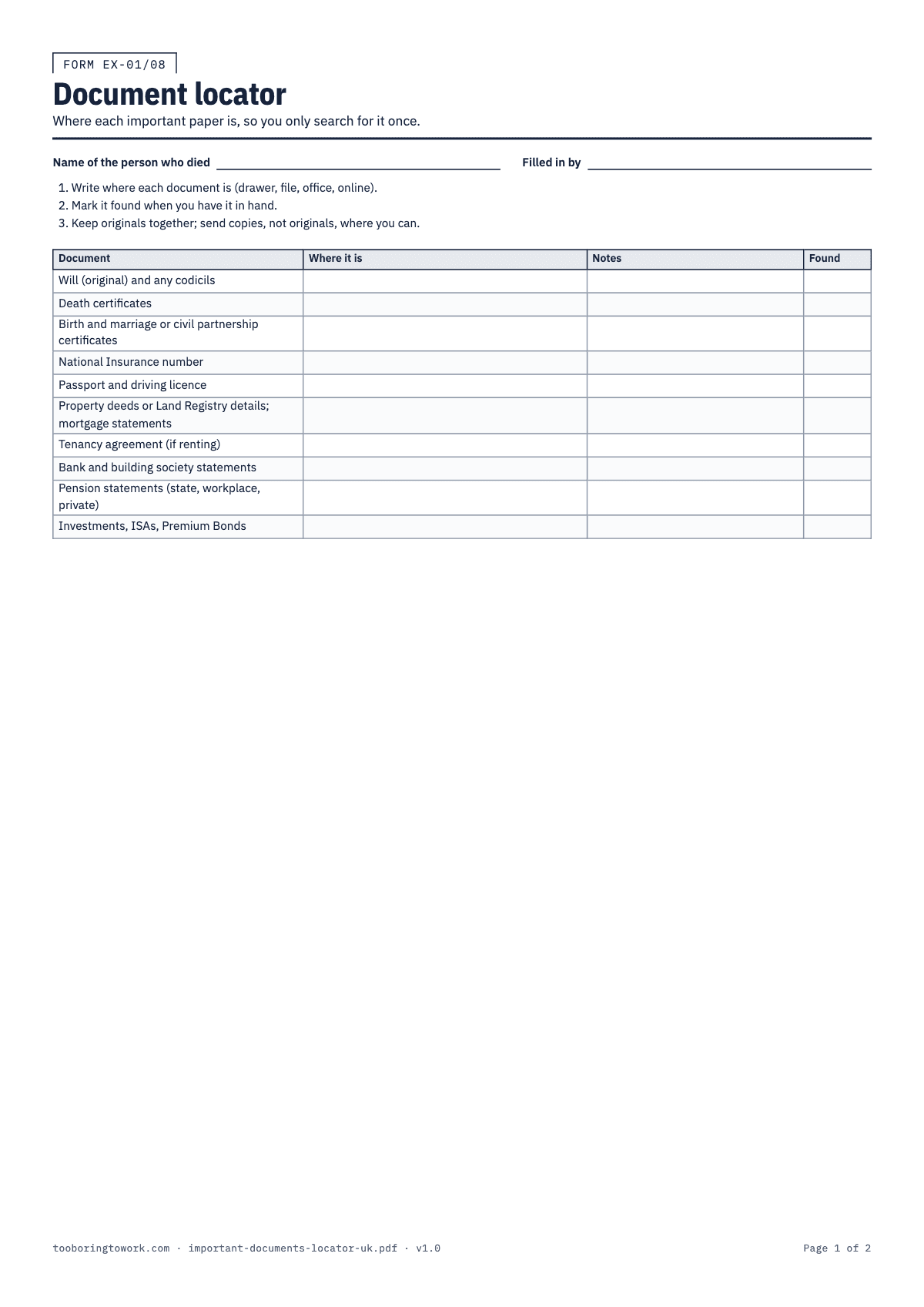
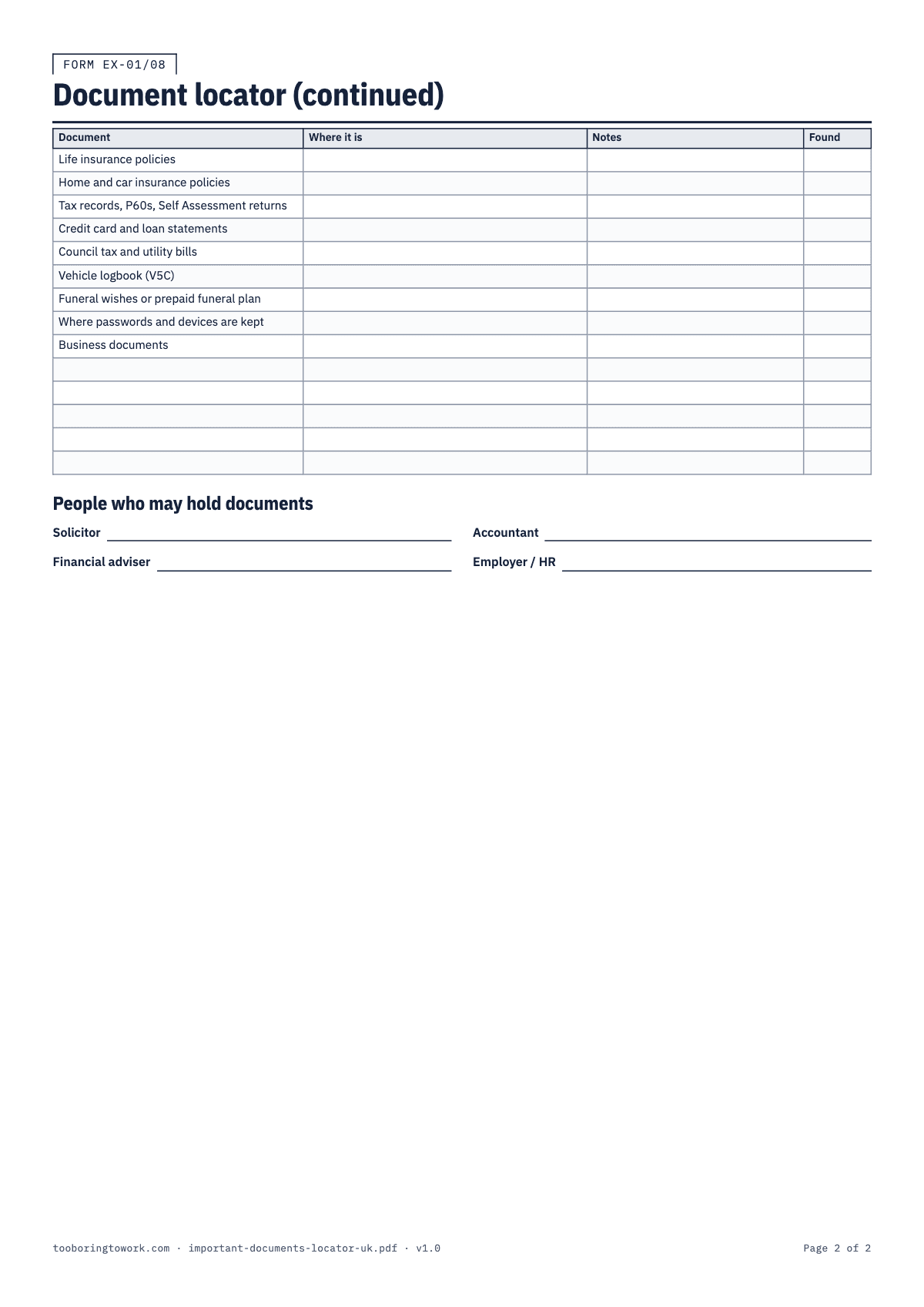
It is a two-page A4 PDF to print. Page one has boxes for the name of the person who died and who is filling in the form, followed by a table with four columns: Document, Where it is, Notes and Found. Nineteen documents are already listed across the two pages, from the original will and any codicils to birth, marriage and civil partnership certificates, the National Insurance number, passport and driving licence, property deeds or Land Registry details, tenancy agreement, bank and building society statements, pensions, investments, ISAs and Premium Bonds, insurance policies, tax records, loans and cards, council tax and utility bills, the V5C vehicle logbook, funeral wishes, where passwords and devices are kept, and business papers. Page two adds five blank rows and a short section headed People who may hold documents, with lines for a solicitor, an accountant, a financial adviser and an employer or HR contact.
The form does not tell you what to do with each document. It simply records where things are, which you will need for the assets and debts register and for any probate application. It is an organiser, not legal advice.
How to fill it in
- Print both pages. Write the name of the person who died and your own name in the boxes at the top of page one. If more than one relative is searching, agree who holds the master copy.
- Start with the will. The original matters, so note exactly where it is: "solicitor’s strongroom, Hill & Co" or "metal box, wardrobe, spare room". If there is no will in the house, ask the solicitor who helped with any property purchase, and check the person’s address book and bank statements for payments to a law firm.
- Work down the Document column. In Where it is, be specific enough that someone else could go straight to it: "grey filing cabinet, second drawer, folder marked Bank" rather than "study". For documents kept online, write which email address or account they are in, never the password.
- Use Notes for anything useful: account or policy numbers, the date of the most recent statement, whether a document is an original or a copy, or who has borrowed it.
- Tick Found only when the document is in your hands or you have confirmed that it is safe where it is. Leave the box empty while you are still searching.
- Add anything that is missing from the list in the blank rows on page two: premium bond certificates found separately, share certificates, a timeshare, a storage unit key, medical equipment on loan, a safe or lockbox.
- Fill in the People who may hold documents section. A solicitor may hold the will or deeds, an accountant may hold tax returns, a financial adviser may know about investments and pensions, and an employer’s HR team can confirm workplace benefits.
- Keep originals together in one safe place and send copies wherever you can. Record what you post, and to whom, in the who to inform list so you can ask for anything original to be returned.
A filled-in example
| Document | Where it is | Notes | Found |
|---|---|---|---|
| Will (original) and any codicils | Held by Price & Morgan solicitors, Cardiff | Copy in the bureau. Firm has the original; appointment booked. | ✓ |
| National Insurance number | On old P60s in the grey filing cabinet | Written on page one too. | ✓ |
| Pension statements (state, workplace, private) | Blue folder, spare room | Two workplace schemes; one letter from 2019 only. | ✓ |
| Vehicle logbook (V5C) | Glovebox of the car (found on day 12) | Not in the house at first. Searched the bureau twice before checking the car. Moved to the blue folder. | |
| Where passwords and devices are kept | Small notebook, kitchen drawer; laptop in lounge | Laptop PIN not known. Photos backed up online. | ✓ |
Common mistakes
- Sending original documents in the post. Originals can go missing, and some, like the will, are very hard to replace. Send copies unless an organisation insists, and note in the locator when an original leaves the house.
- Writing "study" or "somewhere in the loft" in the Where it is column. Vague locations mean searching again later. Be precise enough for a stranger to find it.
- Throwing away old paperwork during the clear-out. Recent statements, tax records and letters from pension schemes can matter for months. Keep anything financial until the estate is finished.
- Assuming a document does not exist because it is not in the house. Wills, deeds and share certificates are often held by solicitors, banks or accountants. Ask before concluding there is none.
- Putting passwords on the form. The locator may be shared or copied. Write where login details are kept, not the details themselves.
What the rules say
Probate is the legal right to deal with someone’s money, property and possessions after they die. Executors named in the will apply, or the closest relative if there is no will. It may not be needed if the person only had savings, or if things were owned jointly.
Source: GOV.UK, Applying for probateBeing reviewed
In Scotland, "confirmation" is when a court confirms who is dealing with the finances of someone who has died. It is needed before you can take over bank accounts in their sole name.
Source: mygov.scot, Help after the death of a partnerBeing reviewed
Last reviewed 29 September 2026. We link to official sources; your local rules may differ, so check them.
Questions
- What documents are needed when someone dies in the UK?
- At first, the medical certificate of cause of death to register the death. Then, for dealing with the estate, usually the will, death certificates, recent bank and pension statements, property deeds, insurance policies and tax records. The locator lists nineteen common ones with space for more.
- How do I find out if there is a will?
- Search the person’s home, especially filing cabinets, boxes and safes. Ask their solicitor, and look for letters from any law firm among their papers. Close family members may also know whether one was made and where it was kept.
- What if I cannot find the original will?
- Keep looking, and ask any solicitor the person used. If the original still cannot be found, speak to a solicitor before applying for probate, because a missing original can make the application more complicated.
- Is the Scottish or Northern Irish process different?
- The documents are much the same. The court process in Scotland is confirmation rather than probate, and Northern Ireland has its own probate office, so check mygov.scot or nidirect for the local steps.
- Should I keep the locator after the estate is finished?
- It is sensible to keep it with the estate accounts and copies of key papers. If questions arise later from HMRC, a bank or a beneficiary, knowing where each document ended up saves a lot of searching.