Executor Checklist UK: Estate Administration Task List
The steps of dealing with an estate in England and Wales, in order, with an owner, status and due date for each, and overall progress.
- Excel
- Works in Google Sheets
Included in The Executor Kit (UK) (£32), with 7 other files.
Instant download. One payment. 14-day refunds.
What this is for
Dealing with an estate in England and Wales usually takes months, and much of that time is spent waiting: for a bank to reply, for a valuation, for HMRC, for the Probate Registry. It is easy to lose track of which step comes next, and even easier for relatives to lose track of who is doing what. This task list sets out the usual steps in a sensible order, so the executor or administrator can see the whole job at once and pick up where they left off after a gap.
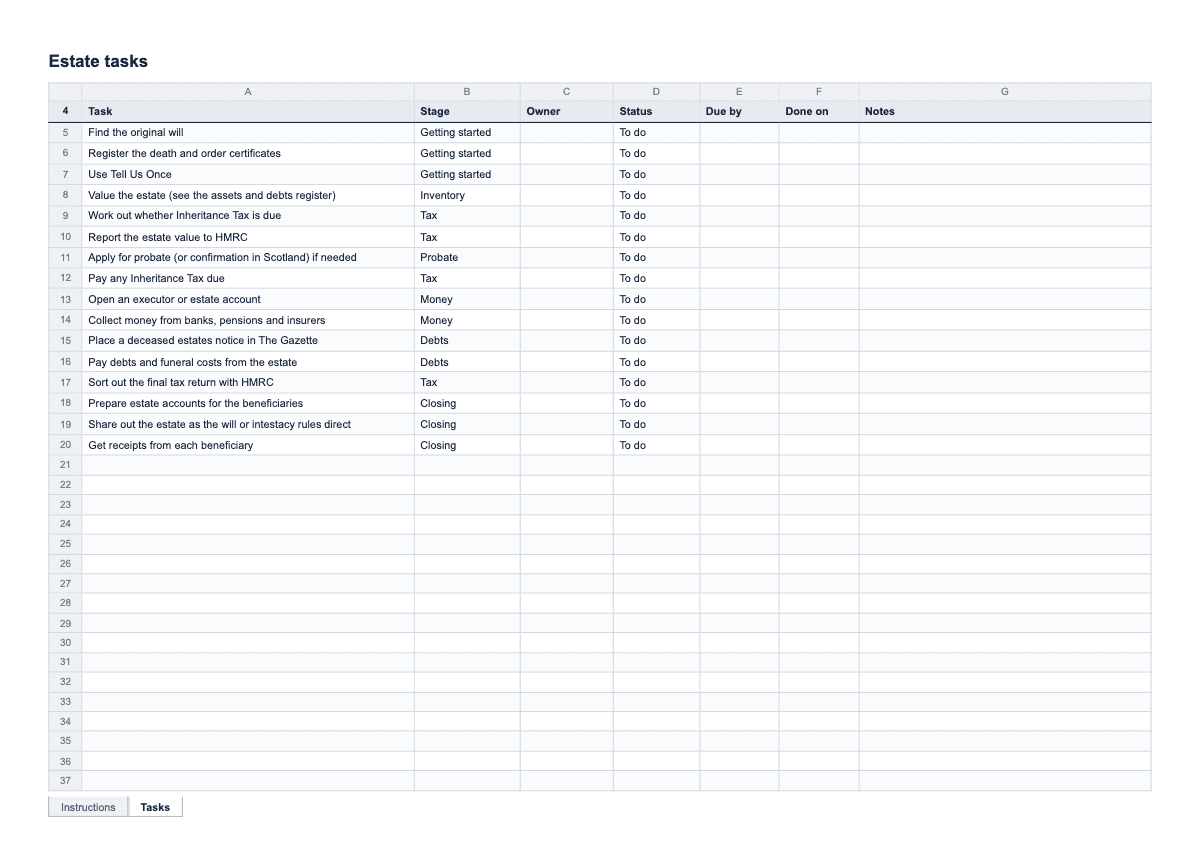
It is an Excel workbook with one working tab, Tasks. Sixteen common steps are already filled in, from finding the original will through valuing the estate, applying for probate, paying any Inheritance Tax, placing a deceased estates notice in The Gazette, and finally sharing out the estate and getting receipts from each beneficiary. Each row has a Stage, an Owner, a Status, a Due by date, a Done on date and a Notes column. A Progress figure at the top shows how much of the list is finished, counting Done and Not needed together.
Not every estate needs every step. A small estate held mostly in joint names may not need probate at all, and many estates have no Inheritance Tax to pay. In Scotland the court process is confirmation rather than probate, and Northern Ireland has its own procedures, so adjust the rows to suit. The list is an organiser, not legal advice. If the estate includes a business, property abroad, a dispute between beneficiaries or tax to pay, a solicitor can guide you through the steps, and this list will show them what has already been done.
How to fill it in
- Open the workbook and read the instructions tab once. Then go to Tasks. The rows are in a rough order, grouped by Stage: Getting started, Inventory, Tax, Probate, Money, Debts and Closing.
- Go down the list and mark anything that clearly does not apply as Not needed in the Status dropdown. For example, if everything was held jointly and the bank has confirmed it will release the money without a grant, the probate row may not be needed. Write the reason in Notes, so the decision is recorded.
- Put a name in Owner for every remaining row. It can be the executor, a co-executor, a relative helping out or the solicitor. One named person per task works better than "family".
- Use Due by for dates that matter. The main fixed one is Inheritance Tax: if any is owed, it must be paid by the end of the sixth month after the death, and HMRC charges interest after that. Any Due by date that passes while the task is not Done or Not needed turns amber, which makes overdue work easy to spot.
- Change the Status as things move: To do, In progress, Waiting, Done or Not needed. Waiting is useful for the long gaps, such as a bank processing a claim or the Probate Registry handling an application. When a task is finished, type the date in Done on.
- Write reference numbers, the names of people you spoke to and the next action in Notes. Keep the detail for each account in the assets and debts register and the costs in the executor expenses log; this tab is the overview.
- Add your own rows at the bottom and choose Other as the Stage if nothing else fits: selling a car, clearing the house, ending a tenancy, a claim against a life policy.
- Share it through Google Sheets if other family members are involved. Everyone sees the same Progress figure and the same Owner names, which cuts down on update calls.
A filled-in example
| Task | Stage | Owner | Status | Due by | Done on | Notes |
|---|---|---|---|---|---|---|
| Value the estate (see the assets and debts register) | Inventory | Carol | Done | 12/06/2026 | All balances at date of death received. House valued by two agents. | |
| Work out whether Inheritance Tax is due | Tax | Carol | Done | 19/06/2026 | Total under the nil-rate band. No IHT to pay; checked with HMRC guidance. | |
| Apply for probate (or confirmation in Scotland) if needed | Probate | Anne | Waiting | Applied online 24/06. Reference in the folder. | ||
| Place a deceased estates notice in The Gazette | Debts | Anne | Done | 02/07/2026 | Two months run from the notice. Nothing to be shared out before early September. | |
| Share out the estate as the will or intestacy rules direct | Closing | Carol | To do | 15/09/2026 | Due date set after the Gazette period ends. Brother asked for his share early; explained why we are waiting. |
Common mistakes
- Sharing out money before the Gazette notice period has ended. The notice gives creditors at least two months to come forward, and it protects the executor from debts they did not know about. Paying beneficiaries early can leave you personally responsible if a debt appears.
- Treating the list as fixed. It is fine to mark rows Not needed, reorder them or add new ones. What matters is that each decision is written down.
- Leaving the Owner column blank. When nobody is named, tasks sit untouched while each person assumes someone else is dealing with it.
- Forgetting the Inheritance Tax payment date while waiting for other things. If tax is due, it is due by a fixed date whether or not probate has been granted.
- Not recording why a step was skipped. A short note such as "joint account, passed to Jean" saves a lot of explaining when a beneficiary or solicitor asks later.
What the rules say
Probate is the legal right to deal with someone’s money, property and possessions after they die. Executors named in the will apply, or the closest relative if there is no will. It may not be needed if the person only had savings, or if things were owned jointly.
Source: GOV.UK, Applying for probateBeing reviewed
In Scotland, "confirmation" is when a court confirms who is dealing with the finances of someone who has died. It is needed before you can take over bank accounts in their sole name.
Source: mygov.scot, Help after the death of a partnerBeing reviewed
Inheritance Tax must be paid by the end of the sixth month after the person died (for example, by 31 July for a death in January). HMRC charges interest after that.
Source: GOV.UK, Pay your Inheritance Tax billBeing reviewed
A deceased estates notice in The Gazette gives creditors at least two months to come forward and protects the executor from debts they did not know about (Trustee Act 1925, section 27).
Source: The Gazette, Do I need to place a deceased estates notice?Being reviewed
The executor must pay the debts and taxes of the person who died from the estate before sharing it out. If money is handed out too early and a debt then cannot be paid, the executor may have to pay it.
Source: GOV.UK, Settling debts and taxesBeing reviewed
The person dealing with the estate values it, reports and pays any Inheritance Tax, applies for probate, pays debts and taxes owed, and then shares out the estate as the will or the law sets out.
Source: GOV.UK, Wills, probate and inheritance: if you’re an executorBeing reviewed
The probate application fee is £526 if the estate is worth more than £5,000; there is no fee if it is £5,000 or less.
Source: GOV.UK, Applying for probate: feesBeing reviewed
The Inheritance Tax nil-rate band is £325,000 and the residence nil-rate band is £175,000; the government has said both stay at these levels up to the 2030 to 2031 tax year.
Source: GOV.UK, Inheritance Tax: thresholdsBeing reviewed
Last reviewed 29 September 2026. We link to official sources; your local rules may differ, so check them.
Questions
- What does an executor have to do?
- In short, the person dealing with the estate values it, reports and pays any Inheritance Tax, applies for probate, pays debts and taxes, and then shares out what is left as the will or the law sets out. The task list breaks that into smaller steps with an owner for each.
- Is probate always needed?
- No. Probate may not be needed if the person only had savings, or if things were owned jointly. Each bank or organisation has its own rules about when it will release money without a grant, so ask them. In Scotland, confirmation is needed before you can take over accounts in the person’s sole name.
- How much does it cost to apply for probate?
- The application fee is £526 if the estate is worth more than £5,000, and there is no fee if it is £5,000 or less. Record the payment in the expenses log so it is repaid from the estate.
- When is Inheritance Tax due?
- If any is owed, it must be paid by the end of the sixth month after the death, for example by 31 July for a death in January. Interest is charged after that. Many estates are below the nil-rate band and have none to pay.
- How long does it take to deal with an estate?
- There is no standard time. Simple estates can be finished in months; those with property to sell, tax to pay or disagreements can take much longer. The Gazette notice alone gives creditors at least two months, and nothing should be shared out before that ends.