What to Do When Someone Dies in the UK: A First-Week Checklist
What usually needs doing in the first days after someone dies in the UK, including registering the death, on one A4 page.
- PDF · A4
Free · PDF
What this is for
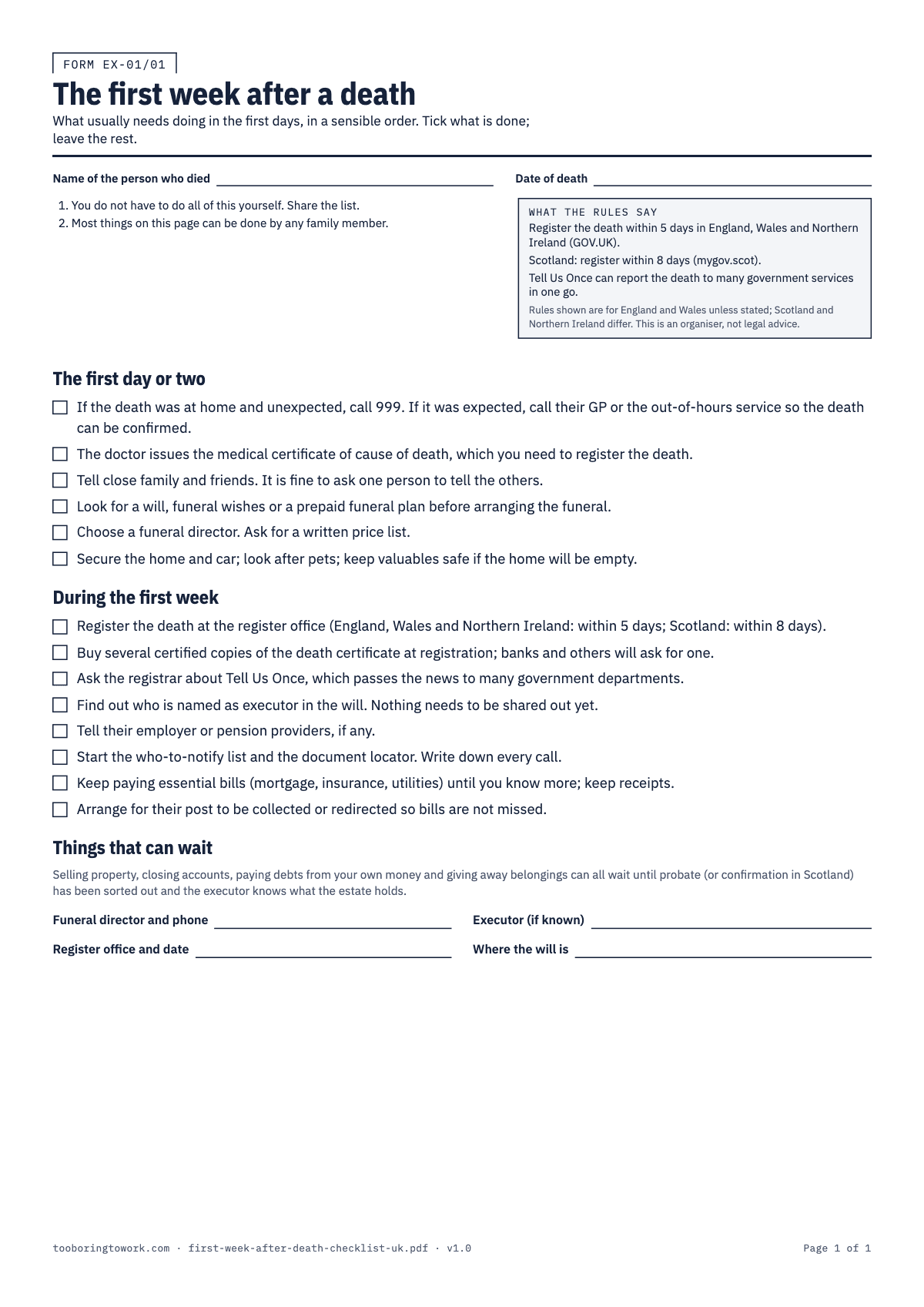
When someone close to you dies, the first few days are hard, and a lot of small practical jobs arrive at once. Most are simple on their own; the difficulty is remembering all of them while grieving. This checklist puts the usual first-week tasks for England, Wales, Scotland and Northern Ireland on one A4 page, in roughly the order they tend to come up, so you can see what matters now and what can safely wait.
The page has two boxes at the top for the name of the person who died and the date of death. Below that are three short sections: the first day or two, the rest of the first week, and a plain note about the things that can wait. At the bottom are four lines to fill in once you know them: the funeral director and their phone number, the executor if one has been named, the register office and the date of the appointment, and where the will is kept. A small box on the page repeats the official time limits for registering the death, with the Scottish limit alongside, and a line about Tell Us Once.
You do not have to do everything on the list yourself, and you do not have to do it all this week. Any family member or friend can take on most of them. Pin it to the kitchen wall, hand a copy to a sibling, and let each person tick what they have done.
How to fill it in
- Print the page and write the full name of the person who died and the date of death in the two boxes at the top.
- Start with the section headed "The first day or two". If the death happened at home and was not expected, the first item is to call 999. If it was expected, call their GP or the out-of-hours service so the death can be confirmed. A doctor then issues the medical certificate of cause of death, which you need before the death can be registered.
- Work down the rest of that section as you are able: telling close family and friends, looking for a will, funeral wishes or a prepaid funeral plan, choosing a funeral director and asking for a written price list, and making the home, car and any pets safe. Tick each line when it is done. Leave the ones that do not apply.
- Book the appointment at the register office as early as you can. In England, Wales and Northern Ireland the death should be registered within five days; in Scotland, within eight days where possible. If you cannot manage that, ring the register office and tell them. When you have the appointment, write the office and the date in the box at the bottom of the page.
- At the appointment, buy several copies of the death certificate. Banks, pension providers and insurers will each want to see one, and ordering extra copies later takes time. Ask the registrar about Tell Us Once, which can pass the news to many government departments in one go, unless the death was in Northern Ireland, where it is not available.
- In the "During the first week" section, find out who is named as executor in the will and write their name in the Executor line. Nothing needs to be shared out yet. Tell their employer or pension providers if they had any, and arrange for their post to be collected or redirected so letters about bills and accounts are not missed.
- Keep paying the essential bills, such as the mortgage, rent, insurance and energy, until you know more, and keep every receipt. If you pay anything from your own money, write it in the executor expenses log so it can be paid back from the estate later.
- One item on the list is to start a record of calls. Use the free who to inform list for that, and the document locator for papers such as the will, deeds and bank statements.
- Read the note headed "Things that can wait" before you do anything else with money or belongings.
A filled-in example
| Checklist item | Done | Note written on the page |
|---|---|---|
| Tell close family and friends | ✓ | Ruth rang the aunts; cousin Jen told Irene’s friends from church. |
| Look for a will, funeral wishes or prepaid plan | ✓ | Paul found the will in the bureau, top drawer. Funeral plan letter in the same folder. |
| Choose a funeral director; ask for a written price list | ✓ | Ruth chose Irene’s local firm. Price list kept with the funeral plan letter. |
| Register the death at the register office | ✓ | First slot was day 7. Paul rang the office on day 2 to say so; they noted it. Registered on day 7. |
| Buy several copies of the death certificate | ✓ | 6 copies bought at registration. |
| Ask the registrar about Tell Us Once | ✓ | Done at the appointment. Details kept in the who to inform list. |
Common mistakes
- Trying to do everything in the first week. Most estate work, including probate, bank accounts and belongings, can wait until after the funeral. The first week is mainly about registering the death and the funeral.
- Buying only one copy of the death certificate. Several organisations will want to see one at the same time, and waiting for extra copies can hold things up for weeks.
- Paying the person’s debts or large bills from your own money straight away. Keep essential bills going, but let the estate pay its own debts once the executor knows what it holds.
- Giving away belongings or money before the will has been found and read. A kind gesture can cause problems if the will says otherwise.
- Keeping everything in your head. Writing down who you rang, when, and what they said saves you repeating the same call, and helps if someone else takes over.
What the rules say
Register a death within 5 days in England and Wales, and tell the register office straight away if you need more time. Northern Ireland also asks for registration within five days.
Source: GOV.UK, What to do after someone dies: Register the deathBeing reviewed
In Scotland, a death must be registered within 8 days where possible.
Source: mygov.scot, Register a deathBeing reviewed
Tell Us Once lets you report a death to most government organisations in one go, including HMRC, DWP, the Passport Office, DVLA and the local council. It is not available in Northern Ireland and does not tell banks, utilities or other companies.
Source: GOV.UK, What to do after someone dies: Tell Us OnceBeing reviewed
Death certificates from the General Register Office cost £12.50 each and are sent 4 days after you apply; you can also order them from the register office where the death was registered.
Source: GOV.UK, Order a birth, death, marriage or civil partnership certificateBeing reviewed
Probate is the legal right to deal with someone’s money, property and possessions after they die. Executors named in the will apply, or the closest relative if there is no will. It may not be needed if the person only had savings, or if things were owned jointly.
Source: GOV.UK, Applying for probateBeing reviewed
In Scotland, "confirmation" is when a court confirms who is dealing with the finances of someone who has died. It is needed before you can take over bank accounts in their sole name.
Source: mygov.scot, Help after the death of a partnerBeing reviewed
If your husband, wife, civil partner or cohabiting partner died while you were under State Pension age, you may be able to get Bereavement Support Payment. Claim within 3 months of the death to get the full amount.
Source: GOV.UK, Bereavement Support PaymentBeing reviewed
Last reviewed 29 September 2026. We link to official sources; your local rules may differ, so check them.
Questions
- How long do you have to register a death in the UK?
- In England and Wales a death should be registered within 5 days, and Northern Ireland asks for the same. If you need more time, tell the register office straight away. In Scotland the limit is 8 days where possible. If the death has been reported to a coroner, registration may take longer.
- What does Tell Us Once cover?
- Tell Us Once reports a death to most government organisations in one go, including HMRC, DWP, the Passport Office, DVLA and the local council. It does not tell banks, energy suppliers or other companies, so you still need to contact those yourself. It is not available in Northern Ireland.
- How many copies of the death certificate should I get?
- Count the banks, building societies, pension providers and insurers the person used, and buy enough that you are not waiting for one to be returned. Copies ordered later from the General Register Office in England and Wales cost £12.50 each.
- Do I need to apply for probate in the first week?
- No. Probate comes later, once you know what the estate holds, and some estates do not need it at all. In Scotland the equivalent is confirmation. The first week is for registering the death, the funeral and making things safe.
- Is there anything with a deadline that I might miss?
- If your husband, wife, civil partner or cohabiting partner died while you were under State Pension age, you may be able to get Bereavement Support Payment. Claiming within 3 months of the death gets the full amount.