Tenant Screening Checklist and Rental Application
The same screening steps for every applicant, plus a rental application form that asks only what you need to decide.
- PDF · Letter
- Word
Included in The Landlord Kit ($29), with 7 other files.
Instant download. One payment. 14-day refunds.
What this is for
Small landlords tend to screen by instinct: a nice phone call, a tidy car, a good feeling at the showing. The trouble is that instinct is inconsistent, and inconsistency is exactly what a fair housing complaint looks for. If one applicant was asked for three pay stubs and the next was waved through, you have a problem even if you meant nothing by it. Running every applicant through the same written steps, and writing down why you decided what you decided, is the simplest protection there is.
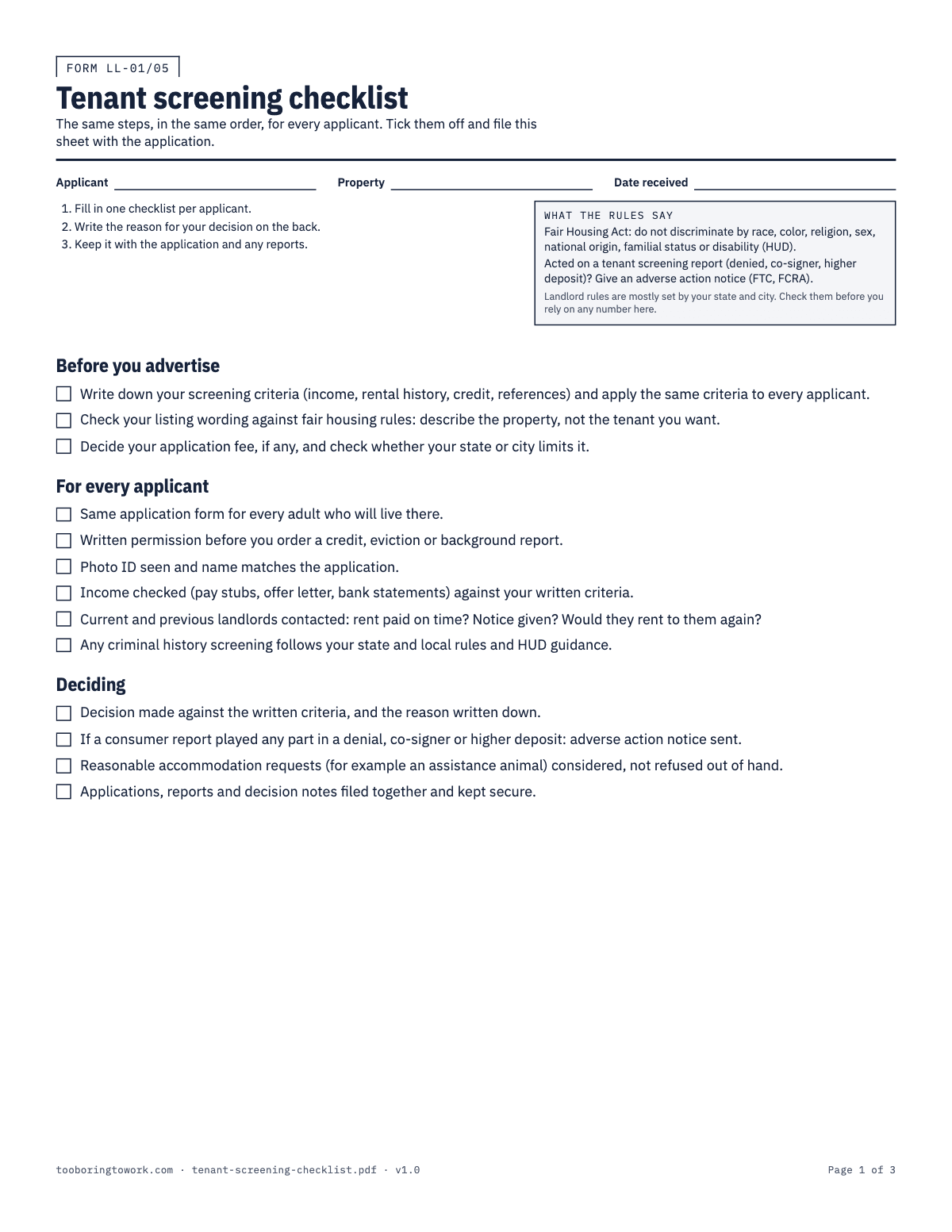
The screening checklist is one page per applicant, with fields for the applicant, the property and the date received. It is split into three stages. Before you advertise: write down your criteria, check the listing wording, decide on any application fee. For every applicant: same form, written permission before ordering reports, ID seen, income checked, landlords called, criminal history screening done within your rules. Deciding: decision made against the written criteria with the reason recorded, adverse action notice sent when a report played a part, accommodation requests considered, everything filed together. A rules box at the top names the two federal rules that apply to every rental: the Fair Housing Act and the FCRA adverse action notice.
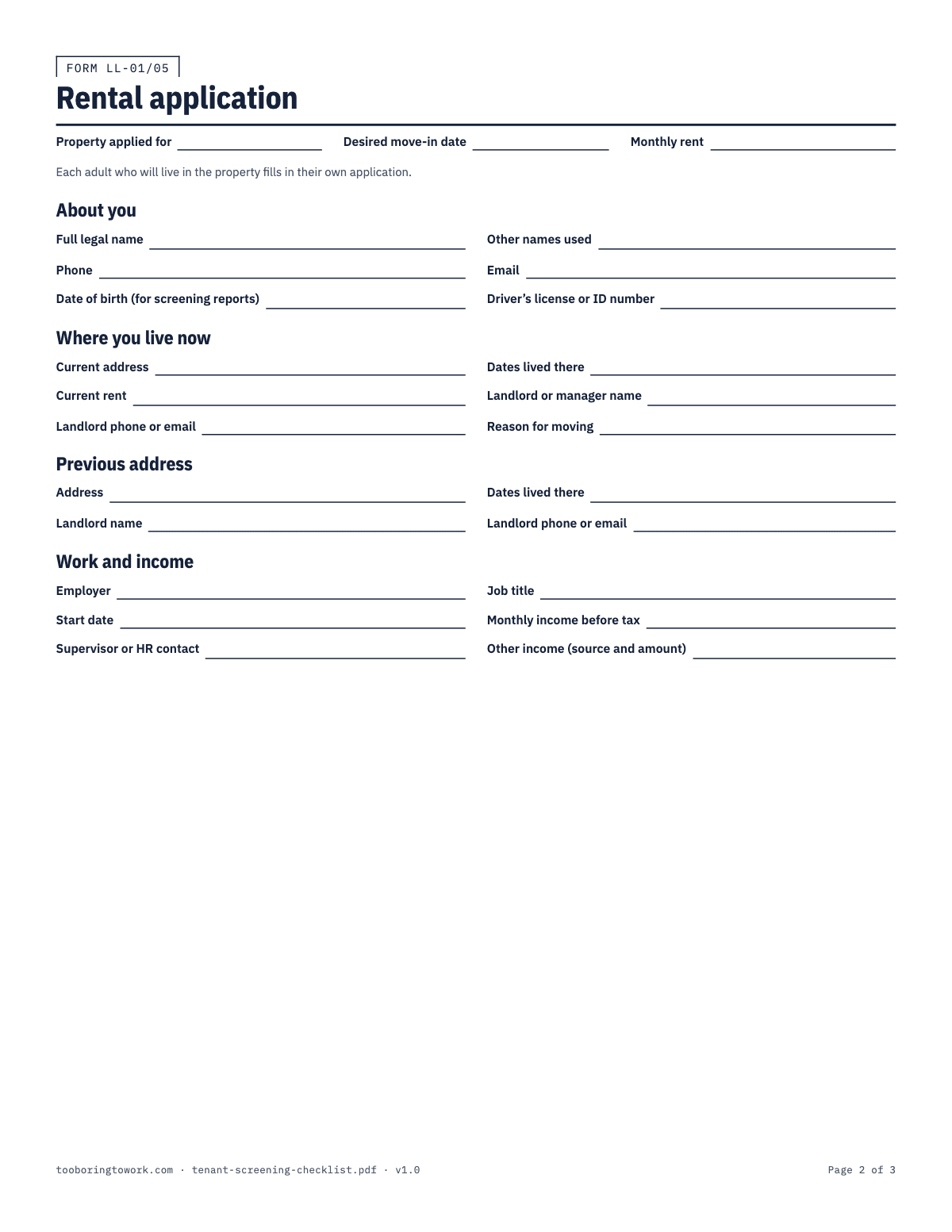
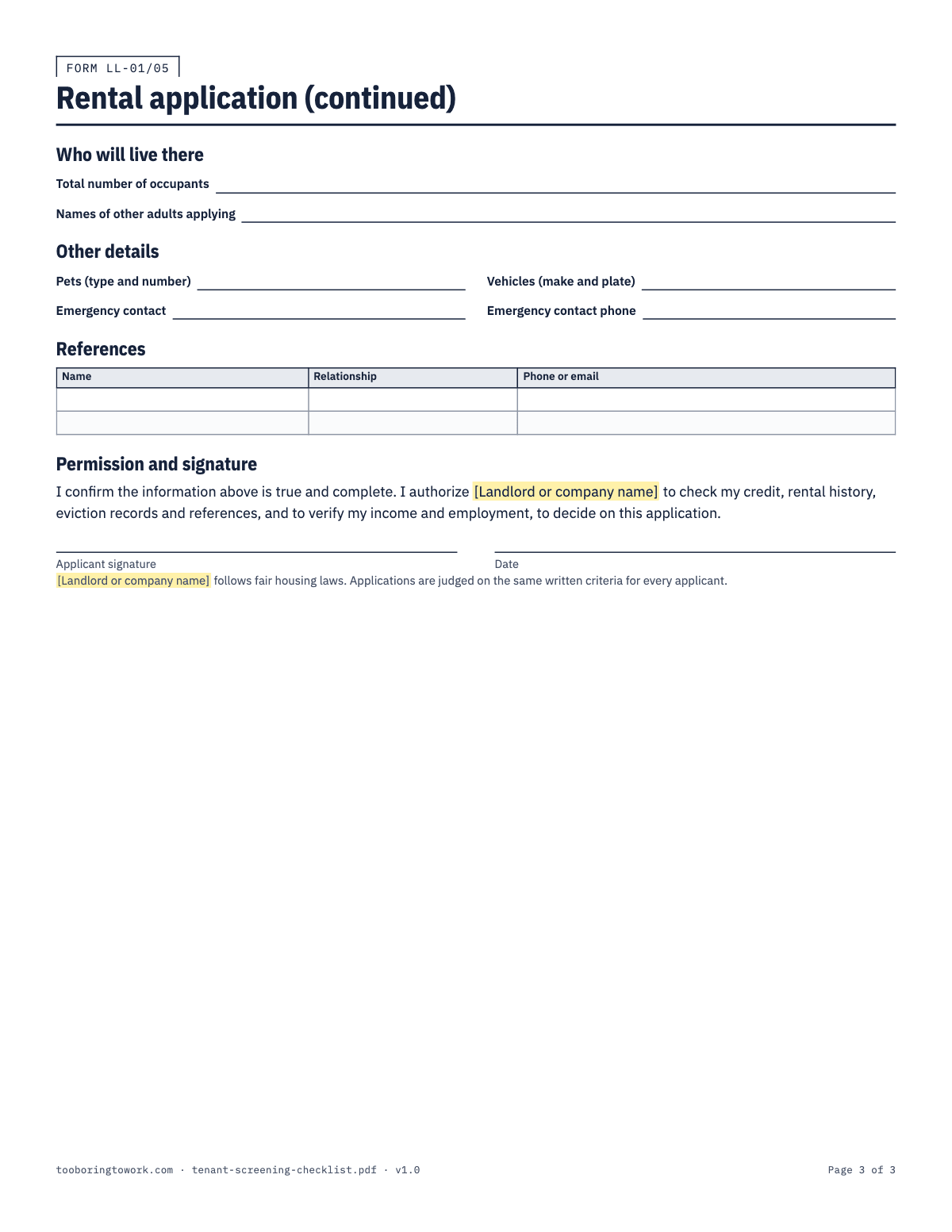
The rental application behind it is two pages: the property and move-in date, the applicant’s details, current and previous addresses with landlord contacts, work and income, who will live there, pets and vehicles, references, and a signed permission to check credit, rental history and references. It asks for the total number of occupants, on purpose, and not the ages of children or anything about family makeup, because familial status is a protected class. Both files come as a Letter-size PDF and as an editable Word document, so you can add your name and adjust fields. This is a practical checklist, not legal advice; state and local fair housing laws often go further than federal law.
How to fill it in
- Before you list the unit, fill in the "Before you advertise" section once. Write your screening criteria on paper: minimum income (for example, a multiple of the rent), rental history, credit and references. Whatever you choose, it has to be the same standard for everyone.
- Check your listing against the federal advertising rule: no statement that indicates a preference or limitation based on a protected class. Describe the unit (two bedrooms, second floor, no elevator, near the bus line), not the tenant you imagine living there. Look up whether your state or city limits application fees before you set one.
- When someone applies, start a new checklist. Fill in Applicant, Property and Date received, and give every adult who will live there their own copy of the rental application.
- Get the signed permission on the last page of the application before you order any credit, eviction or background report. Tick the box.
- Work down "For every applicant" in order: ID seen and the name matches, income checked against your written criteria using pay stubs, an offer letter or bank statements, and current and previous landlords contacted. Ask the landlords the same questions every time: was rent on time, was notice given, would you rent to them again.
- If you screen for criminal history, do it within your state and local rules and HUD guidance, and apply it the same way to every applicant. Some cities restrict when or whether you may ask.
- Decide against your written criteria, and write the reason on the back of the checklist in plain words: "income below 3x rent, no co-signer offered". If a screening report played any part in denying the application, requiring a co-signer or asking for a larger deposit or higher rent, send an adverse action notice.
- If an applicant asks for a reasonable accommodation, such as an assistance animal in a no-pets building, consider it and respond; don’t refuse it out of hand. File the application, any reports and the checklist together, and keep them secure.
A filled-in example
| Step | Done | Note |
|---|---|---|
| Same application form for every adult who will live there | Yes | Two adults, two forms (M.T. and D.T.) |
| Written permission before ordering reports | Yes | Signed 05/04, both applicants |
| Income checked against written criteria | Yes | Combined $5,100/mo vs. criteria 3x rent ($4,350) |
| Current and previous landlords contacted | Yes | Current: always on time. Previous: no answer after two calls |
| Decision made against written criteria, reason written down | Yes | Approved with co-signer due to credit report |
| Adverse action notice sent | Yes | Emailed 05/09: agency name and contact, free report, right to dispute |
Common mistakes
- Asking about children, ages, pregnancy or marriage plans. Familial status is protected under the Fair Housing Act. The application asks how many people will live there, and that is all you need for occupancy.
- Changing the criteria halfway through. If you relax the income requirement for one applicant, you have to be able to explain why and do the same for the next. Write the criteria down before the first showing and stick to them.
- Skipping the adverse action notice because you "didn’t really rely" on the report. If a consumer report was part of the reason you denied, asked for a co-signer, charged more or asked for a bigger deposit, the notice is required.
- Treating an assistance animal request like a pet request. Refusing a reasonable accommodation that a person with a disability needs is discrimination under the Fair Housing Act, whatever the no-pets clause says.
- Deciding and forgetting. Months later, you will not remember why the other applicant was turned down. A two-line reason on the back of the checklist, filed with the application, is your answer if anyone asks.
What the rules say
The federal Fair Housing Act bars discrimination in renting based on race, color, religion, sex, disability, familial status or national origin (42 U.S.C. §3604). State and local laws often add more protected classes.
Source: Fair Housing Act, 42 U.S.C. §3604Being reviewed
It is unlawful to publish any notice, statement or advertisement for a rental that indicates a preference, limitation or discrimination based on a protected class (42 U.S.C. §3604(c)).
Source: Fair Housing Act, 42 U.S.C. §3604(c)Being reviewed
If you deny an applicant, require a co-signer, ask for a larger deposit or charge more rent because of a consumer report, you must give an adverse action notice with the reporting agency’s contact details and the applicant’s right to a free report and to dispute it.
Source: FTC, Using Consumer Reports: What Landlords Need to KnowBeing reviewed
Refusing reasonable accommodations in rules or policies, or reasonable modifications at the tenant’s expense, that a person with a disability needs to use a home is discrimination under the Fair Housing Act (42 U.S.C. §3604(f)(3)).
Source: Fair Housing Act, 42 U.S.C. §3604(f)(3)Being reviewed
Last reviewed September 29, 2026. We link to official sources; your local rules may differ, so check them.
Questions
- What can landlords not ask on a rental application?
- Anything aimed at a protected class. Under federal law that means race, color, religion, sex, disability, familial status or national origin, and state and local laws often add more protected classes, so look up your own list before you write the listing. Stick to questions about the tenancy: identity, income, rental history, occupants, pets and references.
- What is an adverse action notice?
- It is a notice the FCRA requires when you deny an applicant, require a co-signer, ask for a larger deposit or charge more rent because of something in a consumer report. According to the FTC, it must give the reporting agency’s contact details and tell the applicant they can get a free copy of the report and dispute it. If a credit score was used, the notice must also include the score and its key factors.
- What screening criteria should a small landlord use?
- Common ones are income relative to rent, rental history and landlord references, credit, and eviction records. The exact numbers are up to you, within your state and local rules. What matters most is writing them down in advance and using the same ones for every applicant.
- Can I refuse an applicant with a pet?
- You can have a no-pets policy, but an assistance animal for a person with a disability is not a pet under fair housing rules. Refusing a reasonable accommodation that a disabled person needs is discrimination under the Fair Housing Act. Treat the request seriously, ask only what you are allowed to ask, and write down your response.
- Why does the application ask for total occupants instead of ages?
- Because you need to know how many people will live in the unit, for occupancy limits and the lease, but you don’t need to know who they are. Questions about children or their ages invite a familial status complaint. Every adult who will live there fills in their own application.
- Is this checklist legal advice?
- No. It is a set of consistent steps based on the federal rules, with reminders to check state and local law. Fair housing, criminal history screening and application fee rules vary by state and city; if you are unsure about a specific decision, ask a local attorney or your state landlord association.