Security Deposit Deduction List and Return Letter
Work out deductions with evidence for each one and the refund due, then send the itemized statement in an editable Word letter.
- Excel
- Word
- Works in Google Sheets
Included in The Landlord Kit ($29), with 7 other files.
Instant download. One payment. 14-day refunds.
What this is for
Keeping part of a security deposit is the moment a friendly tenancy most often turns into a small claims case. The tenant sees a number and a vague line like "cleaning and damages". A judge, if it gets that far, wants to see each charge, why it was made, and proof that the problem was not there when the tenant moved in. An itemized list with evidence for every line is what turns a deduction from an opinion into a record.
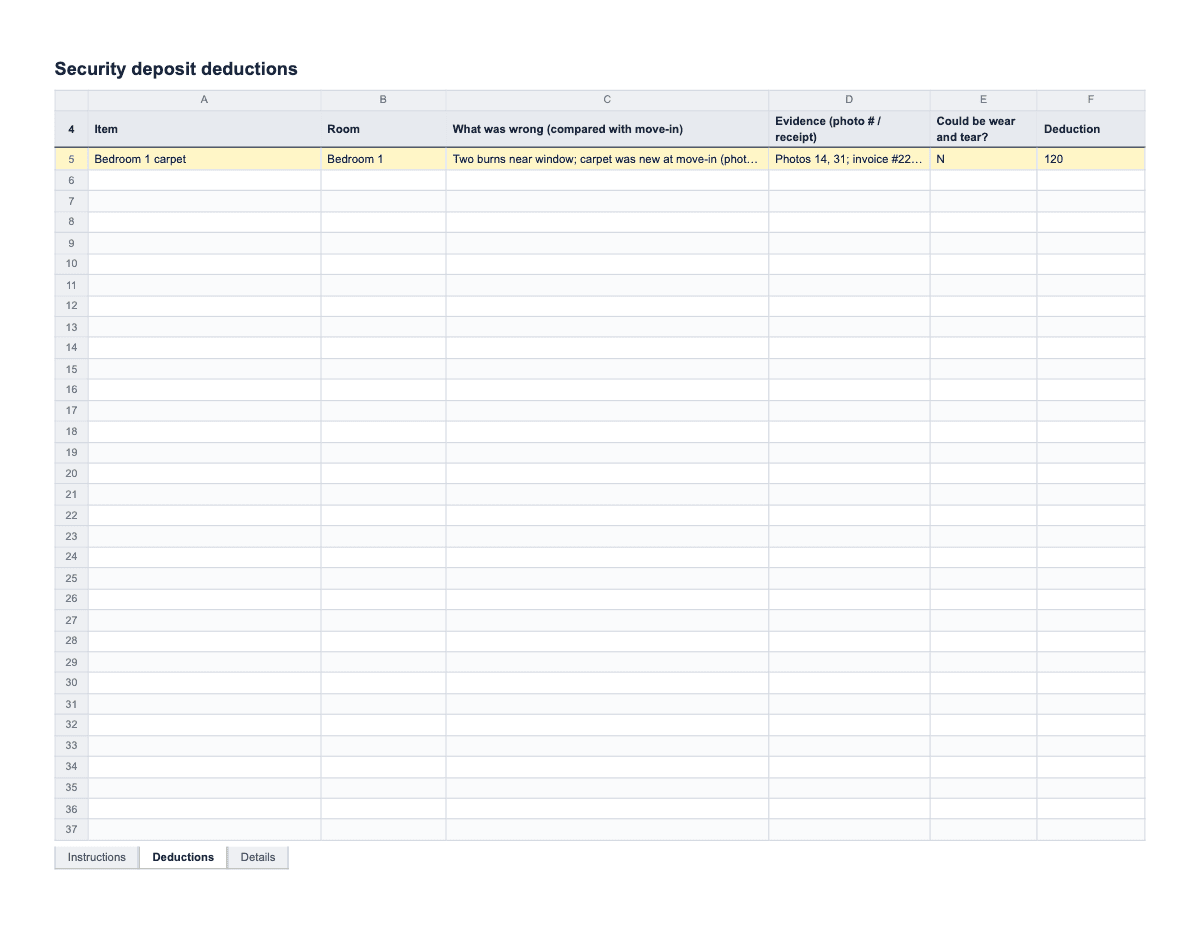
This template has two files. The Excel workbook works out the numbers: a Details tab for the tenancy (tenant, property, deposit held, any interest owed, move-out date, and the number of days your state gives you) and a Deductions tab with one row per charge. Each row says what the item was, which room, what was wrong compared with move-in, the evidence (photo numbers, invoice), whether it could be normal wear and tear, and the amount. The sheet adds up the deductions and shows the refund due: deposit plus interest, minus deductions. The Word file is the itemized statement and return letter, with the same columns, a totals box and highlighted blanks to fill in.
Deadlines, allowed deductions and what the letter must include differ by state, and some cities add their own rules. So this national version does not print a deadline: you type your state’s number of days on the Details tab, and the sheet works out the return-by date. There are separate pages for California, Texas, Florida, New York and Illinois that set out each state’s statute. Everywhere else, check your state and local rules before you send anything.
How to fill it in
- Before anything else, look up your own state’s deadline and itemization rules, and any city rules on top. Keep a note of the statute or official page you used.
- On the Details tab, fill in Tenant name(s), Property and unit, Deposit held, and Interest owed if your state or city requires interest. Enter the Move-out date and the Days your state allows to return or itemize. "Return or itemize by" then shows the date to work toward. Add the Tenant forwarding address as soon as you have it.
- Delete the EXAMPLE row on the Deductions tab.
- Put the move-in and move-out inspection checklist next to you. For each item that changed, add a row on Deductions: Item, Room, What was wrong (compared with move-in), Evidence (photo # / receipt) and Deduction. Charge actual or fairly estimated costs, and keep the invoices.
- In "Could be wear and tear?", choose Y for anything that might just be ordinary use: faded paint, flattened carpet in a hallway, small nail holes. Those rows turn amber. Look at each one again, and remove the charge unless you can explain why it goes beyond normal wear.
- Unpaid rent or fees the lease allows you to take from the deposit go on their own rows, with the rent ledger as the evidence.
- Check the two totals under the table: Total deductions, and Refund due. The refund never shows less than zero; if the deductions are more than the deposit, the difference is a separate debt to pursue, not a negative refund.
- Open the Word letter. Delete the check-your-rules box once you have done the checking, then fill in the highlighted blanks and copy each deduction row into the itemized table, with its evidence and amount. Fill in the totals box to match the workbook.
- Send the letter and the refund to the forwarding address before your return-by date, by a method you can prove later. Keep a copy of the letter, the workbook, the checklist, the photos and the receipts together in the tenant’s file.
A filled-in example
| Item | Room | What was wrong (compared with move-in) | Evidence (photo # / receipt) | Could be wear and tear? | Deduction |
|---|---|---|---|---|---|
| Bedroom 1 carpet | Bedroom 1 | Two burns near window; carpet was new at move-in | Photos 14, 31; invoice #2291 | N | $120.00 |
| Countertop | Kitchen | Knife cut 3 in. near sink; marked N at move-in | Photos 11, 43; quote from J. Stone | N | $210.00 |
| Hallway walls | Entry and hallways | Paint faded and scuffed along one wall | Photos 3, 38 | Y | $0.00 |
| Front door key | Entry and hallways | One of two keys not returned; lock rekeyed | Checklist keys section; locksmith receipt | N | $85.00 |
| Totals | Deductions $415.00, refund due $1,035.00 |
Common mistakes
- Deducting for ordinary wear and tear. Paint that has faded over three years, carpet worn along the usual paths and a few picture-hanging holes are generally part of the cost of renting. Use the wear-and-tear column honestly and let the amber rows make you look twice.
- Charging a round number with nothing behind it. "Cleaning: $300" invites a dispute. The hours, the cleaner’s invoice or a dated quote, and the photo of the oven make it a line item.
- Missing the deadline while waiting for one last invoice. Deadlines are strict, and in some states a late statement can cost you the right to keep any of the deposit. Check what your state says about estimates and send on time, rather than late with a perfect number.
- Sending the letter to the rental address after the tenant has left. Ask for a forwarding address at move-out and write it on the Details tab. If the tenant does not give one, note when you asked.
- Forgetting the tax side. A security deposit you return is not income, but the IRS says any part you keep is income in the year you keep it. Record the kept amount in your income records.
What the rules say
A security deposit you plan to return is not income when you receive it. Any part you keep because the tenant broke the lease is income in the year you keep it (IRS Publication 527).
Source: IRS Publication 527, Rental IncomeBeing reviewed
Last reviewed September 29, 2026. We link to official sources; your local rules may differ, so check them.
Rules by state
Deadlines and limits differ by state. These pages list the rules for each one, with the statute.
Questions
- How long does a landlord have to return a security deposit?
- It depends on the state, and sometimes the city. Deadlines vary widely, and some states set different deadlines for returning the whole deposit and for sending an itemized list. This page does not give a single national number because there isn’t one. The state pages for California, Texas, Florida, New York and Illinois cite each statute; elsewhere, check your state and local rules.
- What can a landlord deduct from a security deposit?
- Commonly: unpaid rent, damage beyond normal wear and tear, and cleaning to return the unit to its move-in condition, where your lease and state law allow it. Each state defines what is allowed, so check yours. On this sheet, every deduction needs an item, a comparison with move-in and some evidence.
- What should an itemized security deposit statement include?
- At a minimum: each deduction, the reason for it and the amount, the total, and what is being returned. Some states also require receipts, photos or specific wording. The Word letter has an item, evidence and amount for every line, and a totals box, and you add anything your state requires.
- Can I deduct more than the deposit?
- The sheet will not show a negative refund; it stops at zero. If the damage or unpaid rent is more than the deposit, the rest is a separate debt. How you go after it, usually by a demand letter and then small claims court, is outside what this template covers.
- Do I have to pay interest on a security deposit?
- Only if your state or city requires it; many do not. The Details tab has a line for interest owed so it is included in the refund due when it applies. Check your state and local rules for the rate and when it has to be paid.
- Is the kept part of a deposit taxable income?
- Yes, according to IRS Publication 527: a deposit you plan to return is not income when you receive it, but any part you keep is income in the year you keep it. Enter the kept amount in your rental income and expense tracker under kept security deposit.