Florida Security Deposit Return: Notice of Claim and Deductions
Florida handles deposits differently from most states. If you are keeping nothing, the whole deposit goes back within 15 days after the lease ends. If you want to keep any of it, you don’t simply send a list with a check: you first send a formal written notice of claim within 30 days, the tenant gets time to object, and only then is the balance paid.
This page walks through that notice-of-claim process under Florida Statutes §83.49, the rules on where the deposit must be held, and how to use the kit’s Excel sheet and Word letter along the way. It is a summary for small landlords, not legal advice.
The file itself is the same in every state: Security Deposit Deduction Sheet and Return Letter. This page covers what is different in Florida.
What the rules say
Florida: with no claim on the deposit, return it within 15 days after the lease ends. To claim part of it, send written notice of the claim and the reason within 30 days, by certified mail or email (Statutes §83.49(3)).
Source: Florida Statutes §83.49(3)Being reviewed
Florida: the notice of claim must state the amount and the reason and follow the wording set out in the statute; a landlord who misses the 30-day notice loses the right to claim against the deposit (Statutes §83.49(3)).
Source: Florida Statutes §83.49(3)(a)Being reviewed
Florida: deposits must be held in a separate Florida bank account or covered by a surety bond, and landlords with five or more units must tell the tenant in writing within 30 days where the deposit is held (Statutes §83.49(1)–(2)).
Source: Florida Statutes §83.49(1)–(2)Being reviewed
Florida: entry for repairs needs at least 24 hours’ notice, between 7:30 a.m. and 8:00 p.m.; the landlord may enter at any time to protect or preserve the premises (Statutes §83.53).
Source: Florida Statutes §83.53Being reviewed
A security deposit you plan to return is not income when you receive it. Any part you keep because the tenant broke the lease is income in the year you keep it (IRS Publication 527).
Source: IRS Publication 527, Rental IncomeBeing reviewed
Last reviewed September 29, 2026. We link to official sources; your local rules may differ, so check them.
Two deadlines: 15 days or 30 days
Which deadline applies depends on a decision you make first: are you claiming anything?
- No claim. Return the full deposit within 15 days after the lease ends.
- A claim on part or all of it. Send written notice of the claim, with the amount and the reason, within 30 days, by certified mail or email.
Miss the 30-day notice and you lose the right to claim against the deposit. There is no late version of the notice. Make the claim-or-no-claim decision early, ideally within a few days of getting the keys back, so the 15-day route is still open if the unit turns out fine.
How the notice-of-claim process works
- Inspect the unit and compare it with the move-in record. Decide what, if anything, you will claim.
- Write the notice. It must state the amount and the reason, and it must follow the wording set out in the statute. Copy that wording from §83.49(3)(a) rather than paraphrasing it.
- Send it within 30 days by certified mail or by email. Keep the mailing receipt or a copy of the sent email with its date.
- Wait. The tenant then has 15 days to object to the claim.
- Pay the balance, the deposit minus what you are keeping, within 30 days of the notice.
| Date | What happens | Counted from |
|---|---|---|
| 31 May | Lease ends; keys handed back; move-out photos taken | Start |
| 12 June | Notice of claim for $340 (broken blind, stained carpet) emailed to tenant | Day 12 of 30 |
| 15 June | Would have been the refund date had there been no claim | Day 15 |
| 27 June | Objection window closes; tenant has not replied | 15 days after notice |
| 1 July | Balance of $1,060 sent by check with a copy of the notice | Within 30 days of notice |
What happens after a tenant objects is set out in the statute; this page doesn’t cover the dispute stage. If an objection arrives, read the section in full or talk to a Florida attorney before keeping the money.
Florida is the one state on this site where the letter has to be worded the statute’s way. Some find that reassuring and some find it tedious; either way, copy it exactly.
Where the deposit must be held, and interest
While you hold it, the deposit must sit in a separate Florida bank account or be covered by a surety bond. A landlord with five or more units must tell the tenant in writing, within 30 days, where it is held.
Interest depends on the arrangement. For an interest-bearing account, the tenant receives at least 75% of the rate paid or 5% simple interest; with a surety bond, the tenant gets 5%. Read the statute for which option applies to you and when it is paid, then put the figure you owe in the "Interest owed" row of the sheet.
Deductions, evidence and what this page leaves out
The Florida facts behind this page cover the notice and the deadlines, not a list of allowed charges. Whether a particular deduction is permitted, and how wear and tear is treated, is outside what this page covers; read §83.49 and your lease.
In practice, claims that hold up tend to be specific and documented: a dated photo, the move-in condition, the cost. The move-in and move-out inspection checklist gives you the before-and-after record to point to.
A useful habit is a single folder per departing household: the signed lease, move-in checklist, dated photographs, contractor quotes, the notice itself and whatever proof of delivery the post office or email system produced. If a dispute reaches small claims court, a judge will want to see those papers in order, and assembling them months later from a phone gallery is miserable work.
Receipts: the facts here say nothing about attaching them to the notice. Keeping them ready is still good practice, since an objection usually turns on the evidence.
Keeping the deposit also has a tax side. The IRS treats what you keep for a broken lease as income in the year you keep it.
Using the Excel sheet and Word letter in Florida
- On the Details tab, enter the tenant names, property and unit, the deposit held and any interest owed under your holding arrangement.
- Florida counts from the end of the lease, so put the date the lease ended in the "Move-out date" row if it differs from the day the tenant left.
- In the days row, type 15 if you are making no claim. Type 30 if you are. The "Return or itemize by" date then shows your notice deadline.
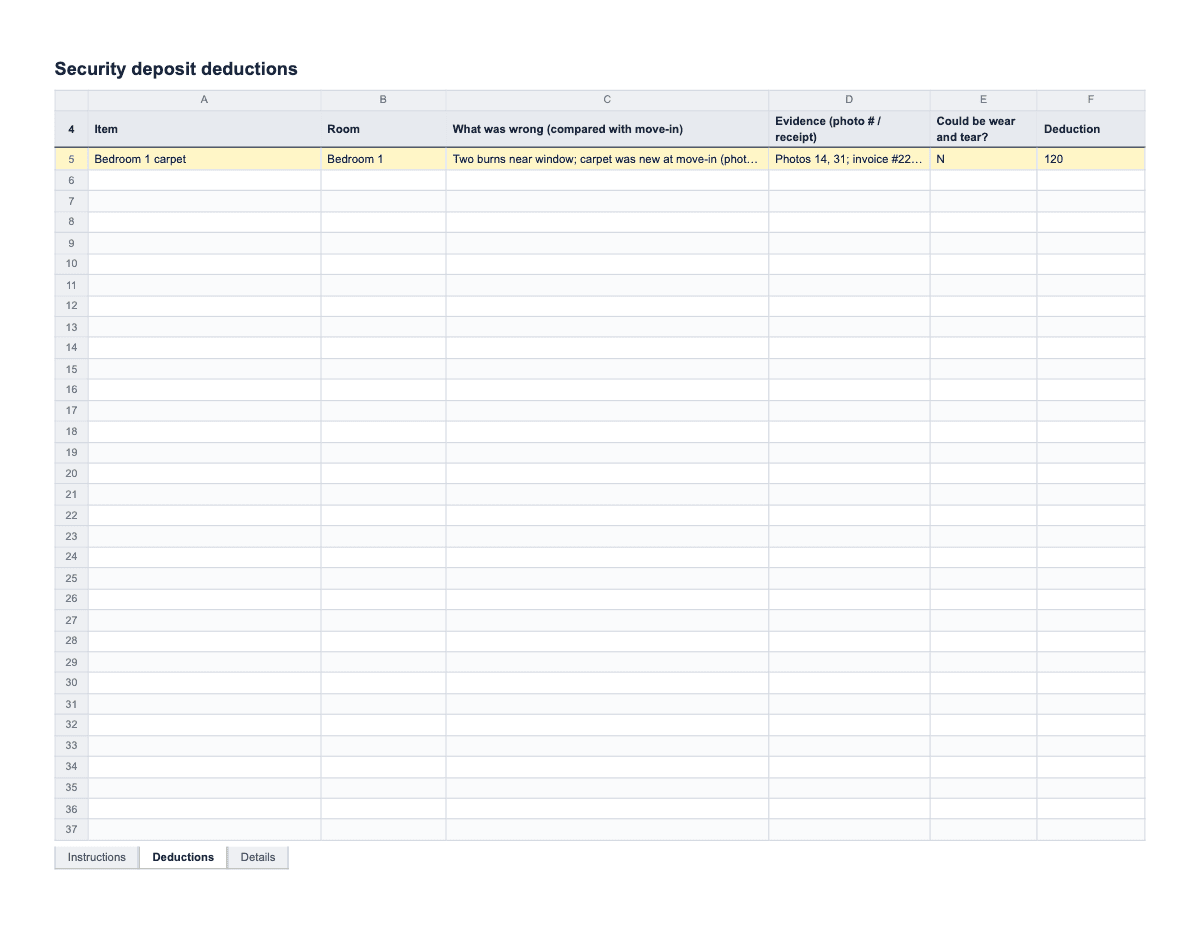
- On the Deductions tab, delete the EXAMPLE row and list each item you are claiming, with the room, what changed since move-in and the photo or invoice that shows it.
- Look again at any amber row marked as possible wear and tear before you include it.
- Open the Word letter. Replace its opening paragraph with the notice wording from the statute, and use the itemized table to show each amount and reason. The totals table shows what you intend to return.
- Send it by certified mail or email before day 30. Then note the date the 15-day objection period ends, and pay the balance within 30 days of the notice.
Questions
- What is a Florida notice of claim on a security deposit?
- It is the written notice a landlord must send, within 30 days, to keep any part of the deposit. It states the amount and the reason and must follow the statute’s wording. Without it, you cannot claim against the deposit.
- Can I send the Florida notice by email?
- Yes. The current statute allows certified mail or email. Whichever you use, keep proof of the date it went.
- Can the kit’s Word letter be used as the notice?
- Only after you add the statutory wording. The default letter is a general itemized statement. Paste the wording from §83.49(3)(a) at the top, keep the itemized table, and check the result against the statute.
- How long does the tenant have to object?
- 15 days from the notice. The balance of the deposit is then due within 30 days of the notice. This page doesn’t cover what to do after an objection, so read the statute if one arrives.
- Do I owe interest on a Florida deposit?
- It depends on how you hold the deposit. Interest-bearing accounts and surety bonds carry interest owed to the tenant; read the statute for the rate and timing that apply to your setup.