New York Security Deposit Return: Itemized Statement and Letter
New York has the shortest deadline of the five states on this site. A landlord has 14 days from move-out to give the tenant an itemized statement of anything kept and return the rest, and a landlord who misses it forfeits the right to keep any of it. Since the 2019 housing reforms, the rules also cover inspections, how much you may collect and where the money sits while you hold it.
This page summarizes General Obligations Law §§7-103 and 7-108 for owners of ordinary market-rate apartments and houses. Rent-stabilized units have additional rules that this page doesn’t cover; if yours is stabilized, check those rules before you rely on anything here. It is not legal advice.
The file itself is the same in every state: Security Deposit Deduction Sheet and Return Letter. This page covers what is different in New York.
What the rules say
New York: within 14 days after the tenant moves out, the landlord must give an itemized statement of any amount kept and return the rest; missing the deadline forfeits the right to keep any of it (General Obligations Law §7-108(1-a)(e)).
Source: New York General Obligations Law §7-108(1-a)(e)Being reviewed
New York: a deposit or advance may not exceed one month’s rent (General Obligations Law §7-108(1-a)(a)).
Source: New York General Obligations Law §7-108(1-a)(a)Being reviewed
New York: a willful violation of the deposit rules can cost up to twice the deposit in punitive damages (General Obligations Law §7-108(1-a)(g)).
Source: New York General Obligations Law §7-108(1-a)(g)Being reviewed
New York: a deposit is held in trust and may not be mixed with the landlord’s own money; in buildings with six or more units it must be in an interest-bearing New York bank account, with the bank named to the tenant in writing (General Obligations Law §7-103).
Source: New York General Obligations Law §7-103Being reviewed
New York: the landlord must offer a move-in inspection, and after notice to end the tenancy must tell the tenant of the right to a pre-move-out inspection with at least 48 hours’ written notice (General Obligations Law §7-108(1-a)(c)–(d)).
Source: New York General Obligations Law §7-108(1-a)(c)–(d)Being reviewed
A security deposit you plan to return is not income when you receive it. Any part you keep because the tenant broke the lease is income in the year you keep it (IRS Publication 527).
Source: IRS Publication 527, Rental IncomeBeing reviewed
Last reviewed September 29, 2026. We link to official sources; your local rules may differ, so check them.
Fourteen days, and what missing them costs
The statement and the refund are both due within 14 days after the tenant vacates. Unlike some states, New York does not just add a penalty for lateness: a late statement means you lose the right to retain any part of the deposit, even for damage you could prove.
This is not the fortnight to take a vacation. Plan the move-out like a small project. Book the cleaner and any trades for the first few days, ask contractors for written quotes rather than verbal estimates, and draft the letter as soon as the inspection is done.
Count days from the actual vacate date and include weekends. If the tenant hands back keys on a Friday, day 14 is two Fridays later.
Move-in and pre-move-out inspections
New York requires the landlord to offer an inspection at move-in. Once either side has given notice to end the tenancy, you must also tell the tenant they can request an inspection before moving out, giving at least 48 hours’ written notice of it.
These visits produce the record the itemized statement relies on. Use the move-in and move-out inspection checklist at both, sign and date it together, and number the photos so the deduction sheet can quote them. Walk every room with the tenant: open closets and cabinets, run faucets, flush toilets, try windows and look under sinks. Write down anything they point out that you missed.
The itemized statement
The statute asks for an itemized statement of any amount kept. The New York facts behind this page don’t spell out attachments such as receipts, so this page won’t claim they are compulsory. Attaching invoice copies and photo references is still the most convincing way to show each charge is real.
Ordinary wear and tear is not something tenants expect to pay for, and a charge for it is the easiest one to challenge. The kit flags those rows so you look twice. For the exact list of what the deposit may cover, read §7-108.
Holding the deposit: trust, bank accounts, interest
- A deposit is held in trust. It may not be mixed with your own money.
- In buildings with six or more units it must go into an interest-bearing account at a New York bank, and the tenant must be told in writing which bank holds it.
- The landlord may keep 1% a year of the deposit as an administration fee; the rest of the interest belongs to the tenant.
Before writing the letter, pull the bank statement showing the interest earned. Take off your 1% fee, and enter the remainder in the "Interest owed" row on the Details tab. In a smaller building without that account, enter 0.
Deposit limits and penalties
A deposit or advance may not exceed one month’s rent. The Attorney General’s guidance adds that you cannot collect last month’s rent and a security deposit together. If a past tenancy broke that limit, fix it before the next one starts.
A willful breach of these rules can cost up to twice the deposit in punitive damages. Combined with forfeiture for a late statement, that makes New York an expensive place to be disorganized.
On the tax side, money kept because a tenant broke the lease becomes income in the year you keep it.
Working through the kit for a New York move-out
- Details tab: type the tenant names, the apartment address and unit, and the deposit held.
- Interest owed: for buildings of six or more units, enter the interest from the bank statement after your 1% fee. Otherwise leave 0.
- Enter the vacate date as the move-out date and type 14 as the days allowed. Put the "Return or itemize by" date in your calendar straight away.
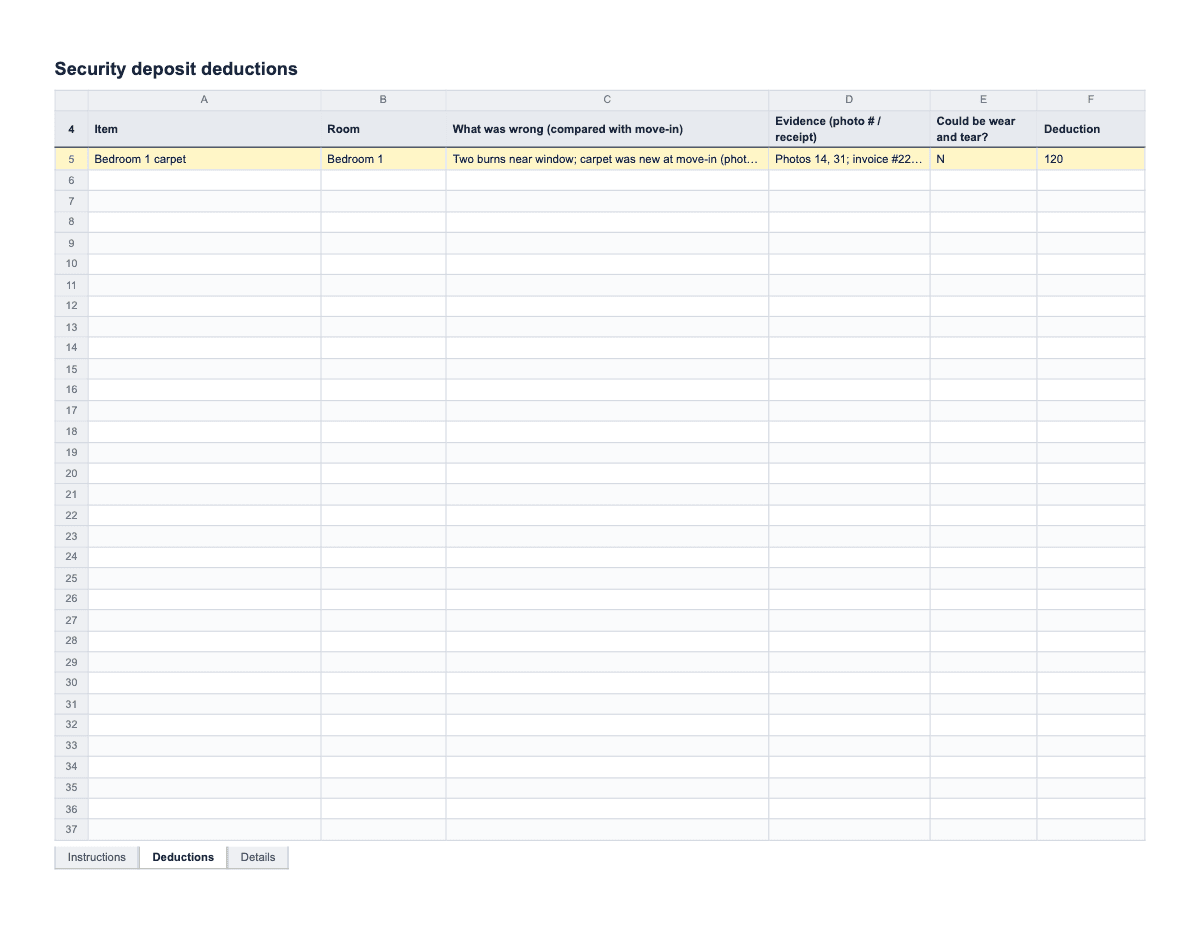
- Deductions tab: clear the EXAMPLE row, then add one line per charge. Describe the fault compared with the signed move-in inspection.
- Evidence column: reference photo numbers, the contractor’s quote or invoice, and the inspection date.
- Anything you mark Y under "Could be wear and tear?" turns amber. A charge you can’t back up invites a challenge to the rest, so remove it.
- In the Word letter, fill the itemized table and totals, name the bank that held the deposit if relevant, and state how the refund is being paid.
- Send by day 14 and keep dated proof: a mailing receipt, a courier tracking page or a saved email.
Questions
- How many days does a New York landlord have to return a deposit?
- 14 days after the tenant moves out, for both the itemized statement and the refund. Missing that deadline forfeits the right to keep any of the deposit.
- Can I take last month’s rent and a security deposit in New York?
- No. The total is capped at one month’s rent, and the Attorney General’s guidance says you cannot collect both last month’s rent and a deposit.
- Does a New York landlord have to pay interest on the deposit?
- In buildings with six or more units the deposit must be in an interest-bearing New York bank account. The tenant gets the interest, less a 1% yearly administration fee you may keep.
- What if repairs won’t be finished within 14 days?
- The deadline doesn’t move because a plasterer is booked up. One approach is to itemize from a written quote, labeled as such, and keep the final invoice on file. Whether a quote is acceptable for a particular charge is something this page can’t settle; read §7-108 or ask a New York attorney.
- Is the rule different for rent-stabilized apartments?
- Rent-stabilized units have additional rules on top of the state deposit law. This page doesn’t cover them, so check the rent stabilization rules for your unit before you send the statement.