Texas Security Deposit Return: Deductions List and Letter
Texas gives a landlord 30 days after the tenant surrenders the property to refund the deposit, and a written, itemized list for anything kept back. The rule has one quirk that matters in practice: the clock for refunding and itemizing only bites once the tenant has given you a forwarding address in writing.
Texas asks for less paperwork than some states and then charges more for getting it wrong. This page explains the Property Code rules that apply, what they leave out, and how to fill in the kit’s spreadsheet and letter for a Texas move-out. It is a plain summary, not legal advice.
The file itself is the same in every state: Security Deposit Deduction Sheet and Return Letter. This page covers what is different in Texas.
What the rules say
Texas: the landlord must refund the deposit within 30 days after the tenant surrenders the premises, but need not refund or itemize until the tenant gives a written forwarding address (Property Code §§92.103, 92.107).
Source: Texas Property Code §§92.103, 92.107Being reviewed
Texas: a landlord who keeps part of the deposit must give a written description and itemized list of all deductions, and may not deduct for normal wear and tear (Property Code §92.104).
Source: Texas Property Code §92.104Being reviewed
Texas: a landlord who keeps a deposit in bad faith owes $100 plus three times the amount wrongfully withheld, plus attorney’s fees; missing the 30-day deadline is presumed bad faith (Property Code §92.109).
Source: Texas Property Code §92.109Being reviewed
A security deposit you plan to return is not income when you receive it. Any part you keep because the tenant broke the lease is income in the year you keep it (IRS Publication 527).
Source: IRS Publication 527, Rental IncomeBeing reviewed
Last reviewed September 29, 2026. We link to official sources; your local rules may differ, so check them.
Thirty days and the forwarding address
Under Property Code §§92.103 and 92.107, the refund is due within 30 days after the tenant surrenders the premises. You are not required to refund or itemize until the tenant has given you a written forwarding address.
In practice, ask for that address on paper or by email at the final walk-through, and note the date it arrived. A passing remark about where they are moving is not the same thing; ask them to confirm the address in writing.
The statute decides what counts as surrender. This page doesn’t cover the edge cases (a tenant who leaves furniture behind, or keys posted weeks later), so read Chapter 92 if your situation is unclear.
A simple rule of thumb: aim to mail the letter within 30 days of the day you got the keys back, whatever date the address arrived. Being early costs nothing.
What the written list has to say
If you keep any part of the deposit, §92.104 requires a written description and itemized list of all deductions. Each item should say what the charge is for and how much it is. "Cleaning and repairs: $650" is a total, not an itemized list.
Write each line so a stranger could follow it: which fixture or surface, its condition when the lease began, its condition now, and what the fix cost. Quote a contractor’s invoice where you have one, and for your own labor state the hours and a fair hourly figure.
The Texas facts on this page do not require you to attach receipts or photos. Attaching copies anyway is sensible practice: it answers most questions before they are asked, and it is your evidence if the tenant disputes a charge.
There is one case where no list is needed: when the tenant owed rent at move-out and does not dispute the amount. Many landlords still send a short statement showing the rent applied, because it closes the file cleanly.
You must also keep records of deposits (§92.106). The spreadsheet, the letter and your proof of mailing make a tidy record; file them with the lease.
Normal wear and tear, and what this page does not cover
Texas bars deductions for normal wear and tear. The line is drawn case by case. Carpet worn thin in a hallway after five years is usually wear; a pet stain soaked through to the pad is usually damage. The more specific your note of what changed since move-in, the easier that line is to defend.
Deposit size: the facts behind this page do not include a Texas limit on how much deposit you may collect. Don’t assume either way; check the statute or ask a local attorney if it matters to you.
Interest: nothing in our Texas facts requires you to pay interest on a deposit. Leave that row at zero unless your lease promises it.
The penalty: $100 plus three times the amount
A landlord who keeps a deposit in bad faith owes $100 plus three times the amount wrongfully withheld, plus the tenant’s attorney’s fees. Missing the 30-day deadline is presumed to be bad faith, which means the law starts from the assumption that you acted badly.
To put numbers on it: wrongly keeping $400 could turn into $100 plus $1,200, before any legal fees. That is the practical reason to send the letter on time even when the deductions are still being argued about.
Money you keep because the tenant broke the lease is income in the year you keep it. Record it in the rental income and expense tracker.
Using the Excel sheet and Word letter in Texas
- On the Details tab, fill in tenant names, property and unit, and the deposit held. Leave "Interest owed" at 0 unless your lease says otherwise.
- Enter the date the tenant surrendered the property as the move-out date and type 30 in the days box. The sheet shows the "Return or itemize by" date.
- Type the written forwarding address, and in the same cell add the date it reached you, for example "rec’d 3 May by email".
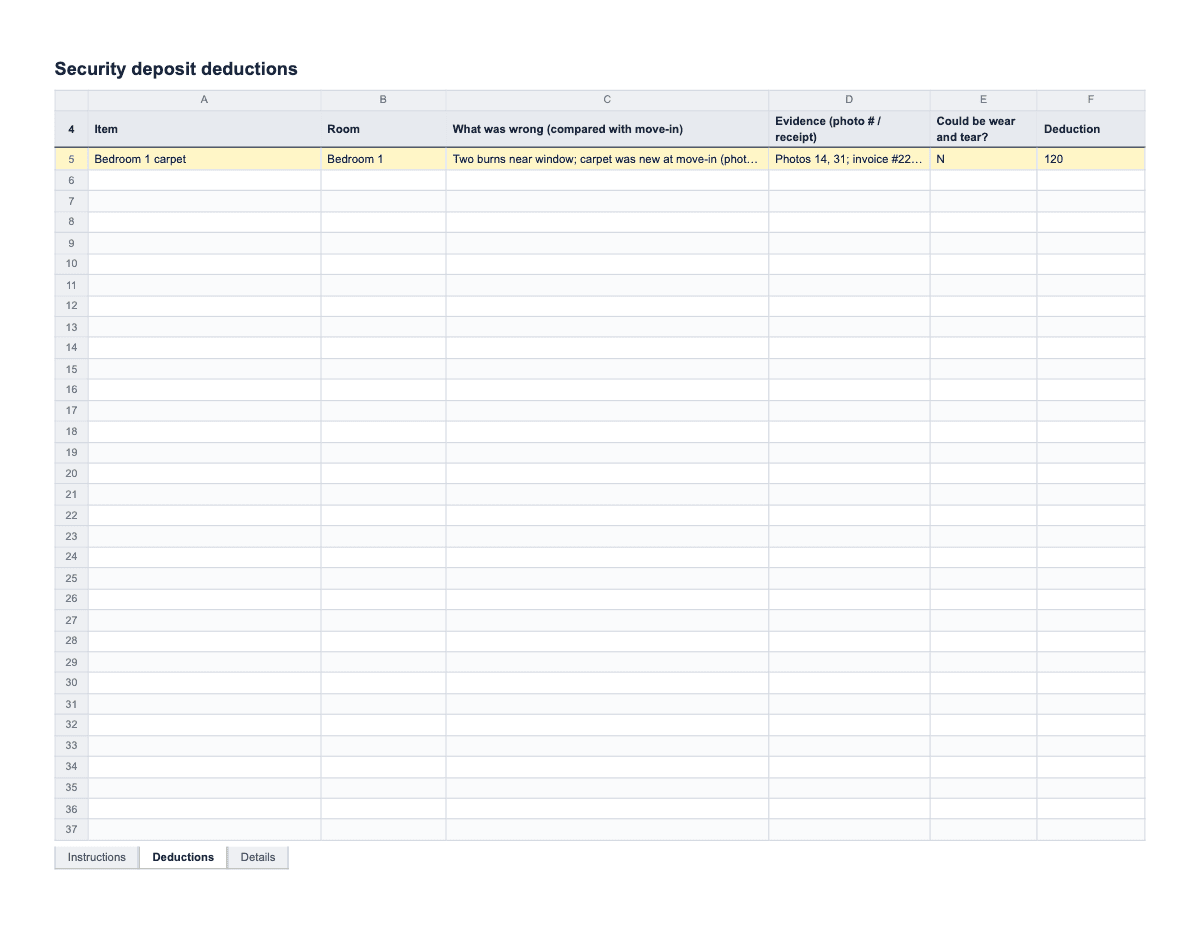
- Go to the Deductions tab and remove the EXAMPLE row. List every charge on its own row: item, room, and what was wrong compared with move-in.
- Fill the Evidence column with photo numbers from your move-in and move-out checklist and any invoice numbers.
- Mark "Could be wear and tear?" as Y where you have doubts. Amber rows are the ones to reconsider; in Texas a normal wear and tear charge should come off the list.
- If the only deduction is undisputed unpaid rent, you may not need the list, but entering the rent as a single row still shows the refund due.
- Copy the rows into the Word letter’s itemized table, complete the totals, and fill the enclosure line. Mail it to the forwarding address and keep proof of the date sent.
Questions
- What if the tenant never gives a forwarding address?
- Texas does not require you to refund or itemize until the tenant gives a written forwarding address. Keep the deposit records and a note of any requests you made for the address. If one arrives later, act on it promptly.
- Can a Texas landlord deduct for carpet cleaning?
- Only for damage or dirt beyond normal wear and tear, which Texas excludes. Routine cleaning of carpet that has simply been lived on is usually wear. Stains, burns or pet damage recorded against the move-in checklist are easier to justify.
- Is there a limit on how big a Texas security deposit can be?
- This page doesn’t cover that: the facts it is built on have no Texas deposit cap. Check the Property Code or ask a Texas attorney before relying on any figure you find elsewhere.
- What happens if I miss the 30 days?
- Missing the deadline is presumed to be bad faith, and bad faith can cost $100 plus three times the amount withheld, plus attorney’s fees. Send the letter on time even if one charge is still in dispute.