California Security Deposit Return: Deductions and Letter
In California the clock starts when the tenant moves out. You then have 21 days to send an itemized statement of deductions and return whatever is left. The statement is more than a list of numbers: it has to carry copies of receipts, a record of any work you did yourself, and photographs. This page covers what the state asks for and how to fill in the kit’s Excel sheet and Word letter so the paperwork is finished well before day 21.
It summarizes California Civil Code §1950.5 as amended for 2026. Some California cities have their own rental ordinances, and this page covers the state statute only, so check your city’s rules as well. It is a practical summary, not legal advice.
The file itself is the same in every state: Security Deposit Deduction Sheet and Return Letter. This page covers what is different in California.
What the rules say
California: within 21 days after the tenant moves out, the landlord must send an itemized statement of deductions and return the rest of the deposit (Civil Code §1950.5(h)).
Source: California Civil Code §1950.5(h)(1)Being reviewed
California: a security deposit may not exceed one month’s rent. Small landlords (natural persons owning no more than two properties with four units in total) may take up to two months’, except from a service member (Civil Code §1950.5(c)).
Source: California Civil Code §1950.5(c)Being reviewed
California: the itemized statement must include copies of bills, invoices or receipts, a description of any work the landlord did with time and hourly rate, and the required photographs (Civil Code §1950.5(h)).
Source: California Civil Code §1950.5(h)(2)–(5)Being reviewed
California: keeping a deposit in bad faith can cost up to twice the deposit in statutory damages, plus actual damages (Civil Code §1950.5(m)).
Source: California Civil Code §1950.5(m)Being reviewed
California: landlords must photograph the unit at or just before move-in (tenancies from 1 July 2025) and after move-out, before and after repairs or cleaning they deduct, and must tell tenants of their right to a pre-move-out inspection (Civil Code §1950.5(f)–(g)).
Source: California Civil Code §1950.5(f)–(g)Being reviewed
California: landlords must give reasonable written notice before entering, with the date, approximate time and purpose; 24 hours is presumed reasonable (Civil Code §1954).
Source: California Civil Code §1954(d)Being reviewed
A security deposit you plan to return is not income when you receive it. Any part you keep because the tenant broke the lease is income in the year you keep it (IRS Publication 527).
Source: IRS Publication 527, Rental IncomeBeing reviewed
Last reviewed September 29, 2026. We link to official sources; your local rules may differ, so check them.
The 21-day deadline and how to count it
The deadline runs from the day the tenant moves out, not from the end date printed on the lease. Within 21 days the tenant must have both the itemized statement and the refund of the balance. Sending one without the other does not finish the job.
The safe habit is to count every calendar day, weekends and holidays included, and to treat the move-out day as day zero. Write down which date you used as move-out and why, especially when keys came back late or belongings were left behind. If you are unsure which date a court would use, pick the earlier one.
The amended statute also deals with returning a deposit electronically when the tenant paid it electronically. If your tenant paid by bank transfer or an app, read §1950.5 on how the refund should go back.
Twenty-one days is plenty, provided you don’t spend twenty of them waiting for the painter’s invoice. Book repairs and cleaning in the first week.
What a California itemized statement must include
California spells out the attachments. According to §1950.5(h), the statement must come with:
- Copies of the bills, invoices or receipts for each repair or cleaning charge.
- For work you or your employees did, a description of the work, the time it took and the hourly rate you charged.
- The photographs the statute requires (see the next section).
There is a small exception: when repair and cleaning deductions add up to $125 or less, you do not have to attach receipts, although the tenant can still ask for them. Keep them either way.
If a repair won’t be finished inside the 21 days, read subsection (h) of the statute before you send anything. This page doesn’t cover that case.
Photographs and the pre-move-out inspection
For tenancies that began on or after 1 July 2025, you must photograph the unit at or just before move-in. You also photograph it after move-out, and before and after any repair or cleaning you plan to charge for. A deduction with no matching before-and-after pictures is hard to defend.
You must also tell the tenant they can ask for an inspection before they move out. That visit can happen no earlier than two weeks before the tenancy ends, with 48 hours’ written notice. In practice it lets both of you see the same problems before the keys come back. For ordinary visits, California presumes 24 hours’ written notice is reasonable.
The move-in and move-out inspection checklist has a photo log, so photo numbers on the checklist can be quoted directly on the deduction sheet.
What you can and can’t deduct
The state rule we rely on here is short: no deductions for ordinary wear and tear. Faded paint after several years, light scuffs by door handles and carpet flattened along a walkway are the usual examples in practice. A cigarette burn, a broken blind or a hole in a wall usually is not wear and tear.
The statute also lists the purposes a deposit can be used for. This page doesn’t reproduce that list, so read the statute if you plan to deduct anything other than damage or cleaning.
Check the deposit figure too. A deposit generally may not exceed one month’s rent; small landlords (people owning no more than two properties with four units in total) may take two months’, but not from a service member. If you collected more, get advice before you write the letter.
What getting it wrong can cost
Keeping a deposit in bad faith can cost up to twice the deposit in statutory damages, on top of the tenant’s actual damages. Missing receipts, photos or the deadline makes good faith harder to show.
Anything you keep because the tenant broke the lease is income in the year you keep it. Note it in the rent ledger so it isn’t forgotten at tax time.
Filling in the sheet and letter for California
- Open the Excel file and go to the Details tab. Enter the tenant names, property and unit, and the deposit held. Leave interest owed at 0 unless your city requires interest on deposits.
- Type the move-out date, then type 21 in "Days your state allows to return or itemize". The "Return or itemize by" date fills itself in. Add the forwarding address.
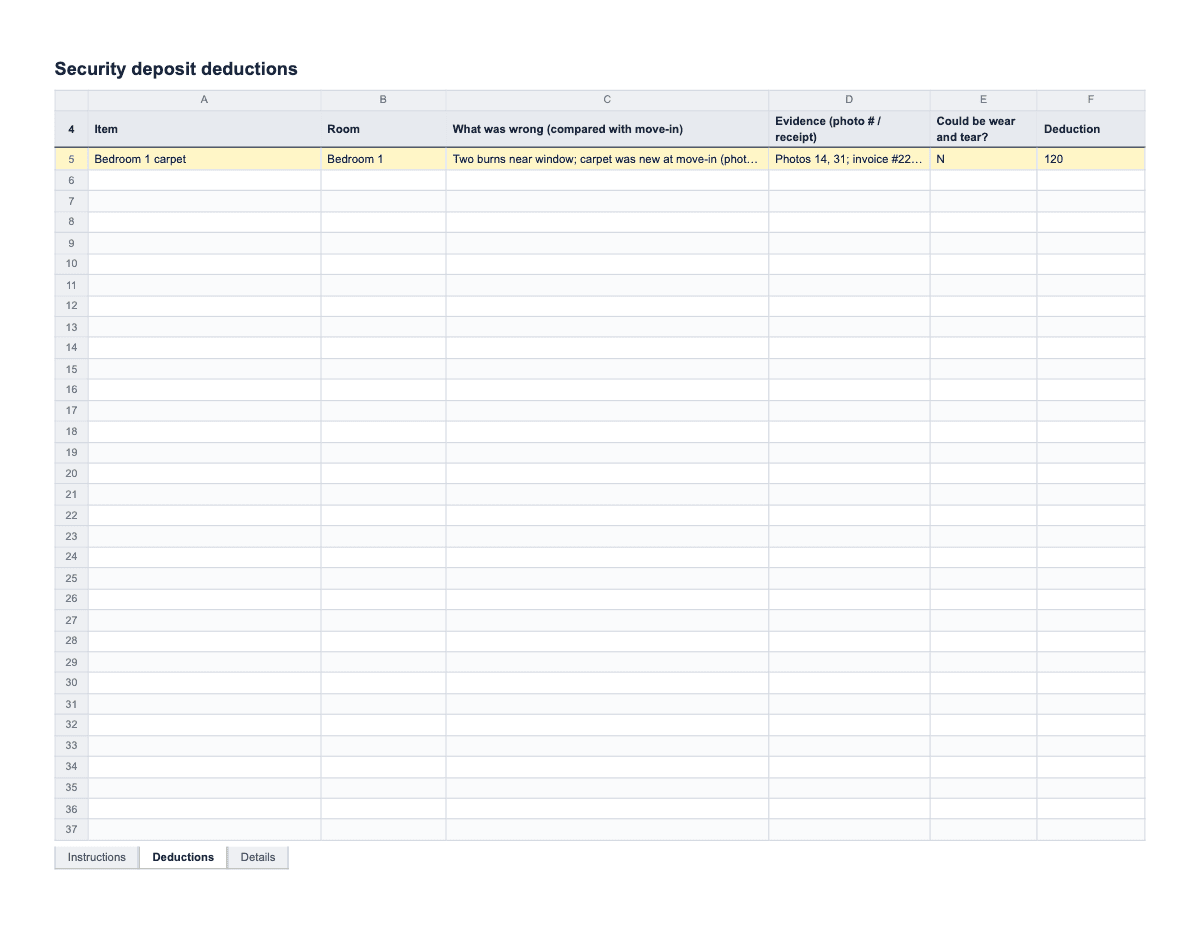
- On the Deductions tab, delete the EXAMPLE row. Add one row per item, with the room and what was wrong compared with the move-in photos and checklist.
- In the Evidence column, give the before and after photo numbers and the invoice or receipt number. For work you did yourself, add the hours and your hourly rate, for example "3 h at $45, photos 18–21".
- Set "Could be wear and tear?" honestly. Rows marked Y turn amber. In California, rewrite those with evidence that the damage goes beyond ordinary use, or delete them.
- Check the total deductions and the refund due at the top of the sheet.
- Open the Word letter. Copy each row into the itemized table, then fill in the totals table. Change the enclosure line to say receipts and photos are enclosed, unless your deductions total $125 or less.
- Send the letter and refund by the "Return or itemize by" date. Keep a copy of everything you sent and proof of when it went.
Questions
- How long does a California landlord have to return a security deposit?
- 21 days after the tenant moves out, for both the itemized statement and the refund of any balance. Count from the actual move-out day, not the lease end date.
- Do I have to include receipts with the itemized statement?
- Yes, copies of bills, invoices or receipts go with the statement, plus hours and hourly rate for work you did yourself. The exception is when repair and cleaning deductions total $125 or less; the tenant can still ask for the receipts then.
- Can I charge for repainting after a long tenancy?
- Not for ordinary wear and tear, which California excludes. Paint that has simply aged usually falls into that category in practice. Marks, holes or unapproved colors are a different matter, if your photos show them.
- Do I need move-in photos to make deductions?
- For tenancies starting on or after 1 July 2025, photos at or just before move-in are required, along with move-out photos and before-and-after photos of deducted repairs. Earlier tenancies still benefit from any photos you have.
- What if my city has its own deposit rules?
- Some California cities have their own rental ordinances, and they can be stricter than the state. This page covers the state statute only. Check your city’s rules before you send the letter.