Illinois Security Deposit Return: Deductions and Letter
Illinois gives you two deadlines for one deposit, which is one more than most people want. According to the Illinois Attorney General, in buildings with five or more units you must return the deposit within 45 days of move-out, or, if you are keeping any part of it, send an itemized statement of damages with paid receipts within 30 days.
Everything on this page comes from the Attorney General’s landlord and tenant summary, which describes the Security Deposit Return Act (765 ILCS 710) and the Security Deposit Interest Act (765 ILCS 715). Read the statute text itself before relying on a detail. Chicago’s Residential Landlord and Tenant Ordinance (RLTO) is stricter and is not covered here. None of this is legal advice.
The file itself is the same in every state: Security Deposit Deduction Sheet and Return Letter. This page covers what is different in Illinois.
What the rules say
Illinois: in buildings with five or more units, return the deposit within 45 days of move-out, or send an itemized statement of damages with paid receipts within 30 days if keeping any part (Security Deposit Return Act, per the Illinois Attorney General).
Source: Illinois Attorney General, Landlord and Tenant Rights and Laws (765 ILCS 710)Being reviewed
Illinois: the Attorney General says there is no statewide legal limit on the size of a security deposit.
Source: Illinois Attorney General, Landlord and Tenant Rights and LawsBeing reviewed
Illinois: a landlord who violates the Security Deposit Return Act may owe two times the deposit plus court costs and attorney’s fees (per the Illinois Attorney General).
Source: Illinois Attorney General, Landlord and Tenant Rights and Laws (765 ILCS 710)Being reviewed
Illinois: landlords of buildings with 25 or more units must pay interest on deposits held six months or more, every 12 months (Security Deposit Interest Act, per the Illinois Attorney General).
Source: Illinois Attorney General, Landlord and Tenant Rights and Laws (765 ILCS 715)Being reviewed
A security deposit you plan to return is not income when you receive it. Any part you keep because the tenant broke the lease is income in the year you keep it (IRS Publication 527).
Source: IRS Publication 527, Rental IncomeBeing reviewed
Last reviewed September 29, 2026. We link to official sources; your local rules may differ, so check them.
Which landlords the Illinois rules cover
The return deadlines described by the Attorney General apply to buildings with five or more units. If you own a duplex, a three-flat or a single rented house, this page doesn’t tell you what applies; check the Act and any local ordinance for your town.
A word on sources. The Attorney General fact sheet is dated January 2024, and the state legislature’s website could not be reached when this page was researched. That is a good reason to open the current statute text on ilga.gov and confirm each number yourself.
Chicago is the big exception. Its RLTO has stricter rules than the state, and a Chicago owner should read the ordinance rather than this page. Other Illinois municipalities may have their own rules too.
30 days or 45 days: which clock you’re on
- Refunding in full: according to the Attorney General, the whole deposit goes back within 45 days of the tenant moving out.
- Keeping something for damage: the itemized statement of damages, with paid receipts, is due within 30 days. The shorter clock is the one that applies once you plan to deduct.
That order matters. It is easy to assume you have 45 days and find on day 31 that the deduction route closed a day earlier. Decide within the first week or so whether you are deducting, and work to 30 days if there is any chance you will.
Receipts are the awkward part. The statement is supposed to include paid receipts, so line up repairs quickly enough that the bills are actually paid before day 30. A contractor who invoices slowly can put the deduction at risk. How the Act treats repairs that can’t be finished in time is not covered by the Attorney General summary we rely on, so read the statute if that happens.
Damage versus ordinary use
The Attorney General summary we rely on talks about damages without listing what counts. In everyday practice, the dividing line is between harm and age. Sun-faded curtains, a dishwasher rack that has rusted slowly and grout that has darkened over years are aging. A shattered shower door, a gouged hardwood floor or a missing smoke detector are harm. The table shows how the owner of a six-unit downstate walk-up might record a few charges; the figures are invented.
| Item | Room | Evidence | Deduction |
|---|---|---|---|
| Drywall patch and repaint, fist-sized hole | Hallway | Photos 7, 19; paid receipt #0415 | $185 |
| Replacement window screen, torn frame | Bedroom 2 | Photo 23; hardware store receipt | $42 |
| Refrigerator shelf, cracked glass | Kitchen | Photo 11; parts order, paid | $58 |
| Faded paint near window | Living room | Marked wear and tear: not charged | $0 |
Interest on deposits in larger buildings
Landlords of buildings with 25 or more units must pay interest on deposits held six months or more, every 12 months, according to the Attorney General. The summary behind this page doesn’t give the rate, so look it up in the Security Deposit Interest Act before calculating.
If the rule applies to you, the interest due at move-out goes in the "Interest owed" row on the Details tab and shows up in the refund. Small landlords below 25 units generally enter 0 there, unless Chicago or another local rule says otherwise.
Deposit size and the double-deposit penalty
The Attorney General says there is no statewide legal limit on how large a security deposit can be. Local rules can still restrict it, so check if you rent in a city with its own ordinance.
A landlord who violates the Security Deposit Return Act may owe two times the deposit plus court costs and attorney’s fees. On a $1,500 deposit, a mistake could therefore cost $3,000, with court costs and fees on top.
The deduction itself has a tax angle: an amount you keep for a broken lease is income in the year you keep it. Log it in the rental income and expense tracker.
Filling in the kit for an Illinois move-out
- Open the Excel workbook. On Details, enter tenant names, the building and unit, the deposit held and, for buildings of 25 units or more, the interest owed.
- Enter the move-out date. For the days allowed, type 30 if you might deduct anything, or 45 if you are certain the full amount is going back.
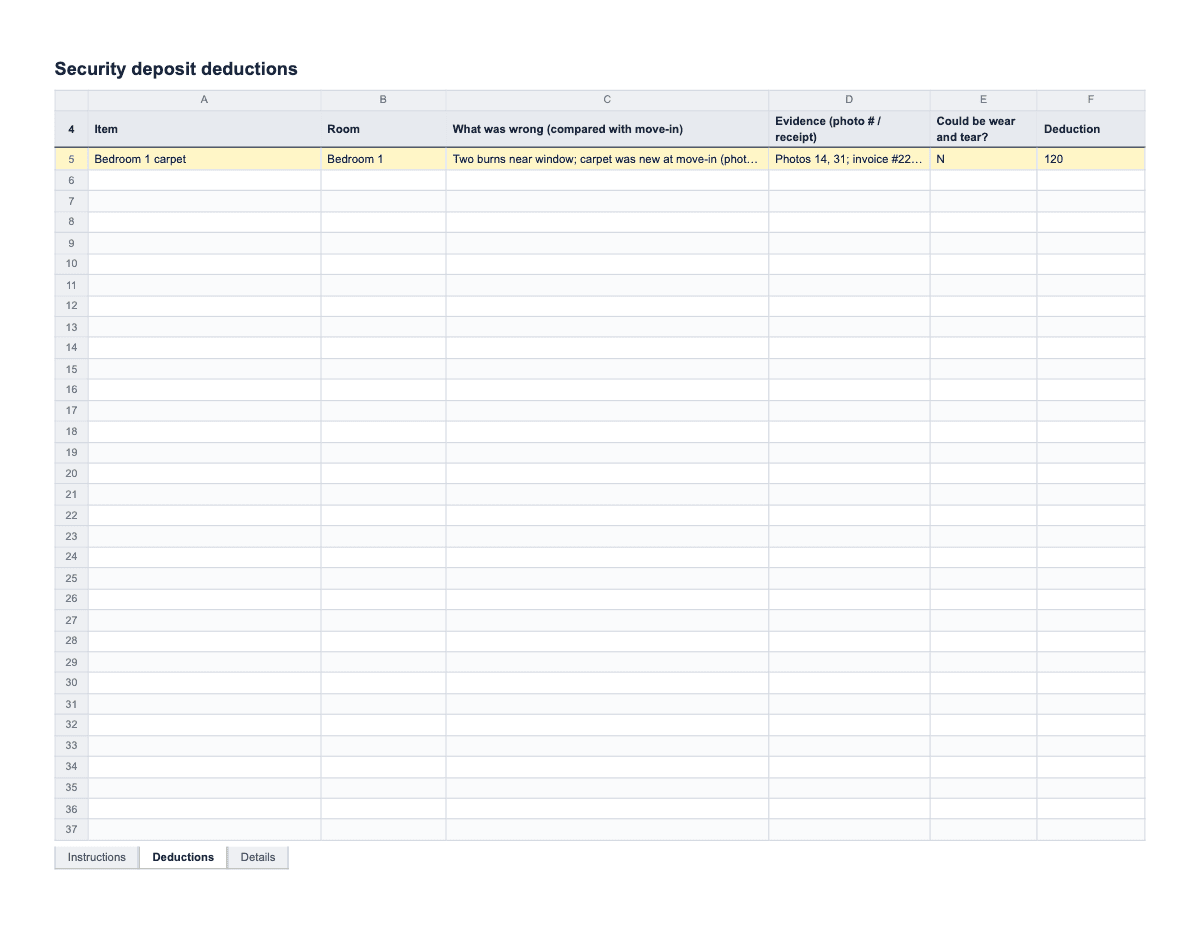
- On Deductions, delete the EXAMPLE row. Give each damaged item a line: the room, what changed since move-in, and the cost.
- Use the Evidence column for the paid receipt or invoice number and the photo numbers from your inspection checklist. An unpaid estimate is not a paid receipt.
- Treat amber rows (marked as possible wear and tear) as questions. If you can’t explain why the damage goes beyond normal use, drop the charge.
- Copy the rows into the Word letter. In Illinois, change the enclosure line to say copies of paid receipts are enclosed, and attach them.
- Mail or deliver the statement before day 30. Keep a copy with the proof of sending, together with the lease and inspection records.
Questions
- How long does an Illinois landlord have to return a deposit?
- According to the Illinois Attorney General, in buildings with five or more units: 45 days to return it in full, or 30 days to send an itemized statement of damages with paid receipts if you keep any part.
- Do Illinois landlords have to pay interest on security deposits?
- The Attorney General says landlords of buildings with 25 or more units must pay interest on deposits held six months or more, every 12 months. Check the Act for the rate. In Chicago, read the RLTO as well.
- Is there a maximum security deposit in Illinois?
- The Attorney General says there is no statewide limit. A city or village can still have its own rules, so check locally.
- Does this page apply to a Chicago apartment?
- Not fully. Chicago’s RLTO is stricter than the state rules described here, and this page doesn’t cover it. Read the ordinance itself before you prepare the statement.
- I own a four-unit building. Which deadline applies?
- The deadlines on this page are for buildings with five or more units. The Attorney General summary we use doesn’t cover smaller buildings, so read the Security Deposit Return Act and your local ordinance.