Allergen Matrix Template for the 9 Major Allergens
Every dish on one grid against the 9 major food allergens, with a may-contain mark and notes. Excel for editing, PDF for the wall.
- Excel
- PDF · Letter
- Works in Google Sheets
Included in The Kitchen Log Kit ($24), with 8 other files.
Instant download. One payment. 14-day refunds.
What this is for
A server gets asked "is there sesame in the burger?" on a Saturday night. The honest answer lives in three places: the recipe, the label on the bun bag, and the head of whoever did the prep that morning. Walking back to the line to ask is slow, and guessing is how people end up in the hospital. An allergen matrix puts every dish on one grid against the 9 major food allergens the FDA recognizes, so anyone on shift can look it up in ten seconds and give the same answer the chef would.
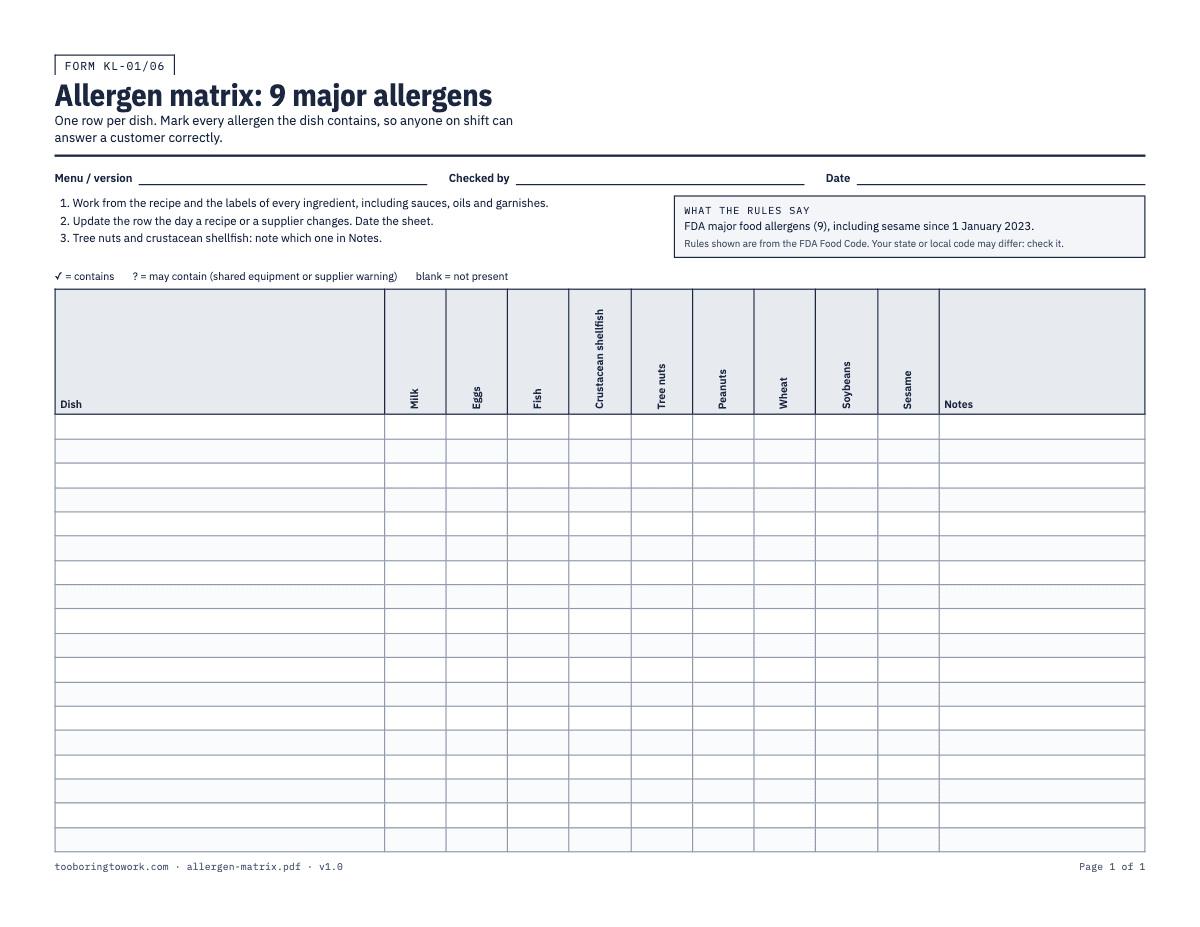
The grid has a row for each dish and a column for each allergen: milk, eggs, fish, crustacean shellfish, tree nuts, peanuts, wheat, soybeans and sesame. Sesame is the newest of the nine, added from 1 January 2023, and it is the one most often missing from older charts. Each cell is ✓ for "contains", ? for "may contain" (a shared fryer, a supplier warning on the label) or blank for "not present". A Notes column at the end is for detail the grid cannot hold: which tree nut, which shellfish, or "can be made without the aioli". At the top are boxes for the menu or version, who checked it and the date.
The Excel file is where you build and maintain it. The Matrix tab has a ✓/? dropdown in every allergen cell, and ✓ cells turn red so the grid can be read at arm's length. A Count column adds up the ✓ marks for each dish, and a Last checked date sits at the end of the row. Print the tab, or the letter-size PDF, for the kitchen and the host stand.
How to fill it in
- List every item on the menu in the Dish column, one per row, including sides, sauces served on the side, desserts, kids' dishes and specials. If a sauce goes on several dishes, some kitchens give it its own row as well, so it only has to be worked out once.
- Work through each dish from the recipe card, ingredient by ingredient, with the product labels in front of you. Go further than the obvious ones: the marinade, the dressing, the oil it is cooked in, the butter it is finished with, the bun, the garnish. Read both the "Contains" line, where there is one, and the full ingredient list.
- Mark ✓ in the column for every allergen the dish contains. In the Excel file, pick it from the dropdown; the cell turns red. Watch for the ones that hide: Worcestershire sauce and Caesar dressing usually contain anchovy (fish), soy sauce usually contains wheat as well as soy, pesto may contain pine nuts or other tree nuts plus cheese, and many buns and crackers carry sesame.
- Mark ? where the allergen is not an ingredient but could get in: fries cooked in the same fryer as breaded shrimp, a "may contain peanuts" warning on the chocolate, a shared slicer for cheese and deli meat. Be honest about the fryer. It is the most common cross-contact point on a line.
- For tree nuts and crustacean shellfish, write which one in Notes ("almond", "shrimp"). A guest allergic to walnuts may eat almonds, and they will ask. Use Notes as well for substitutions the kitchen can reliably do.
- Look at the Count column. A dish showing 0 is either genuinely free of all nine or has not been checked properly. Go back and confirm the zeros; they are the ones staff will lean on hardest.
- Fill in Menu / version, Checked by and the Date at the top of the printed copy, and the Last checked date on each row in Excel. Delete the EXAMPLE row (the Chicken Caesar salad) before you print.
- Update the row the day a recipe changes or a supplier sends a substitute brand. That is when matrices go wrong. Checking labels at the back door on the receiving log catches most substitutions before they reach the line.
- Make sure every server and cook knows where the matrix is and has been shown how to read it, and record that on the food safety training record. A chart nobody has looked at does not answer questions.
A filled-in example
| Dish | Milk | Eggs | Fish | Crust. shellfish | Tree nuts | Peanuts | Wheat | Soybeans | Sesame | Count | Notes |
|---|---|---|---|---|---|---|---|---|---|---|---|
| Chicken Caesar salad | ✓ | ✓ | ✓ | ✓ | 4 | Fish: anchovy in dressing. Wheat: croutons. Can be made without croutons. | |||||
| Cheeseburger | ✓ | ✓ | ✓ | ✓ | ✓ | 5 | Sesame: bun. Eggs: burger sauce. Soy: bun. | ||||
| Fries | ? | 0 | Shared fryer with breaded shrimp. | ||||||||
| Pesto pasta | ✓ | ✓ | ✓ | ✓ | 4 | Tree nuts: pine nuts in pesto. Eggs: fresh pasta. | |||||
| Chocolate brownie | ✓ | ✓ | ? | ✓ | ✓ | 4 | Peanuts: supplier label says may contain. |
Common mistakes
- Working from memory instead of labels. The bun you bought last year did not have sesame; the one the supplier switched you to in March might. Every ✓ should trace back to a recipe card or a label.
- Forgetting the fryer. A dish with no allergens of its own can still pick them up from shared oil, and "no shellfish" on fries cooked with shrimp is a wrong answer.
- Letting specials go on the menu without a row. They change most often and they are the dishes staff know least about.
- Putting the matrix up once and never updating it. An out-of-date chart is worse than none, because people trust it. Date every copy and reprint when anything changes.
- Leaving tree nuts or shellfish as a bare ✓. The guest will ask which one, and the server will have to walk to the kitchen anyway.
What the rules say
The FDA recognizes 9 major food allergens: milk, eggs, fish, crustacean shellfish, tree nuts, peanuts, wheat, soybeans and sesame. Sesame was added by the FASTER Act, effective 1 January 2023.
Source: FDA, Food AllergiesBeing reviewed
States and local agencies adopt different editions of the FDA Food Code, so the exact rules that apply depend on your state or local health code.
Source: FDA, Adoption of the FDA Food Code by State and Territorial AgenciesBeing reviewed
Last reviewed September 29, 2026. We link to official sources; your local rules may differ, so check them.
Questions
- What are the 9 major food allergens?
- The FDA recognizes nine major food allergens: milk, eggs, fish, crustacean shellfish, tree nuts, peanuts, wheat, soybeans and sesame. Sesame was added by the FASTER Act and took effect on 1 January 2023, which is why older eight-allergen charts are missing a column.
- Do restaurants have to have an allergen chart?
- Rules on allergen notices, menu statements and staff training for restaurants are set at state and local level, and states adopt different Food Code editions, so ask your health department what applies to you. Even where a chart is not required, it is the fastest way for staff to give guests a consistent answer.
- What does "may contain" mean on an allergen matrix?
- On this matrix, ? means the allergen is not an ingredient but could be present: a shared fryer, a shared cutting board or slicer, or a precautionary warning on a supplier's label. It tells a guest with a severe allergy that the dish is a risk even though the recipe does not list it.
- How do I make an allergen chart for my menu?
- Start with a list of every dish, then go through each recipe and every product label used in it, marking each of the nine allergens it contains. Add "may contain" marks for shared equipment and label warnings, and note which tree nut or shellfish. Have a second person check it, date it, and update it whenever a recipe or supplier changes.
- What does the Count column do in the Excel file?
- It counts the ✓ marks in each row. Its main use is catching the zeros: a dish with a count of 0 is either free of all nine allergens or has not been filled in, and those are worth double-checking. ? marks are not counted, so a dish with only may-contain marks still shows 0.
- Should the allergen matrix be at front of house or in the kitchen?
- Both. Servers need it at the host stand or the POS to answer guests, and the kitchen needs it at the pass so a ticket marked "allergy" can be checked against it. The opening checklist has a line for confirming each morning that the current version is up to date and at the pass.