Fridge and Freezer Temperature Log
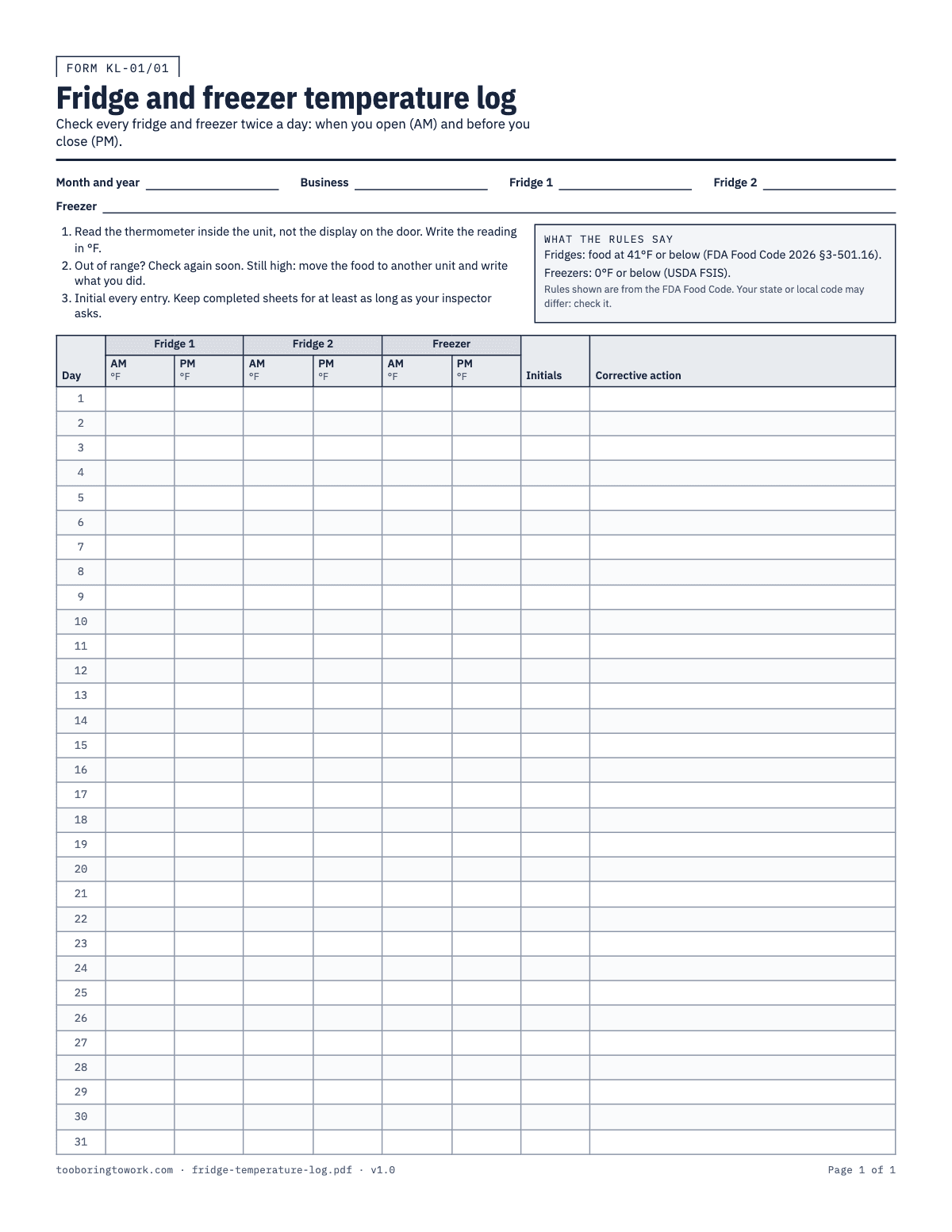
One month per page for two fridges and a freezer: morning and evening readings, initials and a corrective action column.
- PDF · Letter
- Excel
- Works in Google Sheets
Free · PDF + Excel
What this is for
A fridge that drifts warm doesn't announce itself. Food looks the same at 45°F as it does at 38°F, and nobody notices until an inspector opens the door with a thermometer, or a tub of chicken salad turns a day early. Writing the temperature down twice a day is the cheapest way to catch the drift while it is still a worn door seal or a blocked fan, not a fridge full of food you have to throw away.
This log gives each month its own page. There are columns for two fridges and a freezer, a morning and an evening reading for each, initials for whoever took the reading, and a corrective action column for the days something was wrong. Inspectors generally want to see three things: that you check, that you notice when a reading is out of range, and what you did about it. The sheet is laid out around exactly those three.
The Excel version does the same job for kitchens with more units. You list each fridge and freezer once on the Units tab, pick the unit from a dropdown on the Log tab, and the Status column flags any reading above the limit, so a bad number can’t sit unnoticed in row 214.
How to fill it in
- Print one page per month and clip it next to the unit, or on the wall by the walk-in. Fill in the month, your business name and what you call each unit ("reach-in by the grill", "walk-in") in the boxes at the top.
- Read the temperature from a thermometer inside the unit, not the display on the door. The display measures air near its own sensor. A hanging thermometer on the middle shelf, or a probe in a glass of water kept in the fridge, tells you what the food is actually sitting in.
- Take the AM reading when you open, before the doors have been opened much. Take the PM reading before you close. Write the actual number in °F: no ranges, no ticks, no "OK".
- Compare each reading with the limits printed at the top of the sheet: 41°F or below for fridges and 0°F or below for freezers.
- If a reading is high, check it again with a second thermometer. Still high: move the high-risk food to another unit, check the door seal and the fan, and write what you did, and when, in the corrective action column.
- Initial every entry. A reading with no initials is hard to stand behind, because nobody can say who took it.
- At the end of the month, file the sheet behind the others, in order. Inspectors often ask to see one particular week, and a folder in date order answers that in seconds.
- Once a month, check the thermometers themselves. A thermometer that reads two degrees low makes every line on this sheet wrong in the same direction; the thermometer calibration log covers the ice-water check.
A filled-in example
| Day | Fridge 1 AM | Fridge 1 PM | Fridge 2 AM | Fridge 2 PM | Freezer AM | Freezer PM | Initials | Corrective action |
|---|---|---|---|---|---|---|---|---|
| 1 | 37 | 39 | 36 | 38 | -2 | -1 | JM | |
| 2 | 37 | 38 | 36 | 37 | -3 | -1 | JM | |
| 3 | 38 | 40 | 37 | 38 | -2 | 0 | AR | |
| 4 | 38 | 46 | 37 | 39 | -2 | -1 | AR | Door left ajar after delivery. Closed it, rechecked 40°F at 9:40 pm. Moved dairy to Fridge 2. |
| 5 | 37 | 39 | 36 | 38 | -3 | -2 | JM | Door gasket replaced, 10 am. |
Common mistakes
- Writing the reading before looking at the thermometer. A column of identical numbers, all 38, all in the same pen, is the first thing an inspector notices.
- Reading the door display instead of a thermometer inside the unit. Displays often sit near the coldest air and hide a warm top shelf.
- Leaving the corrective action column empty after a high reading. A bad number with nothing next to it looks like nobody noticed.
- Filling in the whole week on Friday from memory. A missed day, marked as missed with a short note, is more believable than a perfect week written in one sitting.
- Taking the AM reading straight after a delivery has gone in, when the fridge is always warm. Pick a consistent time and stick to it.
What the rules say
Cold-held TCS food must be kept at 41°F (5°C) or below (Food Code 2026 §3-501.16(A)(2)).
Source: FDA Food Code 2026, §3-501.16(A)(2)Being reviewed
USDA advises keeping freezers at 0°F (-18°C) or below; food kept constantly at 0°F stays safe.
Source: USDA FSIS, Freezing and Food SafetyBeing reviewed
Food thermometers scaled only in Fahrenheit must be accurate to ±2°F; those scaled in Celsius, or both, to ±1°C (Food Code 2026 §4-203.11).
Source: FDA Food Code 2026, §4-203.11Being reviewed
States and local agencies adopt different editions of the FDA Food Code, so the exact rules that apply depend on your state or local health code.
Source: FDA, Adoption of the FDA Food Code by State and Territorial AgenciesBeing reviewed
Last reviewed September 29, 2026. We link to official sources; your local rules may differ, so check them.
Questions
- What temperature should a commercial fridge be?
- The FDA Food Code says cold-held food must be kept at 41°F or below. Many kitchens set their fridges a few degrees colder than that, so opening the door during service doesn’t push the food over the limit. Your state or local code is the one that applies, and states adopt different Food Code editions, so check it.
- How often should I check fridge temperatures?
- Twice a day, at opening and before closing, is a common routine, and it is what this sheet is laid out for. Your health department may expect more, especially for units that are opened constantly during service, so ask what they want to see.
- How long should I keep temperature logs?
- That is set by your state or local health department, and by your HACCP plan if you have one. Ask your inspector. If nobody has given you a number, keeping a full year of sheets in date order means you can answer questions about any recent week.
- Can I use the Excel version instead of paper?
- Yes, as long as the readings are entered when they are taken and an inspector can see them on the spot, on a screen or printed. The Excel file flags high readings in the Status column and works in Google Sheets. Some kitchens use paper at the unit and type the readings in weekly; if you do that, keep the paper.
- Where should the thermometer go inside the fridge?
- Somewhere that reflects what the food experiences: the middle of a middle shelf, away from the fan and the door. Walk-ins have warm spots near the door and cold spots under the evaporator, so a thermometer hung right under the fan will flatter you. If you are not sure, put two thermometers in for a week, top and bottom, and use the warmer spot from then on.
- What should I do if the freezer reads above 0°F?
- USDA advises keeping freezers at 0°F or below. A reading just above that during a defrost cycle or after a delivery often comes back down, so check again later and note it. If food has started to soften or thaw, follow your corrective action plan and write down what you did with it.