Restaurant Opening and Closing Checklists
Two one-page weekly checklists: what to check before the first prep of the day and before the last person locks up.
- PDF · Letter
Included in The Kitchen Log Kit ($24), with 8 other files.
Instant download. One payment. 14-day refunds.
What this is for
The first and last half hour of the day are when a kitchen is least supervised. The opener is often alone, half awake, with a delivery due and the prep list waiting. The closer has been on their feet for ten hours and wants to go home. That is when the walk-in door gets left cracked, the handwash sink goes without paper towels until someone complains, and the sanitizer bucket from last night gets used again at 7 am. A restaurant opening and closing checklist does not make anyone less tired. It just puts the same short list in front of them every day, in the same order, so nothing depends on who is on.
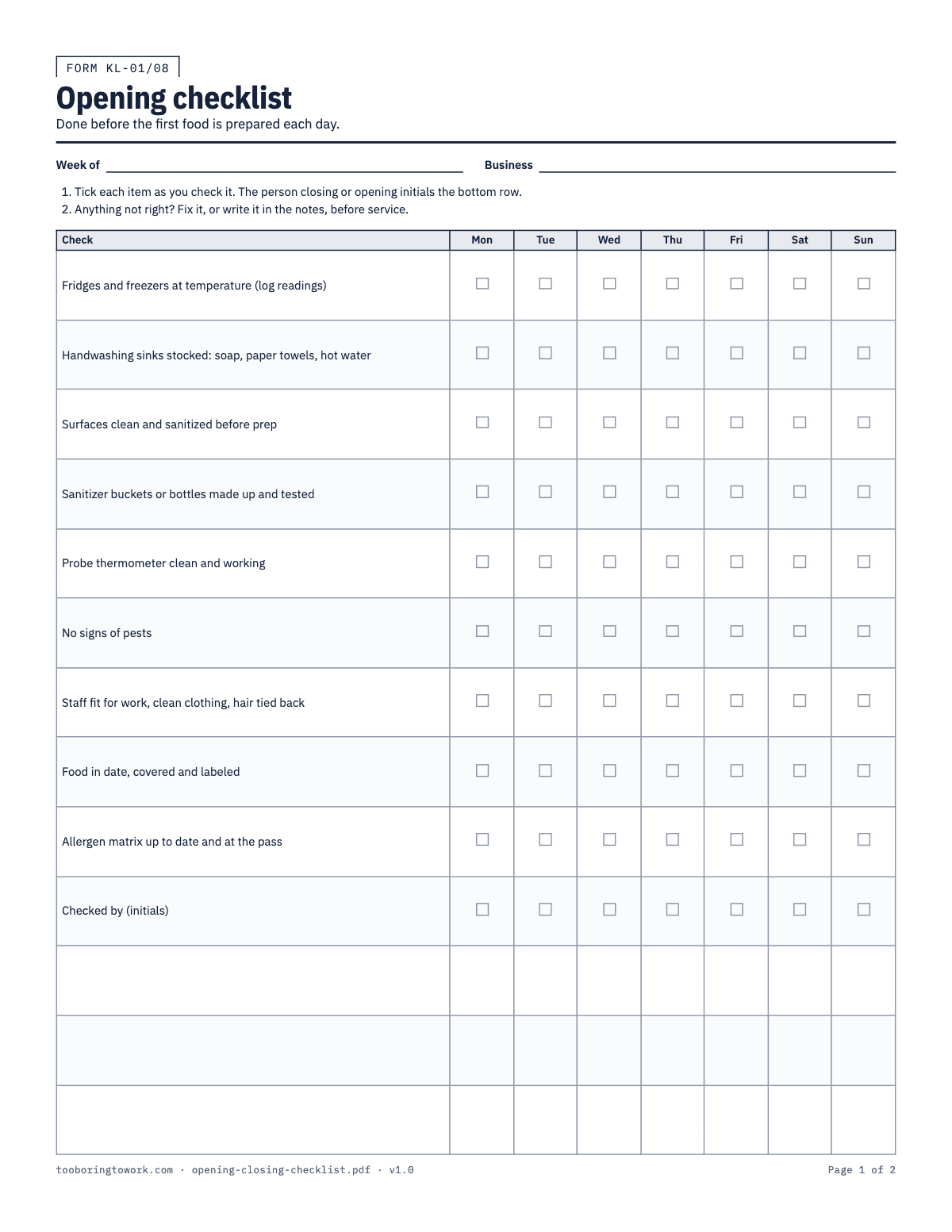
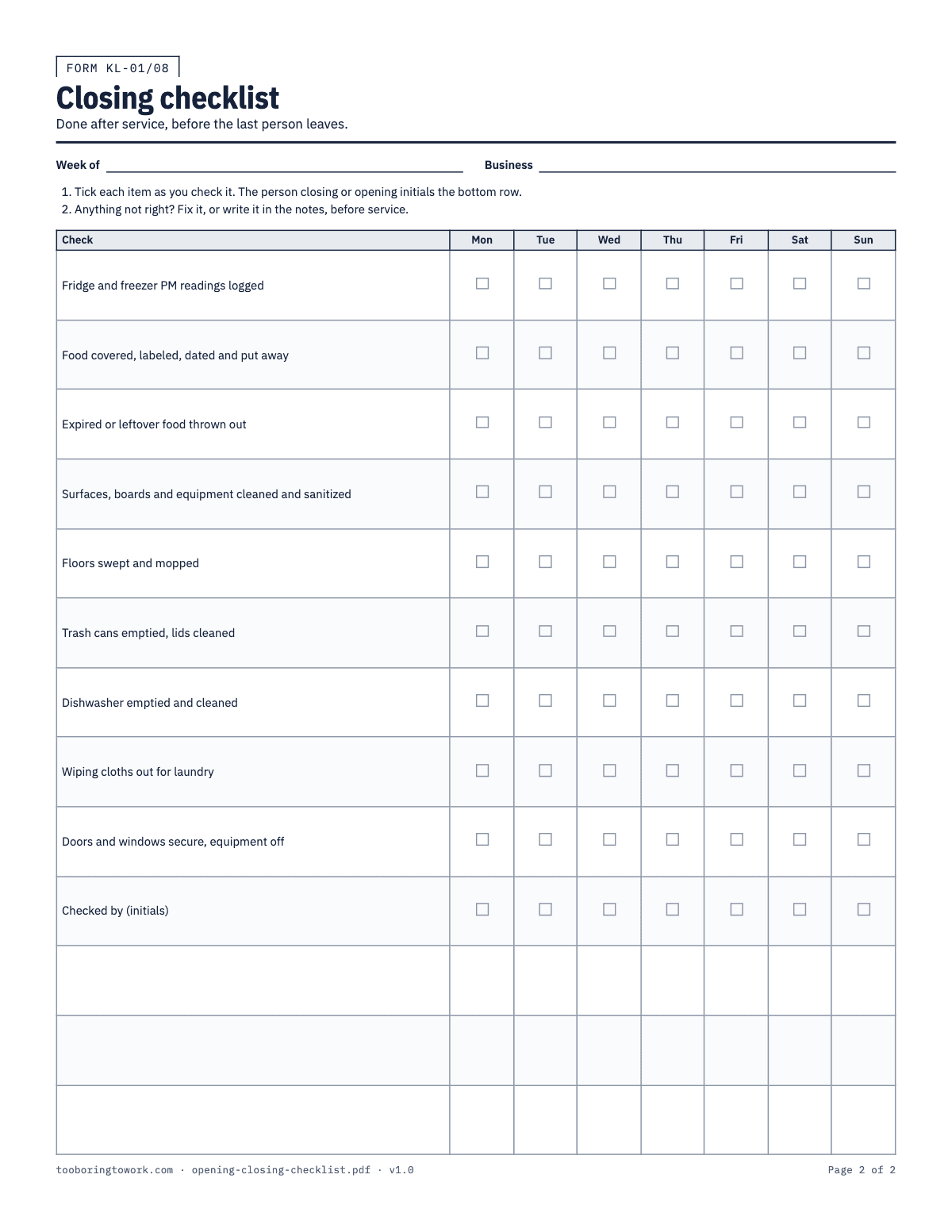
The file is two portrait letter pages, one for opening and one for closing, each covering one week. Each page has a Check column with nine printed items and a tick box for every day, Monday to Sunday. The opening page covers fridge and freezer temperatures, handwash stations, clean and sanitized surfaces, sanitizer made up and tested, a working probe thermometer, signs of pests, staff fit for work, food in date and labeled, and the allergen matrix at the pass. The closing page covers the PM fridge readings, food put away, leftovers and out-of-date food thrown out, surfaces and equipment cleaned, floors, trash, the dish machine, cloths for laundry and lock-up. A "Checked by (initials)" row at the bottom of each day's column shows who did it, and three blank rows take your own checks.
There is no Excel version. Both lists are meant to be ticked on the wall, in the moment, by whoever is holding the keys.
How to fill it in
- Print both pages on Monday and put them where the opener and closer will pass them: the back door, the office door, or next to the time clock. Fill in "Week of" and the business name.
- Add anything your kitchen needs in the three blank rows on each page. Common ones: "hood and fryers off", "gas valve closed", "walk-in door shut and latched", "alarm set", "ice machine scoop out of the ice".
- Opening: go down the list in order before the first food is prepared. Fridge and freezer readings go on the fridge temperature log as well; the checklist only confirms they were taken and were in range.
- Test the sanitizer, do not just make it up. Dip a test strip for your product into the bucket or bottle and compare it with the chart on the strip vial. Write the reading in the box if there is room, or tick only when it is in the range the label gives.
- Look at the people as well as the equipment. "Staff fit for work" means asking the opening crew whether anyone has been sick, and sending home or reassigning anyone who should not be handling food, as your policy and local code say. Clean clothes and hair tied back are checked at the same time.
- Anything not right? Fix it before service if you can. If you cannot, write it in a blank row or on the back ("prep fridge 44°F, food moved to walk-in, repair called 7:20 am") so the manager sees it.
- Closing: tick each item as you do it, not all at once at the door. Leftovers and anything past its date go in the trash, not back on the shelf for the morning to decide.
- The person opening or closing initials the "Checked by" row for that day. At the end of the week, the manager looks over both pages and files them with the week's other records. The deeper weekly and monthly jobs stay on the kitchen cleaning schedule.
A filled-in example
| Check | Mon | Tue | Wed | Thu | Fri |
|---|---|---|---|---|---|
| Fridges and freezers at temperature (log readings) | ✓ | ✓ | ✓ | ✓ | ✓ |
| Handwash basins stocked: soap, paper towels, hot water | ✓ | ✓ | ✓ | ✓ | ✓ |
| Sanitizer buckets or bottles made up and tested | ✓ | ✓ | Strip read low. Remade bucket, retested in range 6:50 am | ✓ | ✓ |
| Allergen matrix up to date and at the pass | ✓ | ✓ | ✓ | ✓ | ✓ |
| Checked by (initials) | OS | OS | HN | OS | HN |
Common mistakes
- Ticking the whole opening list from the office, before walking the kitchen. Each tick should mean someone looked at the thing, not remembered that it is usually fine.
- Making up sanitizer without testing it. Too weak does not sanitize; too strong can leave a residue on food-contact surfaces and irritate hands. The test strip takes seconds.
- Wrapping leftovers "to decide in the morning". The morning crew does not know when it was made or how it was cooled, and it ends up used or wasted on a guess.
- Leaving the closing checklist for the last person out, who then does it all at the door with their coat on. Split it: the line closes their stations, the dish crew does the dish machine, and the closer checks and initials.
- Letting the list go stale. If your kitchen now has a second walk-in or a fryer that has to be filtered every night, it goes on the sheet this week.
What the rules say
States and local agencies adopt different editions of the FDA Food Code, so the exact rules that apply depend on your state or local health code.
Source: FDA, Adoption of the FDA Food Code by State and Territorial AgenciesBeing reviewed
Last reviewed September 29, 2026. We link to official sources; your local rules may differ, so check them.
Questions
- What should be on a restaurant opening checklist?
- The checks that must be right before food is prepared: fridge and freezer temperatures, stocked handwash sinks, clean and sanitized surfaces, sanitizer made up and tested, a working thermometer, no signs of pests, staff fit for work, food in date and labeled, and the allergen matrix where staff can see it. The opening page here prints those nine and leaves space for yours.
- What should be on a kitchen closing checklist?
- Everything that makes the next morning safe: fridge readings logged, food covered, labeled, dated and put away, leftovers and out-of-date food discarded, surfaces and equipment cleaned and sanitized, floors, trash, the dish machine, cloths sent for laundry, and the building secured with equipment off. Add gas, alarm and hood items in the blank rows.
- Does the health department require opening and closing checklists?
- Usually not as a named document, and rules vary because states and localities adopt different Food Code editions. What inspectors do look at are the things on the list: temperatures, handwashing, sanitizer, storage and labeling. A signed checklist is a simple way to show those checks happen every day.
- Who should fill in the checklist?
- Whoever opens or closes that day, with their initials in the "Checked by" row. If different people do different items, that is fine, but one person should look over the finished column and initial it. A manager checking the week's sheets on Monday closes the loop.
- How do I use this with a temperature log?
- The checklist asks whether the fridge and freezer readings were taken; the readings themselves go on the fridge temperature log. The checklist is a reminder and a sign-off, the log is the record of the numbers. Keep both sheets in the same place.
- Can I change the printed checks?
- Cross out any that do not apply and use the three blank rows on each page for your own. If you find yourself crossing out and adding the same items every week, it is worth writing your own version and printing that. The point is that the list matches the kitchen in front of you.