Hot Holding Temperature Log
A day sheet for food kept hot for service: the time each item went in, four timed temperature checks and what happened to it.
- PDF · Letter
Included in The Kitchen Log Kit ($24), with 8 other files.
Instant download. One payment. 14-day refunds.
What this is for
A steam table looks like it is doing its job as long as there is steam coming off it. The water can be hot while the food in the pan is not: a well that ran low at 1 pm, a lid left off the mac and cheese, a fresh pan of rice dropped on top of the old one, a hot well switched to 4 because somebody thought the soup was catching. Food kept hot for service has to stay at 135°F or above, and the only way to know it is to put a probe in the food on a schedule and write the number down. A hot holding temperature log is that schedule on paper.
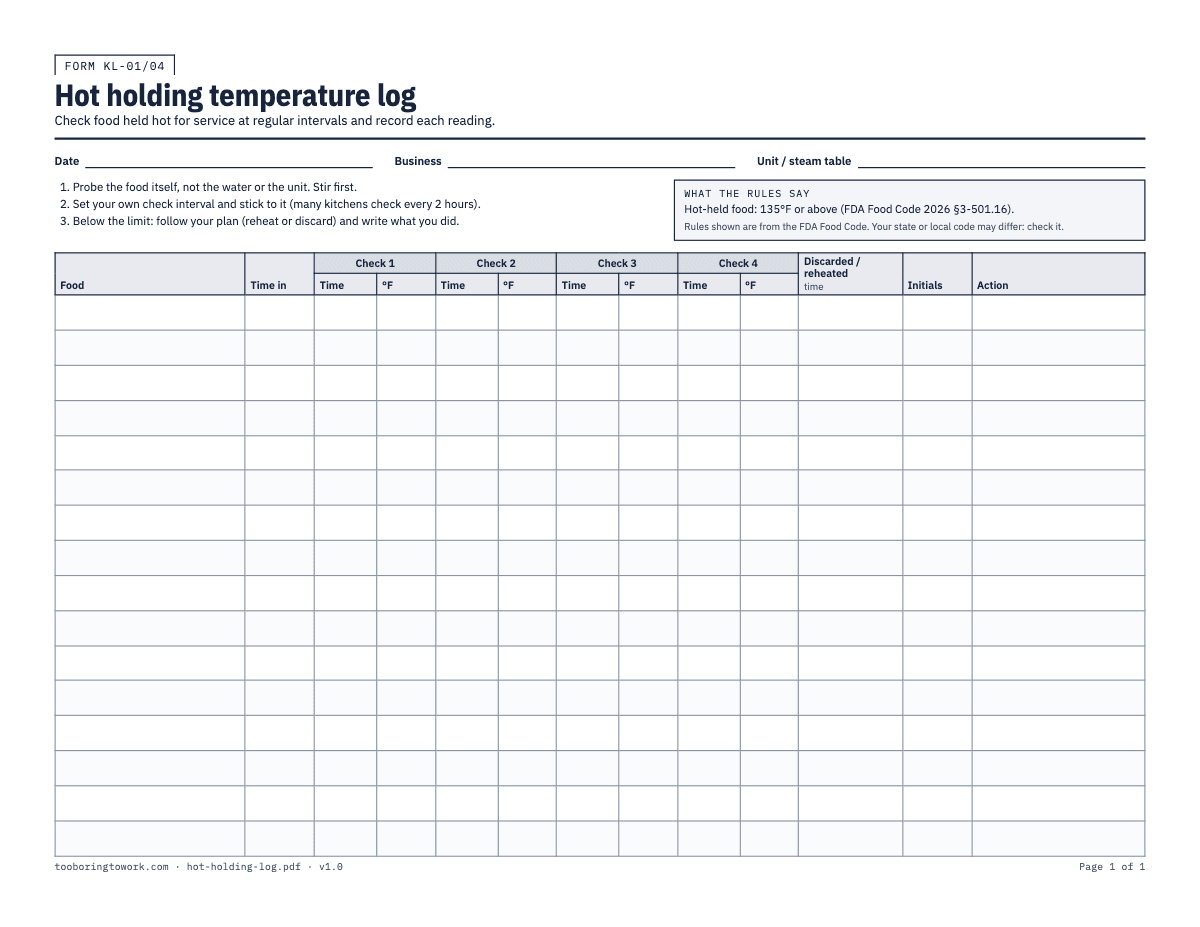
This is a day sheet, one per hot holding unit. At the top you fill in the date, the business and which unit it is (the steam table on the line, the soup well, the buffet hot wells, the holding cabinet). Each row is one food. There is a column for the time it went in, four timed checks with a time and a temperature each, a column for the time it was discarded or reheated, initials and an action column. Sixteen rows fit on a landscape letter page, which is enough for a full line with a couple of pan changes.
The rules box prints the hot holding minimum and the sheet caveat that your state or local code may differ. There is no Excel version: the readings are taken at the pass during service, and paper on a clipboard by the unit is quicker than any screen.
How to fill it in
- Start a new sheet each day for each unit. Fill in the Date, Business and Unit / bain-marie boxes. If you have two steam tables, use two sheets, so a problem can be traced to the right one.
- When a pan goes into the unit, write the Food and the Time in. Write what it is, not where it sits: "pulled pork", "black beans", "gravy", not "well 3". A pan swapped for a fresh one gets a new row.
- Only put food in that is already hot. Hot holding equipment is built to keep food hot, not to heat it up. Food that was cooked and cooled needs to reach 165°F for 15 seconds, within 2 hours on the stove or in the oven first, and that reheat belongs on the cooling log.
- Decide your check interval and stick to it. Many kitchens check every 2 hours; some check hourly on a busy line. Write the chosen interval at the top of the sheet so the next shift uses the same one.
- For each check, stir the food, then probe the center of the pan, not the edge and not the water. Write the time and the reading in °F under Check 1, then Check 2, and so on. Wipe and sanitize the probe between foods, especially between meat and anything else.
- If a reading is below 135°F, act on it before you write it down and walk away. Follow your plan, which usually means reheating it properly or throwing it out depending on how long it may have been low, then fix the cause: add water, put the lid on, turn the well up. Write what you did in Action.
- When a pan comes out, write the time in Discarded / reheated and what happened to it in Action ("end of service, discarded", "reheated to 170°F, back in"). Initial the row.
- At close, check that every row has an end time. File the sheet with the day's other logs. If the same food runs low at the same time every day, that pattern is worth sorting out with the equipment or the prep plan.
A filled-in example
| Food | Time in | Check 1 | Check 2 | Check 3 | Check 4 | Discarded / reheated | Initials | Action |
|---|---|---|---|---|---|---|---|---|
| Pulled pork | 10:45 | 11:00 / 162 | 1:00 / 158 | 3:00 / 151 | 5:00 / 149 | 8:30 | PS | End of service, discarded. |
| Black beans | 10:50 | 11:00 / 171 | 1:00 / 165 | 3:00 / 160 | 5:00 / 158 | 8:30 | PS | End of service, discarded. |
| Rice | 11:00 | 11:00 / 158 | 1:00 / 144 | 3:00 / 128 | 3:05 | PS | Water in well low, lid off. Rice discarded, well refilled, fresh pan in 3:25 (new row). | |
| Rice (fresh pan) | 3:25 | 3:25 / 172 | 5:25 / 160 | 7:25 / 152 | 8:30 | DV | Lid kept on between orders. | |
| Gravy | 11:10 | 11:10 / 180 | 1:10 / 170 | 3:10 / 166 | 5:10 / 161 | 8:30 | PS | End of service, discarded. |
Common mistakes
- Probing the water in the well, or the side of the pan, instead of the food. The water can read 180°F while the middle of a deep pan of rice is well under the limit.
- Using the steam table to reheat cold food from the walk-in. It will get there eventually, slowly, and that is the problem. Reheat on the stove or in the oven, then transfer.
- Topping up an old pan with fresh food. The row on the sheet now describes food of two different ages, and nobody knows how long the bottom layer has been there. Swap the pan and start a new row.
- Skipping the 5 pm check because it is the start of dinner service. That is exactly when pans are being opened, stirred and refilled most, and when temperatures drop.
- Writing a reading below 135°F with nothing in the Action column. An inspector reading the sheet will assume nothing was done, and they will probably be right.
What the rules say
Hot-held TCS food must be kept at 135°F (57°C) or above (Food Code 2026 §3-501.16(A)(1)).
Source: FDA Food Code 2026, §3-501.16(A)(1)Being reviewed
Food that was cooked and cooled, then reheated for hot holding, must reach at least 165°F for 15 seconds in all parts, and reheating must take no more than 2 hours (Food Code 2026 §3-403.11).
Source: FDA Food Code 2026, §3-403.11Being reviewed
States and local agencies adopt different editions of the FDA Food Code, so the exact rules that apply depend on your state or local health code.
Source: FDA, Adoption of the FDA Food Code by State and Territorial AgenciesBeing reviewed
Last reviewed September 29, 2026. We link to official sources; your local rules may differ, so check them.
Questions
- What temperature should hot food be held at?
- The FDA Food Code says hot-held TCS food must be kept at 135°F or above. Many kitchens aim a good way above that so opening lids and stirring during service does not push food under. States adopt different Food Code editions, so check the version your health department uses.
- How often should you check hot holding temperatures?
- The sheet does not fix an interval; that comes from your own procedures and whatever your local code asks for. Every 2 hours is a common routine, and it is what the four check columns are sized for across a lunch-to-dinner day. Some kitchens check every hour, which catches a problem with more time left to fix it.
- What do I do if hot held food is below 135°F?
- Follow your corrective action plan and write down what you did. Plans usually depend on how long the food may have been below the limit, which is why regular checks matter: if the last good reading was recent, you have options; if nobody knows, the safe choice is to discard it. Ask your health department what they accept.
- Can I reheat food in a steam table or hot well?
- It is not what they are built for. They are designed to hold hot food, and they heat cold food slowly. Food that was cooked and cooled should be reheated to 165°F for 15 seconds within 2 hours on equipment meant for it, then moved into the hot well.
- Where exactly should I put the thermometer?
- In the food, in the center of the pan, after stirring. For thick items like pulled pork or mashed potatoes, go to the deepest point. Use a probe thermometer that has been checked recently; the thermometer calibration log covers the ice-water check.
- Do I need a separate sheet for each hot holding unit?
- It is the clearest way to do it. The Unit / bain-marie box at the top is there so each sheet belongs to one unit, and a problem with a well or a heating element shows up as a pattern on that unit's sheet rather than scattered across one long list.