Food Cooling Log: Cooking, Cooling and Reheating
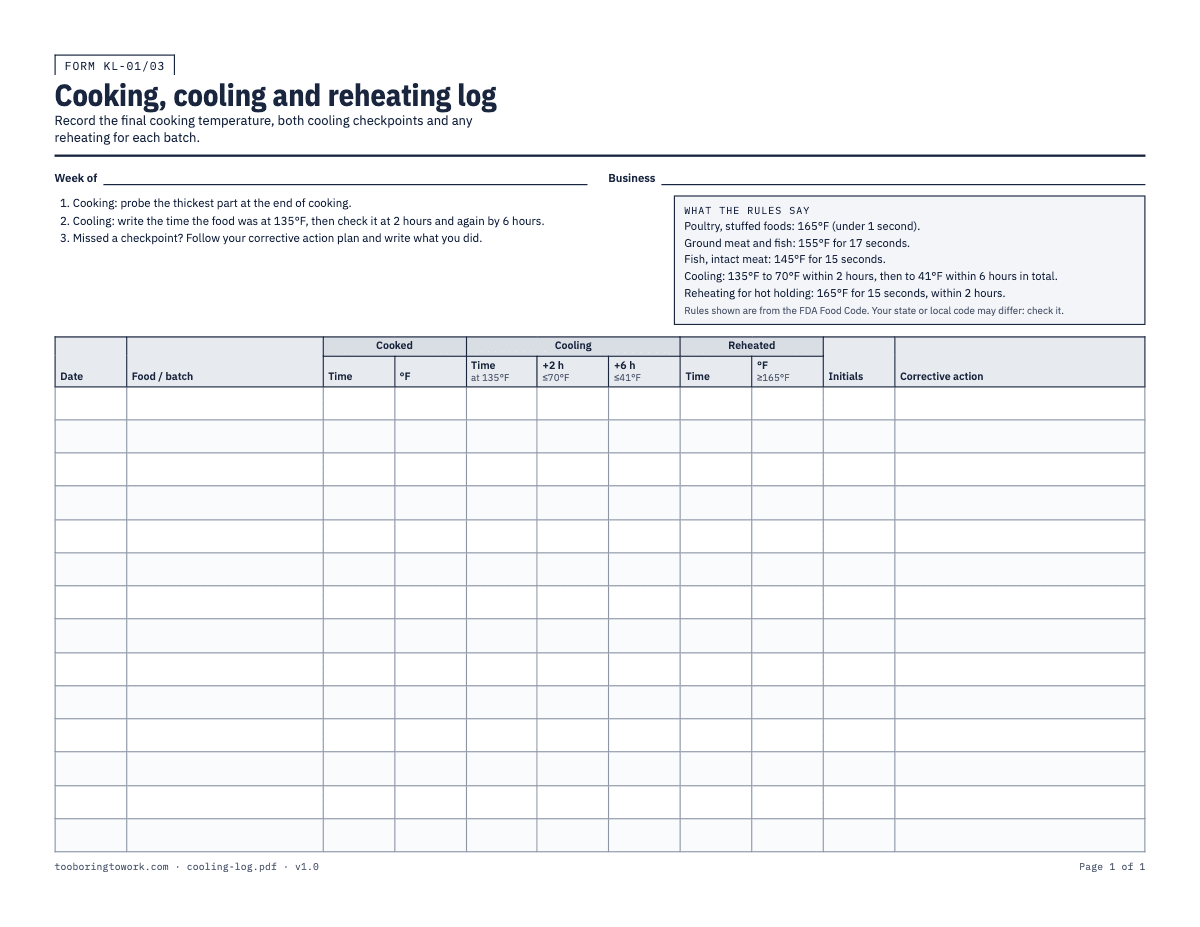
One row per batch: final cooking temperature, the 2-hour and 6-hour cooling checks, and reheating, with a corrective action column.
- PDF · Letter
Included in The Kitchen Log Kit ($24), with 8 other files.
Instant download. One payment. 14-day refunds.
What this is for
Cooling is where good food goes bad without anyone noticing. A twelve-quart stockpot of chili pushed into the walk-in at 10 pm will still be warm in the middle at breakfast, and it will look, smell and taste fine. The FDA Food Code deals with this with a two-stage rule: cooked food has to get from 135°F down to 70°F within 2 hours, and then all the way to 41°F or below within 6 hours in total. The first stage is the tight one, because the warm part of that range is where bacteria multiply quickest. A food cooling log shows the batch made both checkpoints, not just that it went in the fridge.
This sheet puts the whole life of a batch on one row: when it finished cooking and what it read, when it passed 135°F on the way down, the reading at the 2-hour checkpoint, the reading at the 6-hour checkpoint, and, if it comes back out for service, when it was reheated and how hot it got. The rules box at the top prints the cooking, cooling and reheating targets. Fourteen rows per landscape page, one page per week, and a corrective action column for the batch that did not make it.
There is no Excel version. Cooling happens at the stove and in the walk-in, and a clipboard by the reach-in is where people will actually write the numbers.
How to fill it in
- Clip a fresh sheet up at the start of each week and fill in "Week of" and the business name. Keep a pen and a clean, calibrated probe thermometer with it.
- When a batch finishes cooking, write the Date, the Food / batch (be specific: "chicken thighs, 2 hotel pans" or "black beans, 20 qt"), then the Time and the temperature under Cooked. Probe the thickest part of the meat, or the center of the pot after stirring. Check it against the rules box: 165°F for poultry, 155°F for 17 seconds for ground meat, 145°F for 15 seconds for fish and intact cuts.
- As the food comes off the heat and starts to drop, write the time it reads 135°F in the Time column under Cooling. This starts the clock, not the moment the burner went off.
- Split the batch and get it moving: shallow pans, an ice bath in the prep sink, ice wands in the stockpot, pans uncovered on the top shelf of the walk-in until cold. A deep, covered container cools slowly no matter how cold the fridge is.
- Check it before the 2-hour mark, not at it. Many cooks probe at around 90 minutes so there is still time to act. Write the reading in the +2 h column; it needs to be 70°F or below. If you are close to the limit, move the food to smaller pans or into an ice bath now.
- By 6 hours from the start time, probe again and write the reading in the +6 h column. It needs to be 41°F or below. If the batch is a night cool, somebody on the opening shift has to take this reading, so write the deadline in the Corrective action box ("6 h due 4:30 am") for them.
- If a checkpoint is missed, follow your corrective action plan and write what you did in Corrective action, with the time. Depending on your plan and your local code, that might be reheating and starting the cool again, or throwing the batch away. Ask your health department what they expect.
- When cooled food comes back out to be hot held, fill in the Reheated columns. Food that was cooked and cooled has to reach 165°F for 15 seconds, and within 2 hours. Probe the center of the pan, write the Time and the temperature, and initial the row. It then goes onto the hot holding log.
A filled-in example
| Date | Food / batch | Cooked time | Cooked °F | At 135°F | +2 h ≤70°F | +6 h ≤41°F | Reheated time | Reheated °F | Initials | Corrective action |
|---|---|---|---|---|---|---|---|---|---|---|
| 3/9 | Chicken thighs, 2 hotel pans | 10:40 | 172 | 11:05 | 64 | 38 | MB | |||
| 3/9 | Chili, 12 qt stockpot | 2:15 | 190 | 2:50 | 88 | MB | 4:20 pm: 88°F at 1 h 30. Reheated to 170°F, split into 4 shallow pans, ice bath. Restarted clock 4:45 pm. | |||
| 3/9 | Chili (restart), 4 pans | 4:45 | 61 | 39 | MB / JT | Restart from 4:45. Checked 6:20 pm and 10:30 pm. | ||||
| 3/10 | Chicken thighs (from 3/9) | 11:05 | 168 | JT | ||||||
| 3/10 | Rice, 3 sheet pans | 1:30 | 205 | 1:40 | 58 | 37 | AL | Spread thin on sheet pans, uncovered. |
Common mistakes
- Putting a lidded stockpot straight into the walk-in. The outside of the pot gets cold, the middle stays warm for hours, and the rest of the walk-in warms up with it. Portion it into shallow pans first.
- Taking the 2-hour reading late, or not at all, because service got busy. On a Friday the cooling batch is the first thing forgotten. Set a timer on the phone or the oven the moment you write the 135°F time.
- Probing only the edge of the pan. The corner of a hotel pan cools long before the center.
- Leaving the +6 h column empty for night cools. If nobody is there at 3 am, the opening cook needs to know the batch is waiting for a reading and what it read at 2 hours.
What the rules say
Cooked TCS food must cool from 135°F to 70°F within 2 hours (Food Code 2026 §3-501.14(A)(1)).
Source: FDA Food Code 2026, §3-501.14(A)(1)Being reviewed
Cooked TCS food must reach 41°F or below within 6 hours in total from 135°F, which leaves 4 more hours after it reaches 70°F (Food Code 2026 §3-501.14(A)(2)).
Source: FDA Food Code 2026, §3-501.14(A)(2)Being reviewed
Food that was cooked and cooled, then reheated for hot holding, must reach at least 165°F for 15 seconds in all parts, and reheating must take no more than 2 hours (Food Code 2026 §3-403.11).
Source: FDA Food Code 2026, §3-403.11Being reviewed
Poultry, stuffed meat, stuffed fish and stuffed pasta, and stuffing that contains meat must be cooked to 165°F (74°C) for under 1 second (Food Code 2026 §3-401.11(A)(3)).
Source: FDA Food Code 2026, §3-401.11(A)(3)Being reviewed
Ground and other non-intact meat and fish must be cooked to 155°F for 17 seconds, or an allowed alternative such as 158°F for under 1 second (Food Code 2026 §3-401.11(A)(2)).
Source: FDA Food Code 2026, §3-401.11(A)(2)Being reviewed
Fish and intact meat must be cooked to 145°F (63°C) for 15 seconds; whole roasts follow a separate time and temperature chart (Food Code 2026 §3-401.11(A)(1) and (B)).
Source: FDA Food Code 2026, §3-401.11(A)(1) and (B)Being reviewed
States and local agencies adopt different editions of the FDA Food Code, so the exact rules that apply depend on your state or local health code.
Source: FDA, Adoption of the FDA Food Code by State and Territorial AgenciesBeing reviewed
Last reviewed September 29, 2026. We link to official sources; your local rules may differ, so check them.
Questions
- What is the two-stage cooling rule?
- Under the FDA Food Code, cooked TCS food has to cool from 135°F to 70°F within 2 hours, then from 135°F to 41°F or below within 6 hours in total. That leaves up to 4 more hours after the food reaches 70°F. Your state may have adopted a different edition of the code, so check your local version.
- What happens if food does not reach 70°F in 2 hours?
- Follow your corrective action plan and write down what you did. Many kitchens reheat the batch and start cooling again with a faster method, or discard it; which options you have depends on your local code and how long the food has been cooling. Ask your health department what they accept, and write the answer into your plan.
- How often should I check temperatures while food is cooling?
- The sheet has two checkpoints, at 2 hours and 6 hours, because those are the limits. In practice, many kitchens also probe partway through the first stage, often around the hour mark, so a slow batch is caught with time to fix it.
- What temperature do you reheat food to for hot holding?
- Food that was cooked and cooled on site, then reheated to be held hot, must reach 165°F for 15 seconds in all parts, within 2 hours. Record it in the Reheated columns on this sheet. Once it is on the steam table, it needs to stay at or above the hot holding minimum.
- Do I need to log every batch I cool?
- Log every batch of TCS food you cook and cool for later: stocks, sauces, beans, rice, braises, cooked meat. It is what an inspector asks about when they see cooked food in the walk-in. If your HACCP plan or health department asks for more detail than this sheet holds, follow them.