Food Thermometer Calibration Log
Ice-water and boiling-water readings for each food thermometer, with a pass column, your local boiling point and what you did.
- PDF · Letter
Included in The Kitchen Log Kit ($24), with 8 other files.
Instant download. One payment. 14-day refunds.
What this is for
Every temperature log in the kitchen trusts one small object. If the probe in the cook's pocket reads four degrees high, the chicken that "hit 165" did not, and the cooling batch that "made 70" was warmer than the sheet says. Nothing about a drifting thermometer is visible. It happens after it gets dropped on the tile, rattled around in a drawer with the tongs, left on the flat-top for a minute, or run through the dish machine when it was never meant to be. A weak battery can do it too: some cheap digital probes read low long before the screen goes blank. The only way to catch it is to put it in something whose temperature you already know, and a thermometer calibration log is the record that you did.
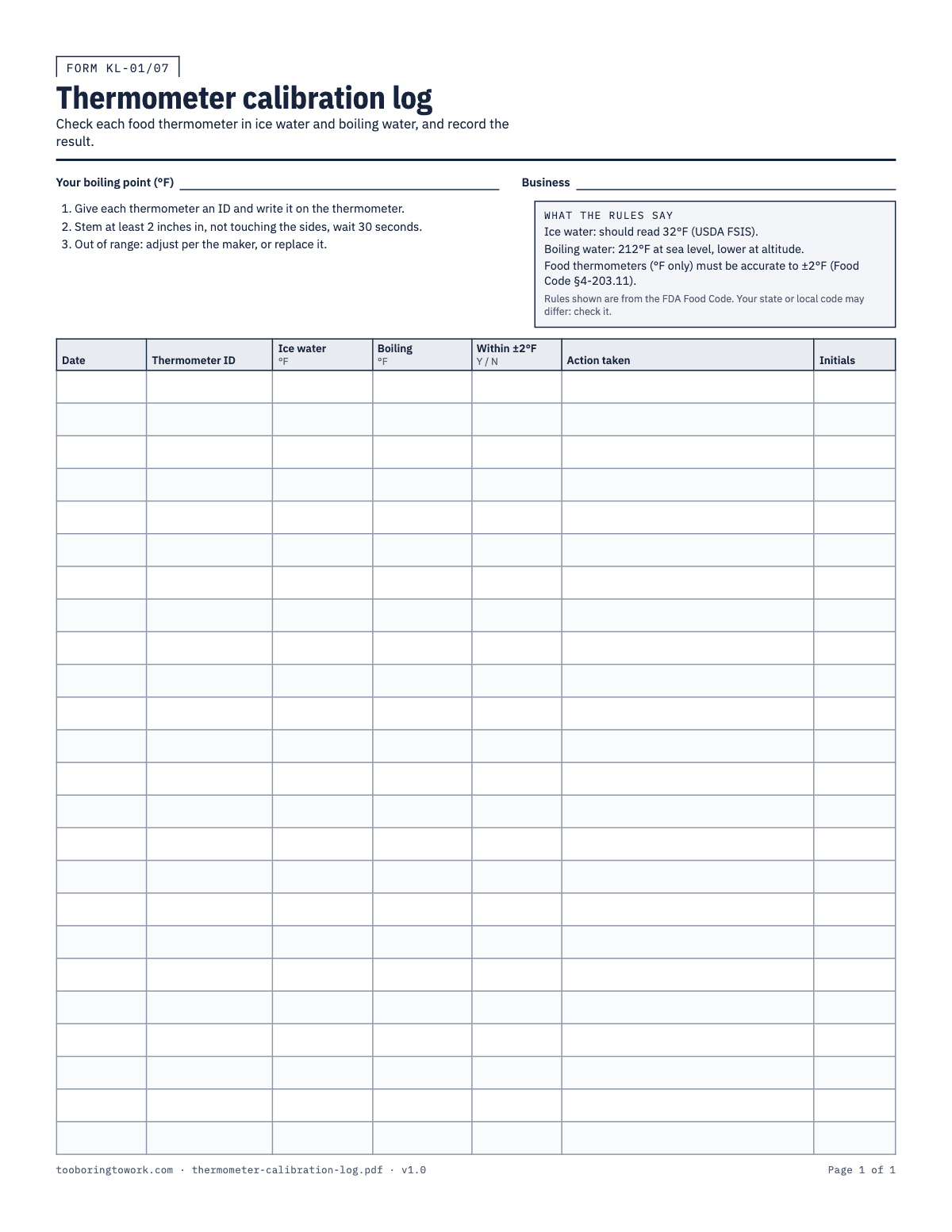
This portrait letter sheet has 24 rows, enough for several thermometers over months of checks. Each row has the Date, a Thermometer ID, the reading in Ice water and in Boiling water in °F, a Within ±2°F column (Y/N), Action taken and Initials. At the top there is a box for your business name and one for your boiling point, because water only boils at 212°F at sea level and your kitchen may not be at sea level. The rules box prints the ice-water target of 32°F and the Food Code accuracy standard: food thermometers scaled only in Fahrenheit must be accurate to ±2°F.
There is no Excel version. The whole check takes a few minutes at the prep sink, so the sheet belongs taped inside a cabinet door near the ice machine, or wherever the thermometers are kept.
How to fill it in
- Give every food thermometer an ID and write it on the thermometer itself with a marker or a label: "P1", "grill probe", "manager's dial". Without an ID, a row on this sheet does not say which thermometer it was.
- Before the first check, fill in your boiling point at the top. If your kitchen is well above sea level, look up the boiling point for your elevation, or boil water and read it with a thermometer you have just checked in ice water. Everything in the Boiling column is compared with this number, not with 212°F.
- Ice-water check: fill a glass with ice, ideally crushed, and top it up with cold water. Stir and let it sit for a minute. Put the stem at least 2 inches in, not touching the sides or bottom, and wait 30 seconds. It should read 32°F. Write the reading in the Ice water column.
- Boiling-water check: bring a pot of water to a full rolling boil. Put the stem at least 2 inches in, not touching the pot, and wait 30 seconds. Write the reading in the Boiling column. Watch your hand in the steam; a pair of tongs helps.
- Compare both readings with the targets. Write Y in Within ±2°F if both are within two degrees of 32°F and of your boiling point, N if either is not.
- If it fails, adjust it the way the manufacturer says. Many dial thermometers have a nut under the head: hold it with a small wrench or the tool on the sheath and turn the dial until it reads 32°F in the ice water. Some digital ones have a reset or calibration button. If it cannot be adjusted, take it out of service. Write what you did in Action taken ("adjusted to 32°F, rechecked 32°F" or "binned, replaced with P4").
- Initial the row. Recheck an adjusted thermometer straight away and write the result on the next row, so the sheet shows it passed afterwards.
- Pick a routine and write it on the sheet: many kitchens check every thermometer weekly or monthly, and any time one is dropped, and before it is used for cooling or hot holding checks after a long gap.
A filled-in example
| Date | Thermometer ID | Ice water °F | Boiling °F | Within ±2°F | Action taken | Initials |
|---|---|---|---|---|---|---|
| 4/1 | P1 (digital) | 32 | 203 | Y | EW | |
| 4/1 | P2 (dial) | 36 | 207 | N | Reads 4°F high. Adjusted nut to 32°F in ice water. | EW |
| 4/1 | P2 (dial) | 32 | 203 | Y | Recheck after adjusting. | EW |
| 4/1 | P3 (grill) | 33 | 202 | Y | EW | |
| 4/8 | P3 (grill) | 38 | 208 | N | Dropped on Friday. Digital, no adjustment. Replaced with P4. | NB |
Common mistakes
- Checking in a glass of water with a few cubes floating in it. If there is not more ice than water, it will not be at 32°F and the thermometer will look wrong when it is not.
- Comparing the boiling reading with 212°F in a kitchen at altitude. A perfectly good thermometer will fail, somebody will "adjust" it, and it will then read wrong everywhere else.
- Adjusting a thermometer and not writing it down. The sheet then shows a failed thermometer that apparently stayed in use.
- Checking only the manager's thermometer. The one in the cook's pocket is the one that gets dropped, and it is the one that takes most of the readings.
- Logging an infrared gun as if it were a probe. Infrared thermometers measure surfaces, which is handy for a griddle or the outside of a delivery case, but they cannot tell you the internal temperature of a roast or a pot of soup. Keep a proper stem thermometer for food readings.
What the rules say
Ice-water check: stir ice and water in a glass, put the stem at least 2 inches in without touching the sides, wait 30 seconds. The thermometer should read 32°F.
Source: USDA FSIS, Food ThermometersBeing reviewed
Boiling-water check: put the stem at least 2 inches into boiling water without touching the pot and wait 30 seconds. It should read 212°F at sea level, and lower at altitude.
Source: USDA FSIS, Food ThermometersBeing reviewed
Food thermometers scaled only in Fahrenheit must be accurate to ±2°F; those scaled in Celsius, or both, to ±1°C (Food Code 2026 §4-203.11).
Source: FDA Food Code 2026, §4-203.11Being reviewed
States and local agencies adopt different editions of the FDA Food Code, so the exact rules that apply depend on your state or local health code.
Source: FDA, Adoption of the FDA Food Code by State and Territorial AgenciesBeing reviewed
Last reviewed September 29, 2026. We link to official sources; your local rules may differ, so check them.
Questions
- How do you calibrate a food thermometer with ice water?
- Fill a glass with ice, add cold water, and stir. Put the stem at least 2 inches in, clear of the sides, and wait 30 seconds; it should read 32°F. If it does not, adjust it as the manufacturer says, or replace it if it cannot be adjusted.
- How accurate does a food thermometer need to be?
- The FDA Food Code says food thermometers scaled only in Fahrenheit must be accurate to ±2°F. That is what the Within ±2°F column on this sheet checks. Your state may be on a different edition of the code, so check the version your health department uses.
- What temperature does water boil at my altitude?
- Water boils at 212°F at sea level and lower at altitude. The easiest way to find your own number is to check a thermometer in ice water first, then use it to read a rolling boil in your kitchen, and write that number in the box at the top of this sheet.
- How often should I calibrate kitchen thermometers?
- Follow the manufacturer's instructions and whatever your health department asks for. Weekly or monthly is a common routine, plus any time a thermometer is dropped, goes through a big temperature change, or gives a reading that seems off. The sheet has enough rows for a year of monthly checks on two thermometers.
- Which method is better, ice water or boiling water?
- Ice water is easier to get right, because 32°F does not change with altitude, and it tests the range closest to fridge and cooling temperatures. Boiling water tests the hot end, near cooking and holding temperatures, but it depends on knowing your local boiling point and it is the one people rush. The sheet has columns for both; doing both catches a thermometer that is accurate at one end and not the other.
- Do I need to calibrate the thermometers inside fridges?
- It is worth checking them in ice water too, because the fridge temperature log is only as good as those readings. Unhook the hanging dial from the walk-in shelf, drop it into the slurry, and note the result against its own ID. Brand-new thermometers deserve a check straight out of the box as well; factory settings are not always right.