Food Receiving Log for Deliveries
A weekly sheet for checking deliveries at the back door: supplier, items, temperatures, packaging, dates and whether you accepted it.
- PDF · Letter
Included in The Kitchen Log Kit ($24), with 8 other files.
Instant download. One payment. 14-day refunds.
What this is for
The back door is the one point where you can still say no. Once a case of chicken is on the walk-in shelf, it is your chicken, and if the truck's reefer failed an hour up the road, that is now your problem too. Most delivery problems are visible in the first minute: a case that is soft when it should be frozen, a box of fish sitting in its own melted ice, a crushed carton of eggs, a date that is two days out on product you ordered for the week. A food receiving log makes that minute a habit, and gives you a written record when you have to call the supplier about a credit.
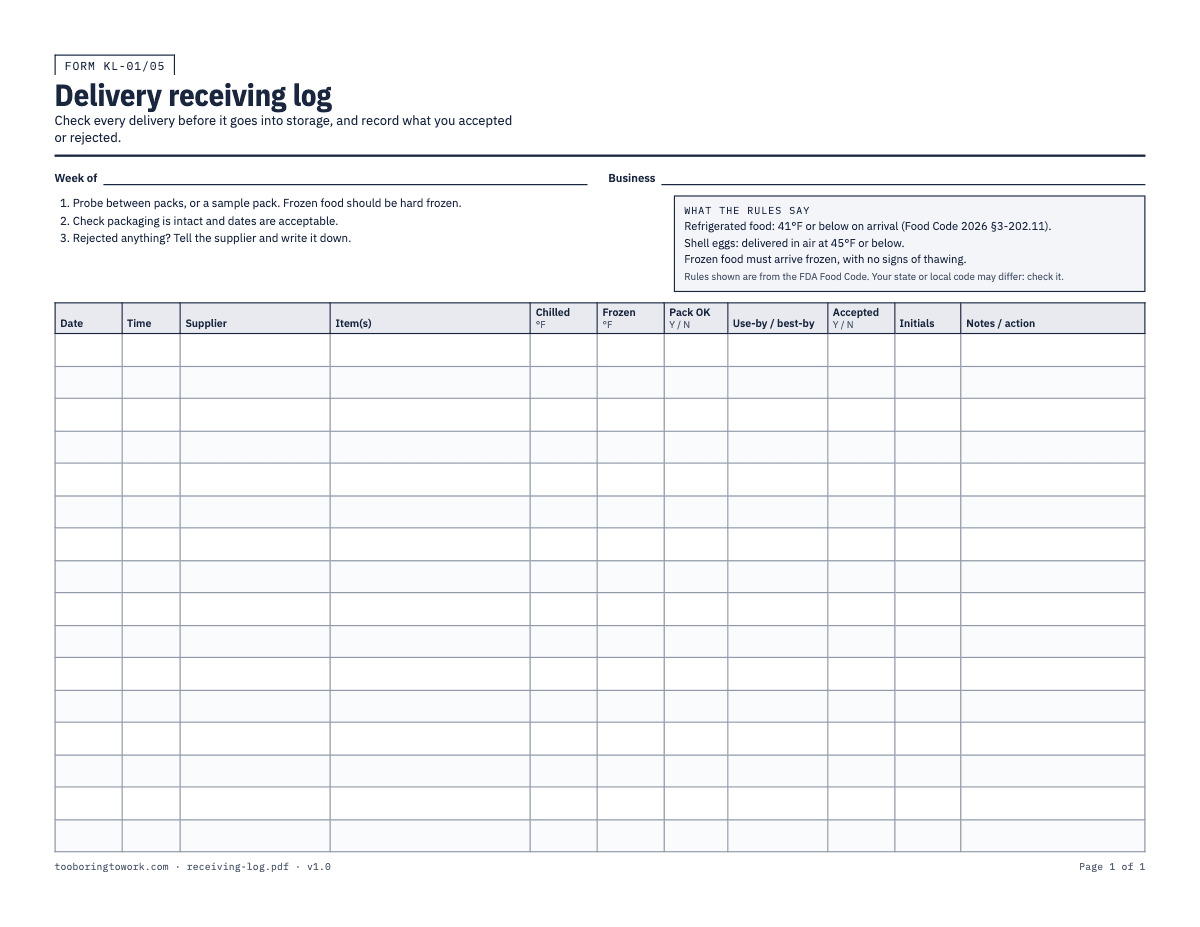
This is a weekly landscape sheet with sixteen rows. Each delivery, or each part of a delivery you check separately, gets a row: Date, Time, Supplier and Item(s), a Chilled and a Frozen temperature column in °F, Pack OK (Y/N), the Use-by / best-by date, Accepted (Y/N), Initials and a Notes / action column. The rules box prints the receiving limits from the FDA Food Code: refrigerated food at 41°F or below, shell eggs delivered in air at 45°F or below, and frozen food received frozen, with no sign of thawing.
There is no Excel version of this log. Deliveries are checked at the door with a probe in one hand and the invoice in the other, and a clipboard hanging by the receiving area is what gets used.
How to fill it in
- Hang the sheet by the back door with a pen and a probe thermometer that has been checked recently. Fill in "Week of" and the business name at the top.
- Check before you sign. Ask the driver to wait, and if they will not, write that in Notes / action. Signing the invoice first and checking later makes a credit much harder to get.
- For chilled food, probe between two packs rather than through the packaging: fold the probe between two vacuum packs of meat, or between two cartons of milk, and wait for the reading to settle. For loose product, probe a sample. Write the reading in the Chilled column.
- For frozen food, you are checking that it is frozen hard. Press the case. Look for ice crystals inside the bag, frost on the outside of the case, liquid in the bottom of the box or packs frozen into one block, which usually means it thawed and refroze. You can probe between packs and write the reading in the Frozen column, but the look and feel of the case matter just as much.
- Check the packaging: torn wrap, leaking fish boxes, dented or swollen cans, crushed egg cases, pest damage on dry goods. Write Y or N in Pack OK.
- Check the dates and write the shortest one in Use-by / best-by. If product arrives with less shelf life than you need for your menu, you can refuse it; that is a business decision, and worth agreeing with the supplier in advance.
- Decide and write Y or N in Accepted. If you reject something, tell the driver, keep it off your shelves, and write what was rejected and why in Notes / action ("2 cases chicken breast at 48°F, sent back with driver, credit requested"). Initial the row.
- Put the accepted food away straight away, frozen first, then chilled. A case left on the floor of the kitchen while the lunch rush starts undoes the check you just did. If a supplier substitutes a different brand, read the new label for allergens and update the allergen matrix before it goes on the line.
A filled-in example
| Date | Time | Supplier | Item(s) | Chilled °F | Frozen °F | Pack OK | Use-by / best-by | Accepted | Initials | Notes / action |
|---|---|---|---|---|---|---|---|---|---|---|
| Mon 6/2 | 9:40 | Broadline | Ground beef, 2 cases | 36 | Y | 6/9 | Y | KG | ||
| Mon 6/2 | 9:40 | Broadline | Fries, 4 cases | -4 | Y | 1/27 | Y | KG | ||
| Wed 6/4 | 8:20 | Broadline | Chicken breast, 2 cases | 38 | Y | 6/10 | Y | LR | ||
| Wed 6/4 | 8:20 | Broadline | Chicken breast, 1 case (top of stack) | 48 | Y | 6/10 | N | LR | Rechecked 47°F. Sent back with driver. Called rep 8:35, credit requested. | |
| Thu 6/5 | 7:05 | Dairy | Shell eggs, 15 dz; milk | 38 | N | 6/19 | Y | LR | 1 dozen eggs cracked, set aside, driver credited on invoice. |
Common mistakes
- Letting the driver stack everything inside the door and leave before anyone checks it. Early drops before opening are the worst for this; if you have key-drop deliveries, check them first thing and write down the time you did.
- Probing through the packaging of a vacuum pack of raw meat. It makes a hole and puts the probe into raw product. Fold it between two packs instead.
- Checking one case out of twelve and writing one temperature for the lot. Check the case from the back of the pallet or the top of the stack as well, which is where warm air collects.
- Writing "Y" in Accepted for a rejected item because the rest of the delivery was fine. Use one row per item or case you checked separately, so a rejection is visible at a glance.
- Treating the invoice as the record. The invoice says what was ordered and delivered; it says nothing about the temperature or condition it arrived in.
What the rules say
Refrigerated TCS food must be at 41°F (5°C) or below when it is received, unless the law sets a different temperature for that food (Food Code 2026 §3-202.11).
Source: FDA Food Code 2026, §3-202.11(A)-(B)Being reviewed
Raw shell eggs must be received in refrigerated equipment that keeps an air temperature of 45°F (7°C) or less (Food Code 2026 §3-202.11(C)).
Source: FDA Food Code 2026, §3-202.11(C)Being reviewed
Food labeled frozen must be received frozen, and received food must show no sign of having been out of temperature control (Food Code 2026 §3-202.11(E)-(F)).
Source: FDA Food Code 2026, §3-202.11(E)-(F)Being reviewed
States and local agencies adopt different editions of the FDA Food Code, so the exact rules that apply depend on your state or local health code.
Source: FDA, Adoption of the FDA Food Code by State and Territorial AgenciesBeing reviewed
Last reviewed September 29, 2026. We link to official sources; your local rules may differ, so check them.
Questions
- What temperature should deliveries be received at?
- Under the FDA Food Code, refrigerated TCS food should be at 41°F or below when received, unless the law sets a different temperature for that food. Raw shell eggs must arrive in equipment keeping the air at 45°F or below, and frozen food must arrive frozen. Your state may use a different code edition, so check.
- How do you check the temperature of a delivery without opening every pack?
- Put the probe between two packs, or between two cartons, and give it time to settle. It can read a little differently from a probe inside the food, so if the reading is close to the limit, open one sample pack and probe it properly. Clean and sanitize the probe after each product.
- Can I refuse a delivery?
- Yes. If food arrives above the limit, frozen food shows signs of thawing, or the packaging is damaged, you can reject it. Tell the driver, send it back with them if you can, and write down what you rejected, the reading and who you told. That record is what you use to get a credit.
- Do I need to log every single delivery?
- Log every delivery of food you are responsible for storing, especially chilled and frozen product. For dry goods, many kitchens just note the delivery and the pack check. Your HACCP plan or health department may ask for more; if they do, follow them.
- What about shellfish tags?
- Shellfish tags are a separate record from this sheet, and this log does not replace them. Ask your inspector how they want them stored and for how long, and keep them in date order. You can note "tags filed" in the Notes / action column on the row for that delivery.
- What should I do if a delivery arrives when nobody is there?
- Check it as soon as someone arrives, before prep starts, and write the time you checked in the Time column along with a note that it was an unattended drop. If it is warm or thawed by then, you cannot tell whether it arrived that way, which is a good reason to agree delivery windows with your suppliers.