14 Allergens Matrix Template
Every dish against the 14 allergens UK businesses must declare, with may-contain marks and notes. Excel to edit, A4 PDF to print.
- Excel
- PDF · A4
- Works in Google Sheets
Included in The Kitchen Log Kit (UK) (£19), with 8 other files.
Instant download. One payment. 14-day refunds.
What this is for
Someone at the counter asks whether the carrot cake has nuts in it. The person serving started on Tuesday and the recipe lives in a notebook in the office. An allergen matrix exists so that question gets the same correct answer whoever is standing at the till. UK food businesses have to be able to tell customers about 14 specific allergens, and a grid of dishes against allergens is the plainest way to keep that in one place.
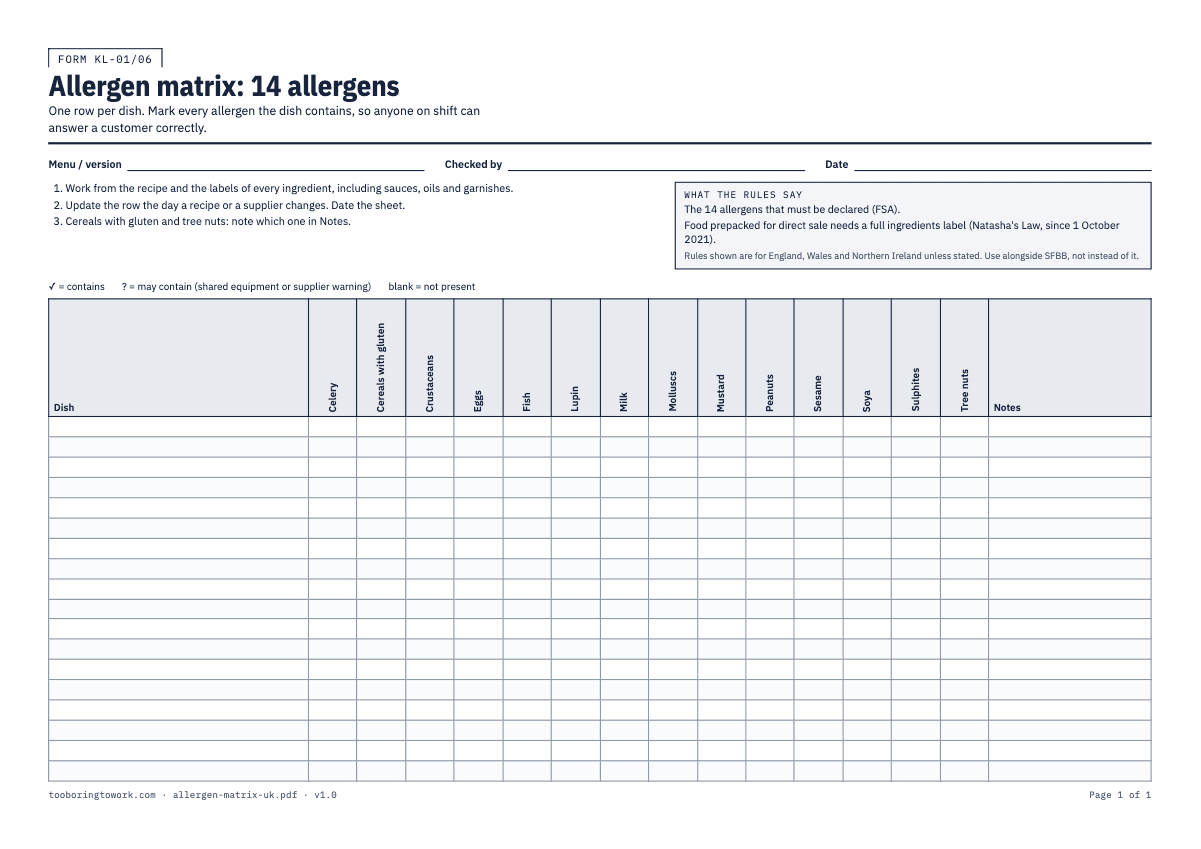
The printed sheet is a landscape A4 page with 18 dish rows and a column for each of the 14: celery, cereals with gluten, crustaceans, eggs, fish, lupin, milk, molluscs, mustard, peanuts, sesame, soya, sulphites and tree nuts. There is a Notes column on the right and boxes at the top for Menu / version, Checked by and Date. A tick means the dish contains it, a question mark means it may contain it through shared equipment or a supplier warning, and a blank means it is not there. The matrix is one record among several. It sits alongside Safer Food, Better Business, your recipe cards and the HACCP-based procedures you already run,
The Excel version is the one to maintain. On the Matrix tab each allergen cell has a dropdown with only ✓ and ? in it, so nobody types "yes" or "Y" instead. Ticked cells are shaded so they catch the eye. A Count column adds up the ticks in each row, which makes a dish with zero stand out: sometimes that is true, often it means the row was never finished. A Last checked date sits at the end of each row, and you print the Matrix tab whenever anything changes.
How to fill it in
- Start from the menu as it is actually served this week, not the one on the website. Write the menu name or a version number ("Winter lunch v3") and today's date in the header. One dish per row. A dish with a choice of bread gets a row per version.
- For each dish, go through the recipe card and the label of every ingredient that goes into it, including the stock cube, the glaze and the garnish. Sauces bought in and decanted into squeezy bottles are where most mistakes hide, so keep the original packaging or a photo of the ingredients panel.
- Mark ✓ in each column where the dish or any of its ingredients contains that allergen. Leave the cell blank only when you have checked and it is not there. The sheet cannot tell a checked blank from a guess.
- Use ? for genuine precautionary risk: a supplier label that says "may contain sesame", or shared equipment you cannot fully separate, such as one fryer for both battered fish and chips. It is not a polite way of saying "not sure".
- Fill in Notes for the two columns that cover a group. For cereals with gluten, say which cereal (wheat, barley, rye, oats). For tree nuts, say which nut (almond, walnut, cashew, pistachio).
- Handle sub-recipes once. If your house pesto, curry paste or brownie base appears in several dishes, give it its own row near the top of the matrix, then copy its marks into every dish that uses it. When it changes, you know which rows follow.
- When a supplier changes or substitutes a product, read the new label before the product goes on the shelf. A different brand of mayonnaise or a cheaper tahini can bring mustard, sulphites or a new may-contain warning. Update the rows the same day, change the date and version, reprint, and bin the old copy.
- Put a printed copy where both the kitchen and front of house can reach it, and tell staff who serve food what to do when asked: check the matrix and the Notes, and if the dish is missing or has changed, ask the chef. Staff who have been briefed on this can have it recorded on the food hygiene training record.
- Anything you prepack on site for direct sale (the sandwich wrapped in the morning and put in the chiller, the boxed salad) needs its own full ingredients label under Natasha's Law. The matrix is a good source for writing those labels, but it does not replace them.
A filled-in example
| Dish | Cereals with gluten | Eggs | Milk | Mustard | Sesame | Sulphites | Tree nuts | Count | Notes |
|---|---|---|---|---|---|---|---|---|---|
| House pesto (sub-recipe) | ✓ | ✓ | 2 | Tree nuts: cashew, from new supplier blend 14/10. Milk: parmesan. | |||||
| Pesto pasta | ✓ | ✓ | ✓ | ✓ | 4 | Gluten: wheat (fresh egg pasta). Nuts via pesto: cashew. Updated 14/10, AK. | |||
| Houmous wrap | ✓ | ✓ | 2 | Gluten: wheat tortilla. Sesame: tahini. | |||||
| Tomato soup | 0 | Checked 14/10: stock is gluten-free, no celery. Bread served separately. | |||||||
| Chips | ? | 0 | Shared fryer with battered fish: may contain gluten (wheat). | ||||||
| Fruit scone | ✓ | ✓ | ✓ | ✓ | 4 | Gluten: wheat. Sulphites: dried fruit. |
Common mistakes
- Checking the dish but not the components. The fried onions on top come out of a tub with wheat flour in the coating, and the Worcestershire sauce in the dressing has fish in it.
- Letting old copies survive. A matrix pinned inside the cupboard door from last spring, and a new one at the pass, will give two answers to one question. Keep one current printout and put the date at the top where it is obvious.
- Using the question mark to cover for guesswork. If half the cells are "?" the chart tells a customer nothing, and it looks like nobody read the labels. Use it where the risk is real and say why in Notes.
- Forgetting sulphites in dried fruit, wine reductions, pickles and some cordials, and mustard in dressings, mayonnaise and spice mixes. These two columns are the ones most often left blank when they should not be.
- Front-of-house staff offering a reassuring answer ("it should be fine") instead of checking. The safe script is short: check the matrix, and if in doubt, ask the kitchen before the order goes through.
What the rules say
Food businesses must declare 14 allergens: celery, cereals containing gluten, crustaceans, eggs, fish, lupin, milk, molluscs, mustard, peanuts, sesame, soya, sulphur dioxide and sulphites (above 10 parts per million), and tree nuts.
Source: FSA, Allergen guidance for food businessesBeing reviewed
Since 1 October 2021 (Natasha's Law), food prepacked for direct sale must be labelled with its name and a full ingredients list with the 14 allergens emphasised.
Source: FSA, Introduction to allergen labelling for PPDS foodBeing reviewed
Last reviewed 29 September 2026. We link to official sources; your local rules may differ, so check them.
Questions
- What are the 14 allergens UK food businesses must declare?
- The 14 allergens are celery, cereals containing gluten, crustaceans, eggs, fish, lupin, milk, molluscs, mustard, peanuts, sesame, soya, sulphur dioxide and sulphites (above 10 parts per million), and tree nuts. The matrix has one column for each of them, in that order.
- Do I need an allergen matrix by law?
- What you must do is declare the 14 allergens in the food you sell. A matrix is one common way of keeping that information organised and consistent, so every member of staff gives the same answer, and it is the format this sheet uses. Your environmental health officer may ask how you manage allergen information, and a dated matrix is easy to show.
- How should I mark "may contain" on an allergen chart?
- Use the ? mark and write the reason in Notes: "shared fryer" or "supplier label says may contain sesame". Keep it for real cross-contamination risks that you cannot control. A customer with a severe allergy needs to know about those, and a chart full of question marks makes the real ones harder to see.
- How often should an allergen matrix be updated?
- Every time a recipe, an ingredient or a supplier changes, on the day it changes. Many kitchens also recheck the whole matrix against current labels when the seasonal menu changes, which catches substitutions nobody mentioned.
- Does Natasha's Law apply to a café's allergen chart?
- Natasha's Law covers food prepacked for direct sale, which must carry a label with its name and full ingredients, with the 14 allergens emphasised. Dishes made to order and served on a plate are not prepacked, so the matrix is how you manage those. If you wrap sandwiches before customers choose them, those need proper labels as well.
- Where should the allergen matrix be kept?
- Somewhere both the kitchen and the people taking orders can read it without leaving their post, such as at the pass or by the till. The Excel file stays on the office computer as the master copy.