Food Delivery Record Sheet
A weekly A4 sheet for goods in: supplier, items, chilled and frozen temperatures, packaging, dates and accept or reject.
- PDF · A4
Included in The Kitchen Log Kit (UK) (£19), with 8 other files.
Instant download. One payment. 14-day refunds.
What this is for
Deliveries arrive at the worst possible moment: mid-prep, with the fryers heating and a driver who wants a signature and is already looking at the next drop. It is tempting to sign, stack the boxes by the back door and deal with them after lunch. That is how a case of chicken spends forty minutes on a warm corridor floor, and how a pack of salmon a day from its use-by ends up in your walk-in. The FSA says to spot-check deliveries for time, temperature and quality, and to reject chilled or frozen food that has not been kept cold enough, contact the supplier and write it down. This food delivery record sheet is where the writing down happens.
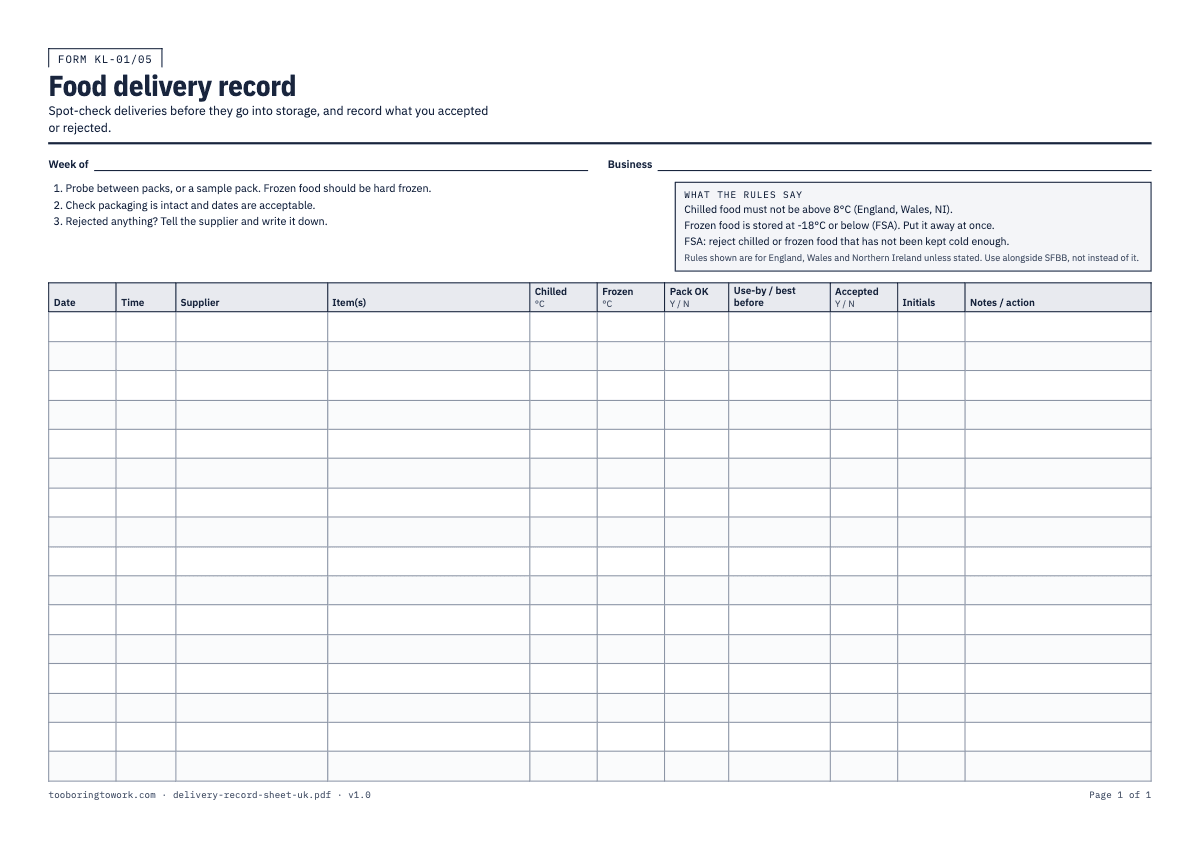
Each weekly A4 landscape sheet has sixteen rows and a box for Week of and Business. A row holds one delivery, or one supplier on a mixed drop: Date, Time, Supplier, Item(s), a Chilled reading in °C, a Frozen reading in °C, Pack OK (Y / N), the Use-by / best before date you saw, Accepted (Y / N), Initials, and Notes / action. The rules box repeats the three numbers your staff need when the van is at the door: chilled food must not be kept above 8°C in England, Wales and Northern Ireland, frozen food is stored at -18°C or below, and anything that has not been kept cold enough gets rejected.
The sheet does not print an acceptance temperature for chilled deliveries, because the FSA does not publish one. If your supplier contract, your HACCP-based procedures or your Safer Food, Better Business pack sets a figure, write it in the margin so the whole team works to the same number. The record is kept alongside those procedures, not in place of them.
How to fill it in
- Keep the current week's sheet on a clipboard by the door the deliveries come through, with a clean probe and some probe wipes in the same place. Fill in Week of and Business on Monday morning.
- When the van arrives, write the Date, Time and Supplier before you unload. Under Item(s), list what came in. For a big order, "dairy and chilled, 14 lines" is fine, with the delivery note stapled to the back.
- Probe one chilled item per delivery at least. Put the probe between two packs, or into a spare sample pack if the supplier gives you one; do not pierce the packaging of food you plan to sell. Write the reading under Chilled. For frozen goods, check they are hard frozen with no soft corners, frost inside the bag or clumped contents, and write the probe reading under Frozen if you take one.
- Look at the packaging and write Y or N under Pack OK. Torn vacuum packs, crushed boxes, wet cardboard under the frozen food and cans with dents on the seam are all reasons for an N.
- Read the dates. Write the shortest use-by or best before on the delivery under Use-by / best before. A use-by that leaves you less time than you need to sell the food is a reason to refuse it, even if the temperature is fine.
- Decide and write Y or N under Accepted. If anything was rejected, hand it back to the driver there and then, ring or email the supplier the same day, and note who you spoke to under Notes / action. A partial rejection gets a Y with the rejected lines listed in the notes.
- Put chilled and frozen goods away first and dry goods last. Frozen food goes into the freezer at once. Initial the row.
- If a supplier swaps a product for a different brand, check the label for allergens before it goes on the shelf and update your 14 allergens matrix if the ingredients have changed.
A filled-in example
| Date | Time | Supplier | Item(s) | Chilled °C | Frozen °C | Pack OK | Use-by / best before | Accepted | Initials | Notes / action |
|---|---|---|---|---|---|---|---|---|---|---|
| Mon 6/10 | 07:40 | Dairy supplier | Milk, cream, butter, yoghurt | 3.8 | Y | UB 11/10 | Y | AO | ||
| Tue 7/10 | 09:15 | Veg wholesaler | Salad, herbs, root veg | 6.1 | Y | n/a | Y | AO | Salad leaves put in fridge first. | |
| Wed 8/10 | 10:05 | Frozen supplier | Chips, peas, ice cream | -19 | Y | BB 03/27 | Y | RS | All hard frozen. | |
| Thu 9/10 | 08:50 | Butcher | Chicken thighs 5 kg, mince 3 kg | 11.2 | Y | UB 12/10 | N | RS | Van fridge not running. Refused all, driver took it back. Rang supplier 09:05, spoke to D. Redelivery 13:00, 3.9°C, accepted. | |
| Fri 10/10 | 07:30 | Fishmonger | Hake, mussels | 2.4 | N | UB 11/10 | Y | AO | One bag of mussels split, rejected. Credit note requested. |
Common mistakes
- Signing the delivery note before checking anything. Once it is signed and the driver has gone, getting a credit for a warm or damaged item is much harder.
- Leaving boxes in the corridor while you finish a job. Ten minutes becomes forty on a busy morning. Check and put away chilled and frozen goods before anything else.
- Probing the air in the van or the outside of a box. Write down a reading from between the packs, where the food is.
- Accepting goods with a use-by of tomorrow because the price was good, then throwing half of it away. Check dates against how fast you actually use the product.
- Rejecting a delivery and writing nothing. If the same supplier turns up warm three times in a month, the sheet is your evidence for changing supplier.
What the rules say
The FSA says to spot-check deliveries for time, temperature and quality, and to reject chilled or frozen food that has not been kept cold enough, contact the supplier and note it down.
Source: FSA, Safer Food Better Business: Suppliers and contractorsBeing reviewed
In England, Wales and Northern Ireland it is an offence to keep food that needs chilling above 8°C, with some exceptions (for England: Food Safety and Hygiene (England) Regulations 2013, Schedule 4).
Source: Food Safety and Hygiene (England) Regulations 2013, Schedule 4 para 2Being reviewed
The FSA says frozen food should be kept at -18°C or below.
Source: FSA, Safer Food Better Business: Prove itBeing reviewed
Safer Food, Better Business (SFBB) is the FSA's free pack of food safety procedures for small businesses in England and Wales, with a diary for daily records that food safety officers can inspect.
Source: FSA, Safer food, better business (SFBB)Being reviewed
Last reviewed 29 September 2026. We link to official sources; your local rules may differ, so check them.
Questions
- What temperature should chilled deliveries be?
- The FSA does not publish a separate acceptance temperature for deliveries. In England, Wales and Northern Ireland, chilled food must not be kept above 8°C, with some exceptions, and the FSA says to reject chilled food that has not been kept cold enough. Many businesses agree a lower figure with their suppliers; if you do, write it on the sheet so everyone uses it.
- Do I have to check every delivery?
- The FSA advice is to spot-check deliveries for time, temperature and quality. In practice many small kitchens probe at least one chilled item from every drop and look at every frozen box, because it takes a minute and a warm delivery is easy to miss by eye. Your own procedures should say how often.
- How do I probe a delivery without damaging the food?
- Place the probe tip between two packs and press them together gently, or use a sample pack if the supplier provides one. Clean and disinfect the probe before and after. Do not pierce a pack you are going to use or sell, and wipe the probe before moving from raw meat to ready-to-eat food.
- What should I do if I reject a delivery?
- Hand the rejected goods back to the driver if you can, tell the supplier the same day, and note it down. Write what was rejected, why, the reading if it was temperature, and who you spoke to in the Notes / action column. Keep a copy of any credit note with the sheet.
- What temperature should frozen food be delivered at?
- The FSA says frozen food should be kept at -18°C or below, and it should arrive hard frozen with no signs of thawing. Soft packs, ice crystals inside the bag or a wet box are all reasons to refuse it. Once accepted, put it straight into the freezer.