Hot Holding Record Sheet
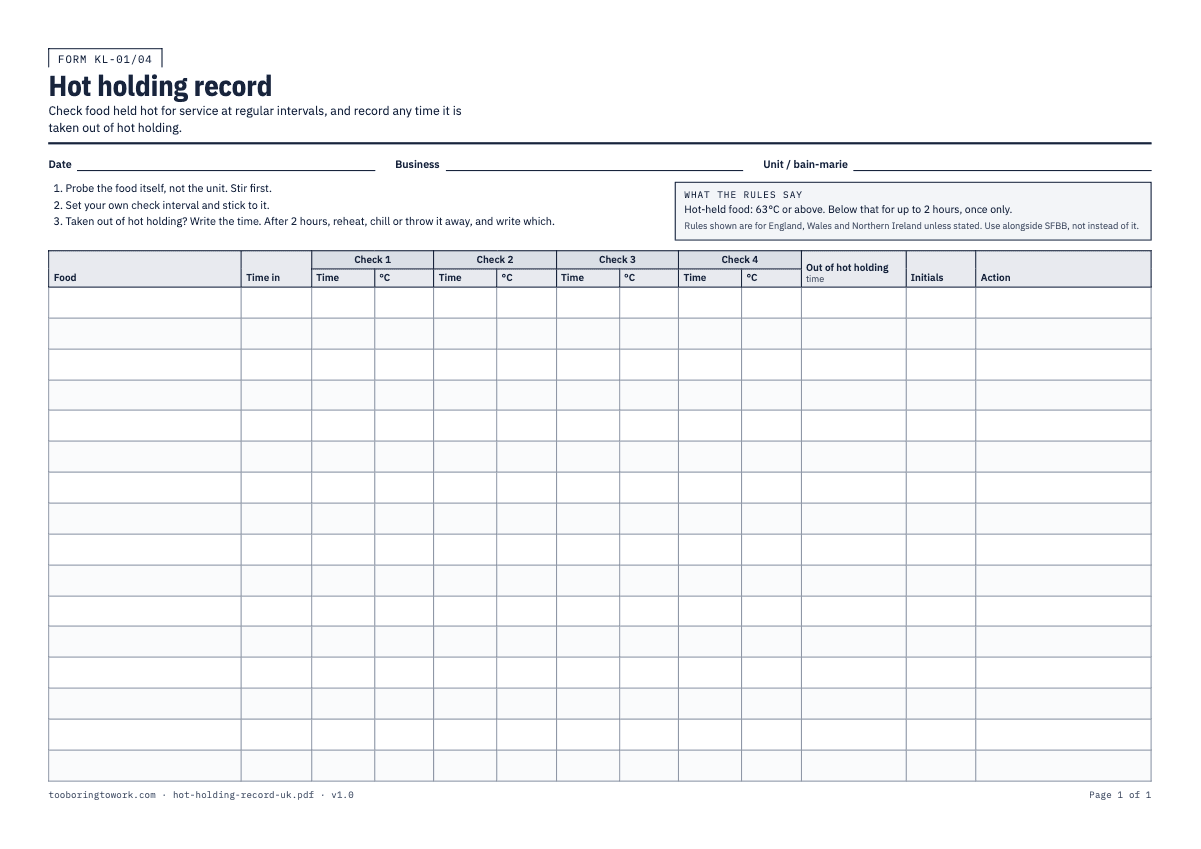
A day sheet for food held hot for service: time in, four timed checks in °C, and when it came out of hot holding.
- PDF · A4
Included in The Kitchen Log Kit (UK) (£19), with 8 other files.
Instant download. One payment. 14-day refunds.
What this is for
A bain-marie looks reassuring, and so does a soup kettle or a glowing gantry lamp. There is steam, there is a lid, the dial is turned up. None of that tells you the curry in the back well is actually hot, and on a carvery Sunday or a busy lunch counter the food at the bottom of a deep pan can sit well below the top for an hour without anyone noticing. Probing it at set times and writing the figure down is the only way to know, and it is the evidence an environmental health officer will look for when they see food kept hot for service.
The number to hold at is 63°C or above. The same rule allows food to drop below 63°C for up to 2 hours, once only, which covers carrying a tray to a function room or putting a dish out on the pass. What the rule does not allow is that 2-hour window being used twice, or quietly stretched. That is why this sheet has an Out of hot holding column: when something comes out of the bain-marie or hot cupboard, you write the time, and anyone on shift can see when the 2 hours runs out.
It is a day sheet on A4 landscape, with Date, Business and Unit / bain-marie at the top and sixteen rows below. Each row is one food: the Time in, four timed checks (time and °C for each), the time it came out of hot holding, Initials, and an Action column. It is PDF only, because a clipboard hung on the hot counter works better than a tablet balanced beside it. Use it alongside Safer Food, Better Business or your own HACCP-based procedures; it records the checks, and your procedures say what to do with the results.
How to fill it in
- Start a new sheet each day for each hot-holding unit. Fill in Date, Business, and which unit it is under Unit / bain-marie ("hot cupboard", "counter well 1 to 4"). If you have two units, use two sheets.
- When food goes in, write what it is under Food and the time under Time in. Food should already be hot when it goes in: a bain-marie is built to keep food hot, and most are slow at bringing cold or lukewarm food back up. Cook or reheat first, probe it on the cooking, cooling and reheating record, then transfer.
- Decide your check interval and write it in the margin so everyone uses the same one. The sheet has room for four checks per food, which suits a lunch service with checks roughly every hour or a longer day with checks further apart. Your SFBB pack or HACCP-based procedures set the interval, not this sheet.
- At each check, stir the food, then probe the middle of the pan, away from the sides. Write the time and the reading in °C in the next Check column. Probe the food itself, not the water in the well.
- If a reading is under 63°C, act at once. Check the obvious causes first: a lid left off, the well run dry, the thermostat knocked down by someone wiping the front, a pan of cold sauce added on top. Then deal with the food as your procedures say, which is often reheating it on the hob and putting it back. Write the reading, what you did and the time in the Action column.
- When food leaves hot holding for display, a buffet, delivery to a table outside or because the unit has been switched off, write the time under Out of hot holding. After 2 hours out, the sheet tells you to reheat it, chill it or throw it away, and write which in Action.
- Initial every check. At the end of service, file the sheet with the day's other records. Check your probe regularly against iced and boiling water on the probe calibration record: a hot-holding reading is only as good as the probe.
A filled-in example
| Food | Time in | Check 1 | Check 2 | Check 3 | Check 4 | Out of hot holding | Initials | Action |
|---|---|---|---|---|---|---|---|---|
| Roast beef, sliced | 11:45 | 12:30 / 71 | 13:30 / 68 | 14:30 / 66 | 15:00 | EH | End of service. Remainder chilled for staff meal. | |
| Roast potatoes | 11:50 | 12:30 / 74 | 13:30 / 70 | 14:30 / 69 | EH | |||
| Gravy | 11:40 | 12:30 / 77 | 13:30 / 58 | 13:45 / 81 | 14:30 / 74 | EH | Lid off, well water low. Refilled well, reheated gravy on hob to 81°C, back in 13:45. | |
| Cauliflower cheese | 12:00 | 12:30 / 70 | 13:30 / 67 | 14:30 / 65 | CJ |
Common mistakes
- Probing the water in the bain-marie, or the side of the pan. Water at 80°C around a deep pan tells you nothing about the middle of the food.
- Putting cold food into a hot cupboard to "warm up". Many units take far too long to lift chilled food, so it spends ages lukewarm. Reheat first, then hold.
- Taking the lid off during a rush and leaving it off. An open well with a low water level can lose heat quickly, and the top layer of food cools while the bottom still reads fine.
- Using the 2-hour allowance twice: out on the pass at lunch, back in the cupboard, out again at tea time. The rule is once only, and the Out of hot holding column is how you show that.
- Leaving the Action column blank after a low reading. An officer reading 58°C with nothing next to it will assume nothing was done.
What the rules say
Hot food on display or kept for service must be held at 63°C or above. Food can be below 63°C for up to 2 hours, once only (for England: 2013 Regulations, Schedule 4).
Source: Food Safety and Hygiene (England) Regulations 2013, Schedule 4 paras 6-7Being reviewed
Safer Food, Better Business (SFBB) is the FSA's free pack of food safety procedures for small businesses in England and Wales, with a diary for daily records that food safety officers can inspect.
Source: FSA, Safer food, better business (SFBB)Being reviewed
Last reviewed 29 September 2026. We link to official sources; your local rules may differ, so check them.
Questions
- What temperature should hot food be held at in the UK?
- Hot food on display or kept for service must be held at 63°C or above. It can be below that for up to 2 hours, once only. The cited regulations are for England; Wales, Northern Ireland and Scotland have their own, so check with your local council if you are unsure.
- How often should I check hot holding temperatures?
- The rule sets the temperature, not the frequency. Your own procedures should say how often you check, and many kitchens probe hot-held food at least once an hour during service. The sheet has four checks per row, so if you need more, start a second row for the same food.
- What is the 2-hour rule for hot food?
- Food that has been hot held can be kept below 63°C for up to 2 hours, and only once. After that you need to reheat it, cool it and chill it, or throw it away. Write the time it came out of hot holding so everyone knows when the 2 hours ends.
- Do pies in a heated display cabinet count as hot holding?
- Yes. Sausage rolls, pasties and jacket potatoes kept warm in a glass-fronted cabinet on the shop counter are hot held, and the same 63°C rule applies. Probe one from the front row and one from the back, since cabinets are often cooler near the door the customer or server opens. The same goes for heat lamps on a chip-shop range or a hotel breakfast buffet: write each tray down as its own row.
- Can a bain-marie be used to reheat food?
- Most are not designed for it. They keep hot food hot, and they can take a long time to bring cold food up, which leaves it warm for too long. Reheat on the hob, in the oven or in a combi, probe it, and then put it in the bain-marie.
- What should I do if hot-held food is below 63°C?
- Follow your procedures. If the food has not already used its once-only 2 hours below 63°C, you can usually reheat it and put it back. If it has, or you do not know how long it has been low, many kitchens throw it away. Write what you did, and when, in the Action column.