Opening and Closing Checks for Food Businesses
Two weekly A4 checklists for the start and end of each day, with a tick box per day and the initials of whoever checked.
- PDF · A4
Included in The Kitchen Log Kit (UK) (£19), with 8 other files.
Instant download. One payment. 14-day refunds.
What this is for
Most food safety problems in a small kitchen are not dramatic. The hand basin has no paper towels, so people wipe their hands on their aprons. Yesterday's rice is still in the fridge with no label. The back door was left on the latch overnight. None of these take more than a minute to spot, and all of them are easier to fix at 7am than to explain to an environmental health officer at 11. Opening and closing checks are a fixed list you walk round at the start and end of each day, so the obvious things get looked at even on the mornings when the person opening is new, or tired, or both.
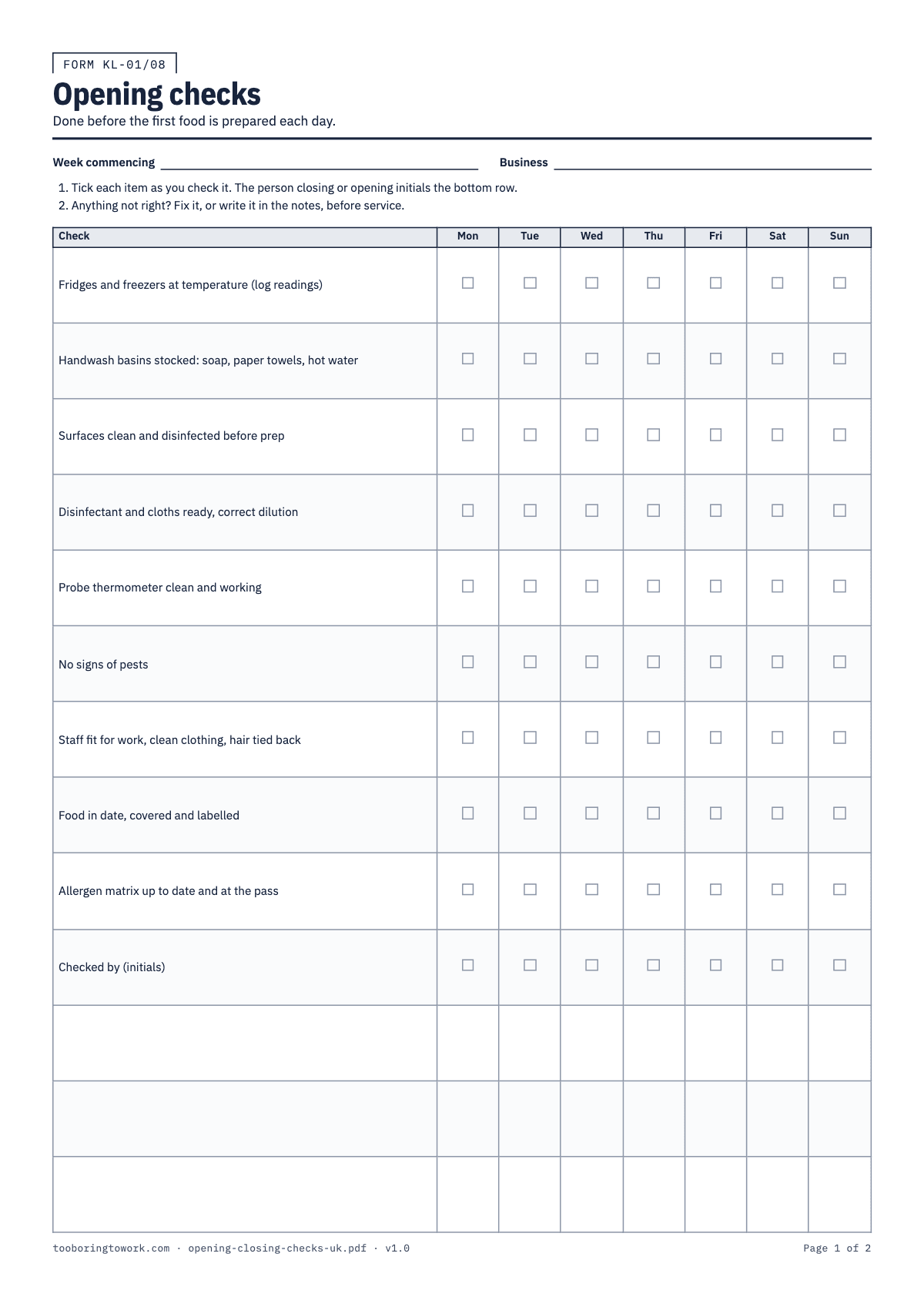
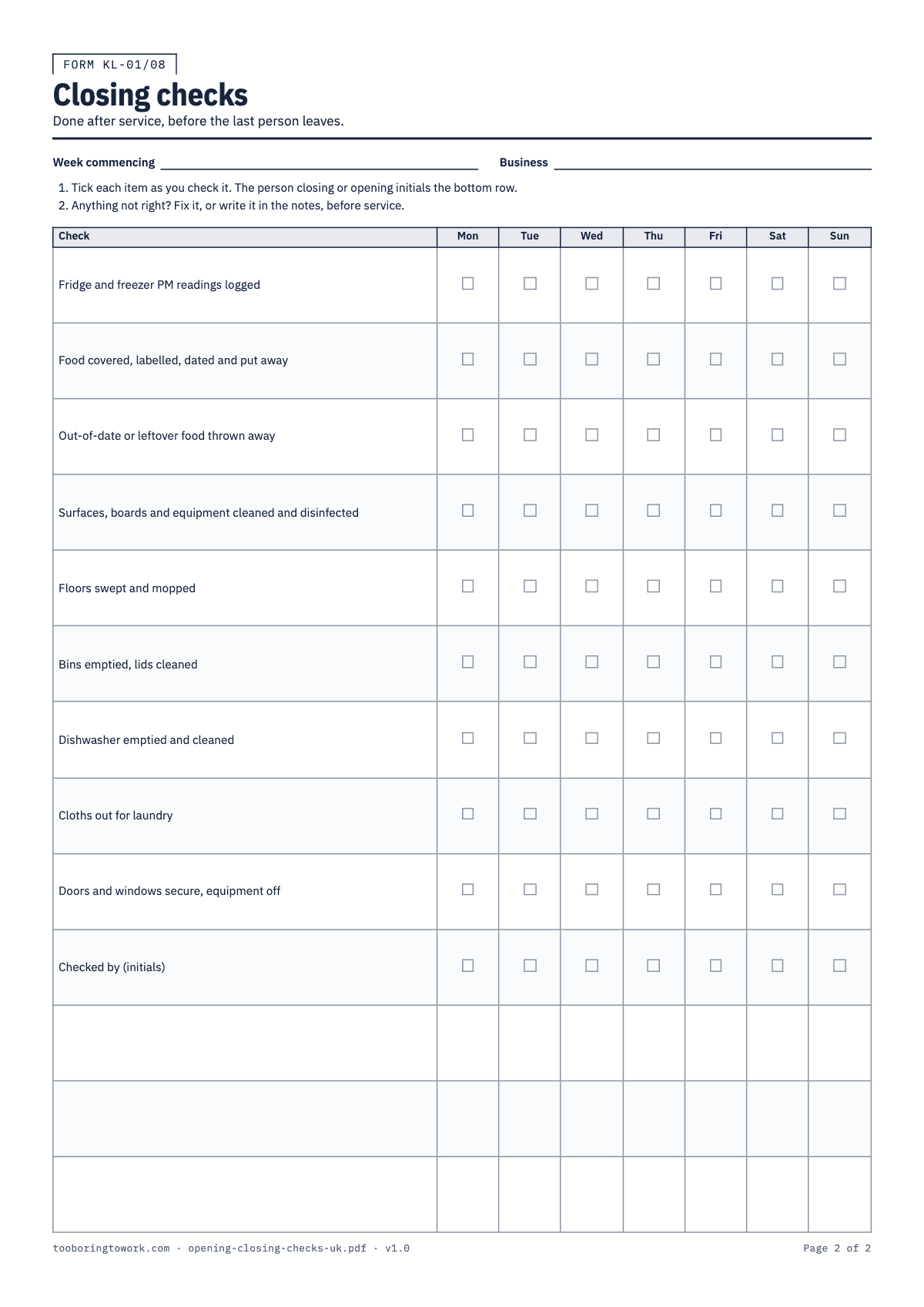
The pack is two portrait A4 checklists, one for opening and one for closing, each covering a week. Down the side are nine printed checks; across the top are tick boxes for Monday to Sunday. The opening list covers fridge and freezer temperatures, stocked hand basins, clean and disinfected surfaces, disinfectant made up at the right dilution, a working probe, pests, staff fitness for work, food in date and labelled, and the allergen matrix at the pass. The closing list covers the evening fridge readings, putting food away covered and dated, throwing out what has gone over, cleaning surfaces and boards, floors, bins, the dishwasher, cloths for laundry, and locking up with equipment off. Each page ends with a "Checked by (initials)" row and three blank rows for checks of your own.
These sheets are a quick daily sign-off. They do not replace the more detailed records they point to, and they work alongside Safer Food, Better Business and your own HACCP-based procedures. If you already sign off each day in an SFBB diary, the checklist is the walk-round that gives that signature something behind it.
How to fill it in
- Print both sheets on Monday morning, or on Sunday night for whoever opens first. Fill in the Week commencing date and the business name at the top of each. Put the opening sheet where the first person in will see it, such as by the hand basin or the kitchen door, and the closing sheet where the last person out will pass it.
- Before the first food is prepared, the person opening works down the list in order and ticks the box for that day against each check. Only tick what you have actually looked at. For the fridge line, take the reading and write it on the fridge and freezer temperature record; the tick here means the reading has been taken and logged, not that you glanced at the door display.
- If something is not right, fix it before prep starts where you can: restock the basin, make up fresh disinfectant, bin the unlabelled container. If it cannot be fixed straight away, do not tick that box. Write a short note in one of the blank rows at the bottom, with the day, what was wrong and what you did, so the next person knows.
- Use the three blank rows for anything specific to your site that should be checked daily: the ice machine scoop kept outside the ice, the fly screen on the back door, the extraction canopy switched on, the blast chiller emptied.
- After service, the person closing does the same with the closing sheet. Food goes away covered, labelled and dated. Anything past its use-by or kept past your own time limit for leftovers is thrown away. The deeper weekly and monthly jobs belong on the kitchen cleaning schedule, not here.
- Whoever did the check writes their initials in the "Checked by" row for that day. If two people shared it, both initial. A column of ticks with no initials underneath is hard to rely on.
- On Sunday night, or when the new sheets go up, file the old pair together in date order. If a day was missed because you were closed, write "closed" across that column rather than leaving it blank.
A filled-in example
| Check | Mon | Tue | Wed | Thu |
|---|---|---|---|---|
| Fridges and freezers at temperature (log readings) | ✓ | ✓ | ✓ | ✓ |
| Handwash basins stocked: soap, paper towels, hot water | ✓ | ✓ | ✓ | |
| Disinfectant and cloths ready, correct dilution | ✓ | ✓ | ✓ | ✓ |
| Allergen matrix up to date and at the pass | ✓ | ✓ | ✓ | ✓ |
| Wed: no hot water at hand basin. Boiler reset 07:40, hot by 07:55. Prep started after that. MB | ||||
| Checked by (initials) | LH | LH | MB | LH |
Common mistakes
- Ticking the whole column at once from the office. The point of the list is to walk round with it. If every day of the week is ticked in the same pen at the same angle, it looks exactly like what it is.
- Treating the fridge tick as a temperature record. The checklist only says the reading was taken. The number itself goes on the fridge log, with any action taken, because that is where someone will look for it.
- Leaving the closing sheet to whoever happens to be last out, with nobody named. On busy nights it slides. Some kitchens put the closing check on the rota by name, the same way they rota the washing up.
- Ticking a box when the problem was noticed but not fixed. An unticked box with a one-line note is honest and useful; a tick next to an empty soap dispenser is neither.
- Letting the list go stale. If you have added a chiller or started doing takeaways, add the new daily checks to the blank rows instead of relying on people to remember them.
What the rules say
Safer Food, Better Business (SFBB) is the FSA's free pack of food safety procedures for small businesses in England and Wales, with a diary for daily records that food safety officers can inspect.
Source: FSA, Safer food, better business (SFBB)Being reviewed
Food businesses must have food safety procedures based on HACCP principles, keep them up to date, and keep records for an appropriate period (Regulation 852/2004, Article 5).
Source: Regulation (EC) No 852/2004 (retained), Article 5Being reviewed
Last reviewed 29 September 2026. We link to official sources; your local rules may differ, so check them.
Questions
- What should be on a kitchen opening checklist?
- The things that must be right before food is prepared: fridges and freezers at temperature, hand basins stocked with soap, towels and hot water, clean disinfected surfaces, disinfectant made up correctly, a working probe, no signs of pests, staff fit for work, food in date and labelled, and allergen information to hand. That is the list printed on this sheet, with room to add your own.
- What are closing checks in a food business?
- The end-of-day routine that leaves the kitchen safe for the morning: food covered, labelled and stored, out-of-date or leftover food thrown away, surfaces and equipment cleaned and disinfected, floors and bins done, cloths sent for washing, and the building secured with equipment off. The closing sheet here lists those jobs with a tick box for each day.
- Are opening and closing checks a legal requirement?
- The law requires food safety procedures based on HACCP principles, and records kept for an appropriate period. Daily checks like these are a common, practical way of showing those procedures are followed from one day to the next. Ask your environmental health officer if you are unsure what they expect to see.
- Does this replace the SFBB diary?
- No. The SFBB diary is where you record the daily sign-off and anything that went wrong, and it stays in use. This checklist gives the person signing a fixed list to walk round first. Some kitchens keep the week's checklist clipped inside the diary so both are shown together.
- How long should I keep completed checklists?
- Records must be kept for an appropriate period, so ask your local council's food safety team what they expect. Many small businesses keep a year of sheets in date order, which answers questions about any recent week.