Cooking Temperature Record Sheet: Cooking, Cooling and Reheating
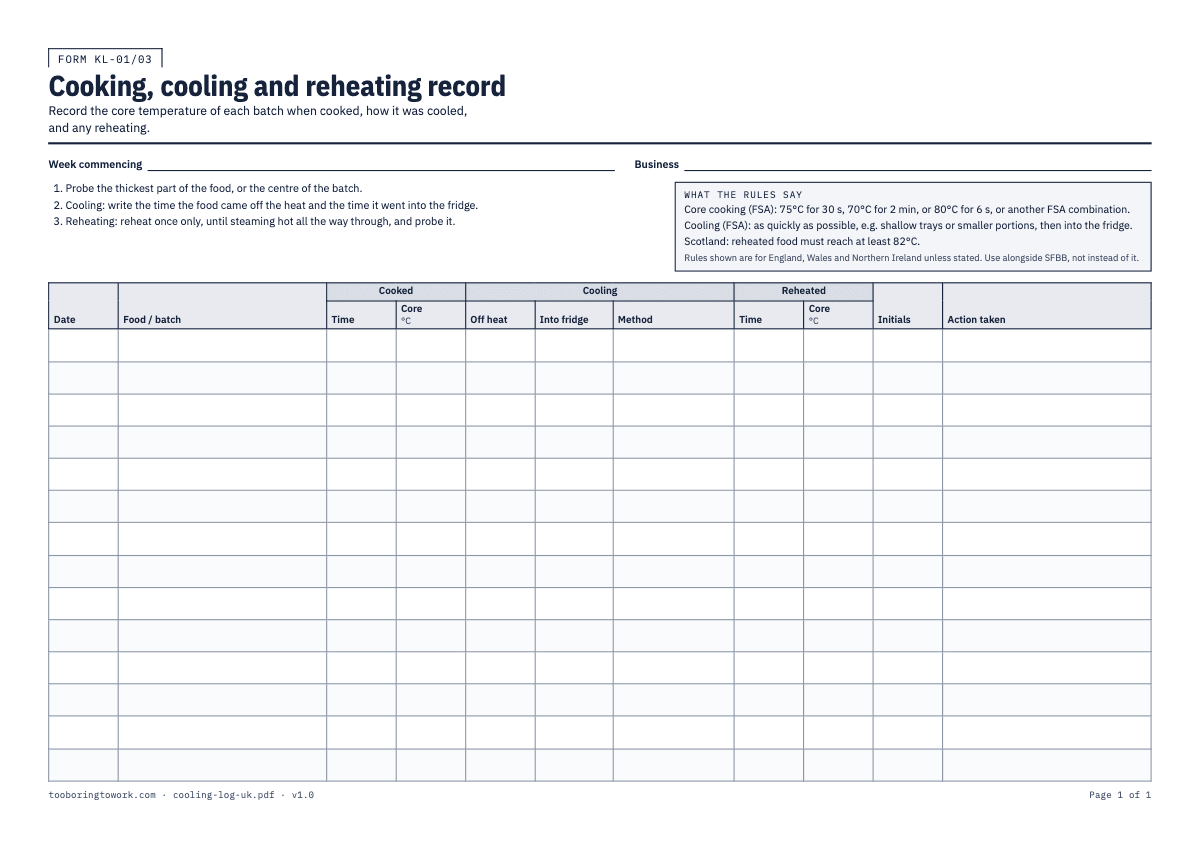
One row per batch: core temperature when cooked, when it came off the heat and went into the fridge, and any reheating.
- PDF · A4
Included in The Kitchen Log Kit (UK) (£19), with 8 other files.
Instant download. One payment. 14-day refunds.
What this is for
A pot of chilli, a tray of roast chicken thighs, ten litres of stock for tomorrow. Anything you cook today and serve later goes through three moments where it can go wrong: it might not get hot enough in the middle, it might sit on the side too long while it cools, and it might be warmed through only halfway when it comes back out. Each of those is invisible once the food is on the plate. A cooking temperature record sheet turns them into three numbers and three times on paper, which is what an environmental health officer will ask about when they see a batch-cooking kitchen.
This sheet gives one row per batch, fourteen rows on an A4 landscape page, with Week commencing and Business at the top. The row follows the food through its day: Cooked (time and core temperature in °C), Cooling (the time it came off the heat, the time it went into the fridge, and the method you used), Reheated (time and core temperature), then Initials and an Action taken column. The rules box at the top lists the FSA core cooking combinations, such as 75°C for 30 seconds or 70°C for 2 minutes, the FSA advice to cool food as quickly as possible, and the separate 82°C reheating rule in Scotland.
There is deliberately no cooling deadline printed on the sheet. The FSA does not publish a fixed number of minutes for small caterers, so the sheet records the two times and lets your own procedures, whether Safer Food, Better Business or a HACCP plan of your own, set what counts as quick enough for each dish. This record sits alongside those procedures; it does not replace them.
How to fill it in
- Start a new sheet each week and keep it on a clipboard by the stove or the blast chiller, with a pen tied to it. Fill in Week commencing and Business.
- When a batch finishes cooking, write the Date, a clear name under Food / batch ("beef ragù, 2 x gastros" is better than "sauce"), and the time in the Cooked columns. Probe the thickest part of the largest piece, or the centre of the pot after stirring, and write the reading under Core.
- Compare the reading with the combinations in the rules box. The FSA lists 80°C for 6 seconds, 75°C for 30 seconds, 70°C for 2 minutes, 65°C for 10 minutes or 60°C for 45 minutes. If you are relying on a lower temperature held for longer, write the time held as well, for example "65°C, held 10 min".
- If food is not being served straight away, write the time it came off the heat under Off heat. Then cool it fast: decant into shallow trays, split big joints, stand pans in iced water, stir sauces, or use a blast chiller if you have one. Write what you did under Method, in two or three words.
- Write the time under Into fridge when it goes in. Label and date the container at the same time. If it sat on the side for longer than your procedures allow because service got busy, say so in Action taken, along with what you decided to do with it.
- When you reheat, probe it again and write the time and Core reading in the Reheated columns. The sheet asks you to reheat once only and until steaming hot all the way through. In Scotland the reheated food must reach at least 82°C, unless that would spoil it.
- If the food then goes into a bain-marie or hot cupboard, carry on with the hot holding record from that point.
- Initial every row. Once a month, check the probe itself in iced water and boiling water and log the result on the probe calibration record. A probe reading 2°C high makes an undercooked batch look fine.
A filled-in example
| Date | Food / batch | Cooked time | Core °C | Off heat | Into fridge | Method | Reheat time | Reheat core °C | Initials | Action taken |
|---|---|---|---|---|---|---|---|---|---|---|
| 14/10 | Beef ragù, 2 gastros | 10:40 | 84 | 10:45 | 11:40 | Shallow trays, ice bath | 17:30 | 78 | TW | |
| 14/10 | Chicken thighs, 1 tray | 11:15 | 79 | Served hot | TW | Went straight to lunch service. | ||||
| 14/10 | Ham hock, whole | 09:30 | 76 | 12:10 | 13:20 | Split into chunks, blast chiller | NB | |||
| 14/10 | Boiled rice, large pan | 12:00 | 96 | 12:10 | 15:05 | Left in pan during service | NB | Too long on the side. Discarded 15:05, fresh batch cooked for evening. Rice now cooled in trays straight away. |
Common mistakes
- Probing the edge of a joint, or the top of a pot that has not been stirred. The outside is always the hottest part; the reading that matters is the coolest one.
- Putting a deep, lidded stockpot straight into the walk-in to cool. It stays warm in the middle for hours and warms up everything around it. Split it into shallow trays first.
- Leaving the Off heat time blank and filling it in when the food goes into the fridge. The gap between those two times is the whole point of the Cooling columns.
- Reheating a portion, sending some out, cooling the rest and reheating it again the next day. Many kitchens treat reheating as a one-time step and throw away what is left.
- Writing "hot" or a tick under Core. If there is no number, there is no evidence the probe went in.
What the rules say
The FSA lists these safe core cooking combinations: 80°C for 6 seconds, 75°C for 30 seconds, 70°C for 2 minutes, 65°C for 10 minutes or 60°C for 45 minutes.
Source: FSA, Safer Food Better Business: Cooking safelyBeing reviewed
The FSA says to cool cooked food that is not served straight away as quickly as possible, for example in smaller portions or shallow trays, then put it in the fridge.
Source: FSA, Safer Food Better Business: Chilling down hot foodBeing reviewed
In Scotland, food that is reheated before it is served or sold must reach at least 82°C, unless that would spoil it (Food Hygiene (Scotland) Regulations 2006, Schedule 4).
Source: Food Hygiene (Scotland) Regulations 2006, Schedule 4 para 3Being reviewed
Safer Food, Better Business (SFBB) is the FSA's free pack of food safety procedures for small businesses in England and Wales, with a diary for daily records that food safety officers can inspect.
Source: FSA, Safer food, better business (SFBB)Being reviewed
Last reviewed 29 September 2026. We link to official sources; your local rules may differ, so check them.
Questions
- What core temperature should cooked food reach in the UK?
- The FSA gives several safe time and temperature combinations: 80°C for 6 seconds, 75°C for 30 seconds, 70°C for 2 minutes, 65°C for 10 minutes or 60°C for 45 minutes. Many small kitchens simply probe for 75°C or above, which only needs to be held briefly. Your SFBB pack or HACCP-based procedures should say which you use.
- How quickly should cooked food be cooled?
- The FSA says to cool food that is not served straight away as quickly as possible, for example in smaller portions or shallow trays, and then put it in the fridge. It does not publish a single cooling time for small caterers, so this sheet records when the food came off the heat and when it went into the fridge. Your own procedures set the target, and your EHO can tell you what they expect for your kitchen.
- What temperature should reheated food reach?
- In Scotland, reheated food must reach at least 82°C unless that would spoil it. In England, Wales and Northern Ireland, kitchens usually reheat until steaming hot all the way through and probe to check, using one of the FSA core combinations. Write the reading on the sheet either way.
- Can I put hot food straight in the fridge?
- Small, shallow portions that have had a few minutes to stop steaming are usually fine and help cooling. A large, deep container of very hot food will struggle to cool in the middle and can warm the fridge and the food around it. Divide it first, and check your fridge temperature records after a big batch goes in.
- Do I need to record every batch I cook?
- Your own procedures decide what you record and how often. Many small kitchens probe and write down every batch that will be cooled and served later, and spot-check dishes cooked to order. What matters to an officer is that the records match what actually happens in the kitchen.