Kitchen Cleaning Schedule Template
Daily, weekly and monthly cleaning tasks for a UK food business on three A4 sheets, with ticks, initials and a two-stage clean.
- PDF · A4
- Excel
- Works in Google Sheets
Free · PDF + Excel
What this is for
Every kitchen gets cleaned. The question an environmental health officer asks is how you know. "We do it every night" is an answer; a sheet on the wall with a tick and a set of initials against each task, for every day of the last month, is a better one. A written schedule also settles the arguments about whose job the extraction canopy is, and it stops the jobs nobody enjoys (behind the fryer, the drain by the pot wash, the top of the walk-in) quietly dropping off the rota until the next inspection.
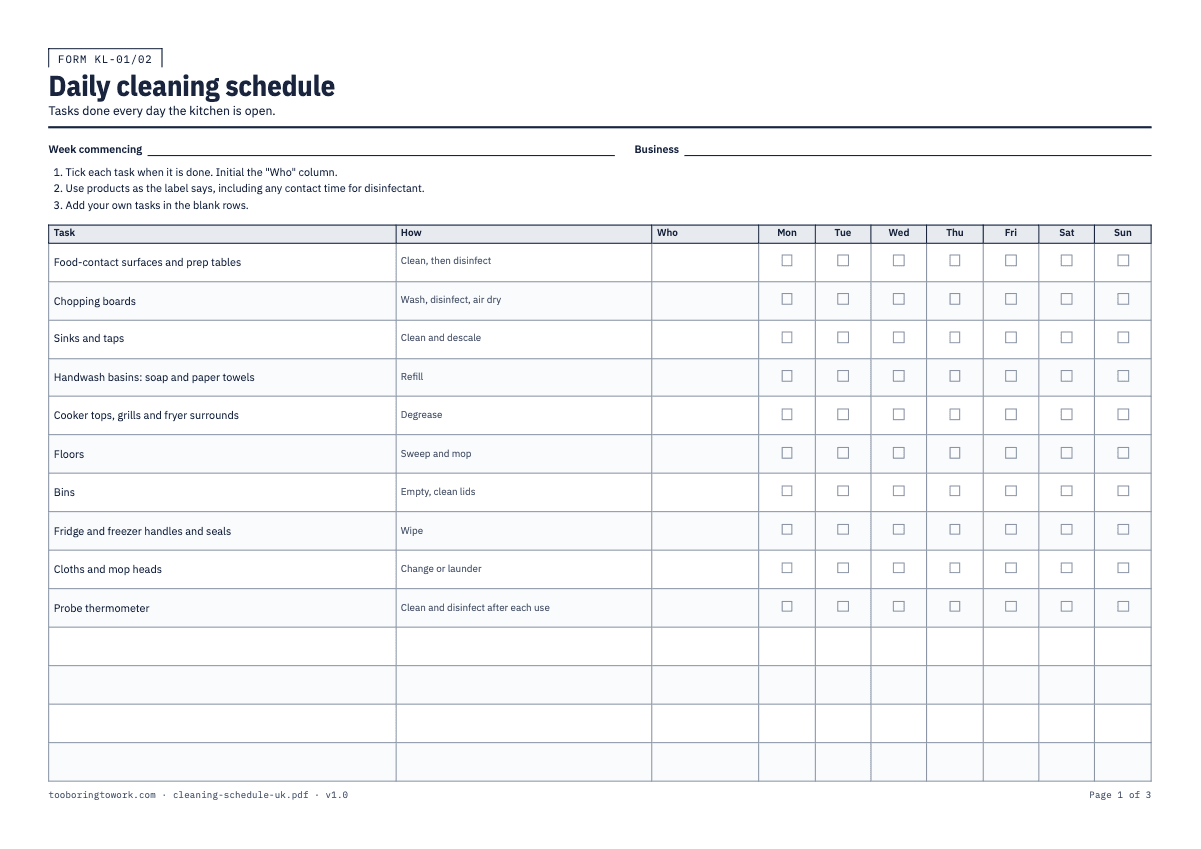
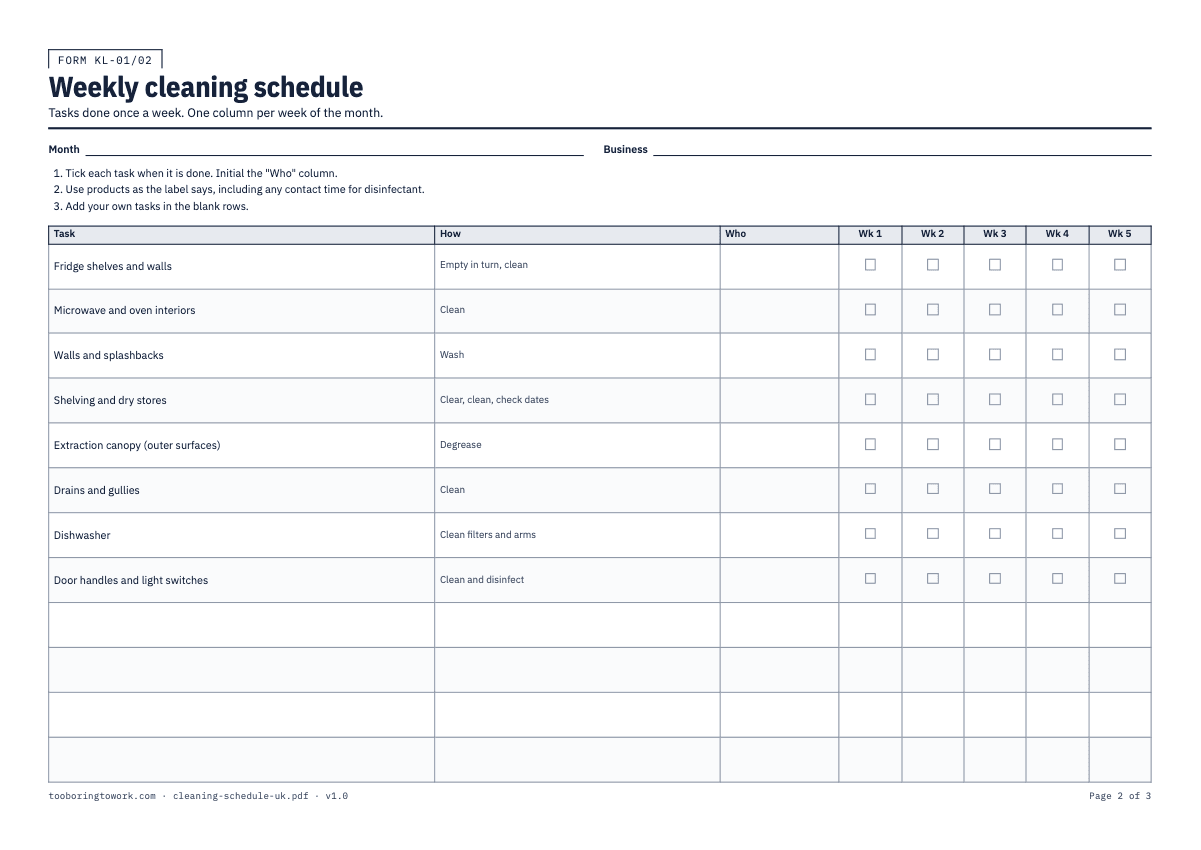
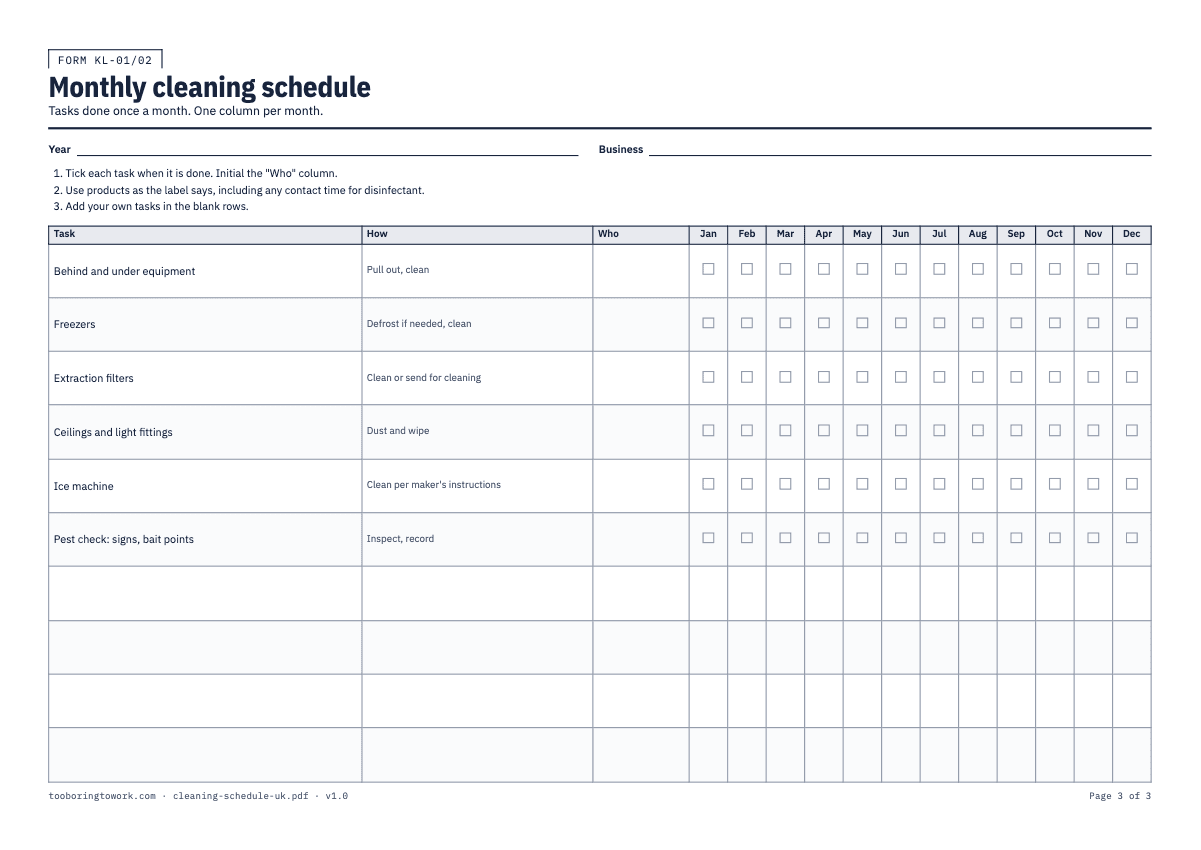
This kitchen cleaning schedule template comes as three A4 landscape sheets. The daily sheet has a tick column for each day from Monday to Sunday and covers the jobs that happen every shift: prep surfaces, chopping boards, sinks, handwash basins, cooker tops, floors, bins, fridge handles and seals, cloths and the probe thermometer. The weekly sheet has five columns, one for each week of the month, for fridge interiors, oven and microwave insides, walls, dry stores, the canopy, drains, the dishwasher and door handles. The monthly sheet runs January to December for the deep jobs: behind equipment, freezers, extraction filters, ceilings, the ice machine and a pest check. Each row has a How column saying what the task involves and a Who column for initials, and there are blank rows for tasks specific to your kitchen.
The Excel version has the same three lists on Daily, Weekly and Monthly tabs. Each tick cell has a dropdown with ✓ for done, ✗ for not done and N/A for days you were closed, and a Done % column works out how much of each task was completed, turning amber when it falls below 100%. It is a record of what was done, used alongside your Safer Food, Better Business cleaning section or your own HACCP-based procedures, not a substitute for them.
How to fill it in
- Print the three sheets and put the daily one somewhere staff pass at the end of a shift, such as by the pot wash or the back door. The weekly and monthly sheets can live in the folder with your other records. Fill in Week commencing and Business on the daily sheet, Month on the weekly one and Year on the monthly one.
- Read down the Task and How columns and change anything that does not fit your kitchen. Cross out the ice machine if you have not got one. Add the combi oven, the slush machine or the pizza oven stone in the blank rows at the bottom.
- Write a name or initials in the Who column for each task so it has an owner. On a small team it might be the same person all week; on a bigger one it is usually the closing chef for daily jobs and the head chef or owner for monthly ones.
- For food-contact surfaces, boards and anything touched by hands, do it in two stages as a matter of practice: clean first with hot soapy water to remove grease and food, then apply a disinfectant or sanitiser. Disinfectant does not work well through a layer of grease.
- Follow the label on each chemical, including the dilution and the contact time, which is how long the product has to stay wet on the surface to work. Many kitchen sprays need a set time before you wipe them off. Wiping straight away is one of the most common reasons a surface is not properly disinfected.
- Tick the day or week column when the task is done, and only then. If a job was missed, leave it blank or mark it with a cross and write why on the back of the sheet or in your SFBB diary. If you were closed, write N/A.
- On the Excel version, choose ✓, ✗ or N/A from the dropdown in each cell. Check the Done % column at the end of the week: amber means something was skipped. Start a fresh copy each week for Daily, each month for Weekly and each year for Monthly, or clear the ticks.
- Keep the finished sheets in date order in the same binder as your fridge temperature records and the opening and closing checks, so an officer can see a whole day in one place.
A filled-in example
| Task | How | Who | Mon | Tue | Wed | Thu | Fri | Sat | Sun |
|---|---|---|---|---|---|---|---|---|---|
| Food-contact surfaces and prep tables | Clean, then disinfect | RP | ✓ | ✓ | ✓ | ✓ | ✓ | ✓ | N/A |
| Chopping boards | Wash, disinfect, air dry | RP | ✓ | ✓ | ✓ | ✓ | ✓ | ✓ | N/A |
| Handwash basins: soap and paper towels | Refill | LM | ✓ | ✓ | ✓ | ✓ | ✓ | ✓ | N/A |
| Floors | Sweep and mop | LM | ✓ | ✓ | ✓ | ✗ | ✓ | ✓ | N/A |
| Note | Thu: mop bucket split, floor swept only. New bucket Fri 9:00, floor mopped before prep. | LM |
Common mistakes
- Ticking the whole week on Sunday night. A row of ticks in the same pen, with the same pressure, looks exactly like what it is.
- Spraying disinfectant and wiping it off in the same movement. Most products need to stay on for their stated contact time, and a quick wipe leaves the surface merely damp.
- Using one cloth for everything from the bin lid to the prep bench. Many kitchens colour-code cloths by area so raw and ready-to-eat work never share one.
- Letting the monthly sheet go blank for a quarter because the head chef who owned it left. Give every monthly task a named person and hand it over when staff change.
- Keeping a schedule that lists equipment you no longer have. An officer who sees "clean the rotisserie" ticked daily, with no rotisserie in the room, will read the rest of the sheet differently.
What the rules say
Safer Food, Better Business (SFBB) is the FSA's free pack of food safety procedures for small businesses in England and Wales, with a diary for daily records that food safety officers can inspect.
Source: FSA, Safer food, better business (SFBB)Being reviewed
Food businesses must have food safety procedures based on HACCP principles, keep them up to date, and keep records for an appropriate period (Regulation 852/2004, Article 5).
Source: Regulation (EC) No 852/2004 (retained), Article 5Being reviewed
Last reviewed 29 September 2026. We link to official sources; your local rules may differ, so check them.
Questions
- Is a cleaning schedule a legal requirement in the UK?
- Food businesses must have food safety procedures based on HACCP principles and keep records for an appropriate period. How you show that your cleaning is planned and done is up to you. The cleaning section of SFBB is one way; a written schedule with ticks and initials is a common way to back it up.
- What should be on a daily cleaning checklist for a kitchen?
- Anything that gets dirty or touched every shift: prep surfaces, boards, sinks, handwash basins, cooker tops and fryer surrounds, floors, bins, fridge handles and cloths. The daily sheet in this template starts with those ten. Add anything specific to your menu, such as a slicer or a grill, in the blank rows.
- What is the difference between cleaning and disinfecting?
- Cleaning removes dirt, grease and food debris. Disinfecting kills bacteria on a surface that already looks clean. In practice kitchens do both in that order, because grease protects bacteria from the chemical. Check the label to see whether your product is a detergent, a disinfectant or a combined sanitiser, and what contact time it needs.
- How often should a commercial kitchen be deep cleaned?
- It depends on what you cook and how busy you are, and your own procedures should set it. This template puts pulling out equipment, extraction filters and ceilings on the monthly sheet, which suits many small kitchens. A kitchen running a fryer all day will usually need the canopy and filters done more often.
- Who should sign the cleaning schedule?
- The person who did the task initials it. The Who column shows who owns each job, and the tick shows it was done that day. Many owners also sign the bottom of the sheet at the end of the week to show it has been checked.
- Can I use the Excel cleaning rota in Google Sheets?
- Yes. Upload it to Google Drive and save it as a Google Sheet. The dropdowns and the Done % column work there too. If the sheet lives on a tablet in the kitchen, make sure it is updated at the time, not typed in from memory at the end of the week.