Fridge and Freezer Temperature Record Sheet
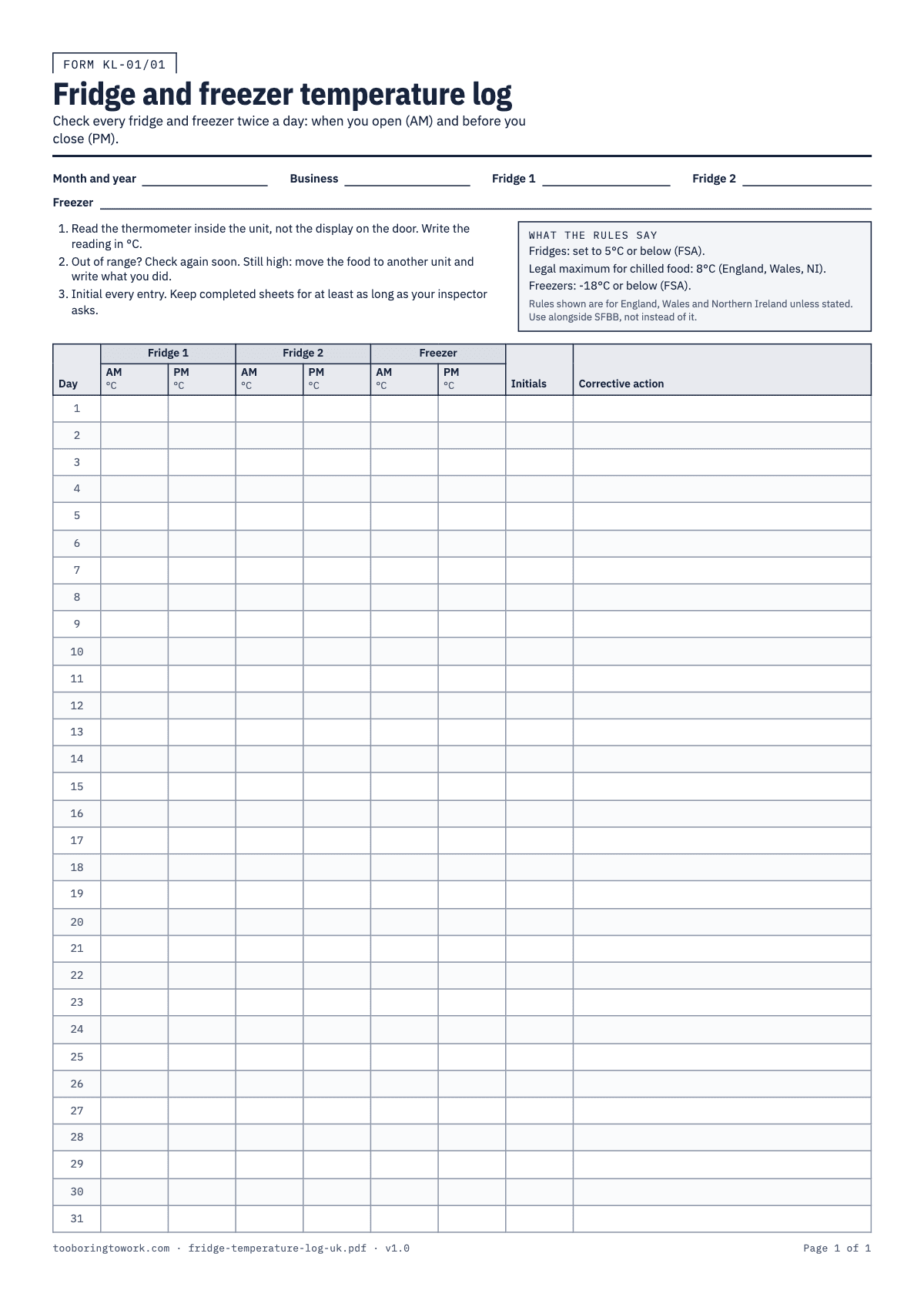
One month per A4 page for two fridges and a freezer: opening and closing readings in °C, initials and the action you took.
- PDF · A4
- Excel
- Works in Google Sheets
Free · PDF + Excel
What this is for
Most fridge problems in a small kitchen start slowly. A seal splits at the hinge, a fan fills with ice, someone wedges a tray of lasagne against the back panel and the airflow stops. The unit keeps humming and the food keeps looking fine. Two readings a day, written on paper by the person who took them, is how you notice a drift of a degree or two while it is still a cheap gasket and not a bin bag full of cooked ham. It is also the first sheet an environmental health officer tends to ask for when they walk in.
This record sheet gives you one month on one A4 page. It has space for two fridges and a freezer, an AM and a PM reading in °C for each, a column for the initials of whoever checked, and a corrective action column for the days a number was wrong. The limits are printed at the top so nobody has to remember them: the FSA recommends setting fridges to 5°C or below, the legal maximum for chilled food in England, Wales and Northern Ireland is 8°C, and frozen food should be at -18°C or below. It sits alongside your Safer Food, Better Business pack or your own HACCP-based procedures. It does not replace them.
If you run more than three units, use the Excel version. You name each fridge and freezer once on the Units tab and choose its type; the target and legal maximum fill in by themselves. On the Log tab you pick the unit from a dropdown, type the two readings and your initials, and the Status column does the comparing. It shows ABOVE 5°C in amber when a fridge is warmer than the recommended setting, and OVER 8°C in red when it has passed the legal limit. That split matters: 6°C on a busy lunchtime is worth watching, 9°C is worth acting on straight away.
How to fill it in
- Print a fresh page on the first of the month and pin it to the wall beside the fridges, not in the office. Fill in Month and year, Business, and the names you actually use for the units in the Fridge 1, Fridge 2 and Freezer boxes, such as "under-counter by the pass" or "upright in the back corridor".
- Keep a thermometer inside each unit, on a middle shelf and away from the door. The digital display on the front reads the air near its own sensor, which is often in the coldest spot. A probe pushed into a small pot of water that lives in the fridge gives a steadier figure than air readings, because it behaves more like food.
- Take the AM reading when you first arrive, before the doors have been opened for deliveries or mise en place. Take the PM reading at the end of the night, before you switch off the lights. Write the number in °C, to one decimal place if your thermometer shows it. No ticks and no "fine".
- Check each figure against the rules box. A fridge at 6°C or 7°C is still under the legal limit but above the FSA recommended setting, so turn the thermostat down a notch and check again in an hour. At 8°C or above, act now.
- When a reading is high, confirm it with a second probe before you move anything. If it is still high, move high-risk food (cooked meats, dairy, prepared salads, anything with a use-by date) to a unit that is holding temperature, then look for the cause: door seal, blocked vents, a unit packed too tight.
- Write what happened in the Corrective action column: what you found, what you moved, the time, and the reading when you rechecked. "Door not shut after delivery, closed 10:15, 4.2°C at 11:00" tells an officer everything in one line.
- Initial every entry, including the recheck. If a new starter takes the readings, put their initials down, not yours.
- On the Excel version, delete the EXAMPLE row on the Log tab before your first real entry, and add one row per unit per day. The formula columns are locked so they cannot be typed over; the sheet explains how to unprotect them if you need to.
- At the end of the month, file the page in a ring binder in date order with your SFBB diary. Once a month, check the probe you use in iced water and boiling water; the probe calibration record has a row for each probe.
A filled-in example
| Day | Fridge 1 AM | Fridge 1 PM | Fridge 2 AM | Fridge 2 PM | Freezer AM | Freezer PM | Initials | Corrective action |
|---|---|---|---|---|---|---|---|---|
| 12 | 3.1 | 4.0 | 2.8 | 3.6 | -20 | -19 | KD | |
| 13 | 3.0 | 4.4 | 2.9 | 3.9 | -21 | -19 | KD | |
| 14 | 3.2 | 4.1 | 3.0 | 9.0 | -20 | -18 | SB | Fridge 2 vent blocked by trays. Cleared, moved chicken and dairy to Fridge 1 at 22:10. 4.6°C at 22:55. |
| 15 | 3.1 | 4.2 | 3.4 | 4.8 | -20 | -19 | SB | Fridge 2 back under 5°C. Staff told not to stack against rear vent. |
| 16 | 3.0 | 4.3 | 3.1 | 3.9 | -19 | -18 | KD |
Common mistakes
- Copying the fridge display instead of reading a thermometer inside. Front displays sit near the evaporator and can say 3°C while the top shelf is at 7°C.
- Writing a whole column of 3s in one pen at the end of the week. Officers see this often and it undermines every other record in the folder.
- Recording 9°C and leaving the action column blank. A high number with no note reads as though nobody looked at it.
- Taking the morning reading straight after the milk delivery has been loaded in. The unit will always look warm then. Read first, unpack second.
- Forgetting the freezer because "freezers are fine". A chest freezer with a failing compressor can creep up for days before anything visibly softens.
What the rules say
The FSA recommends setting fridges and chilled display units to 5°C or below, so chilled food stays at 8°C or below.
Source: FSA, Safer Food Better Business: Chilled storage and displayBeing reviewed
In England, Wales and Northern Ireland it is an offence to keep food that needs chilling above 8°C, with some exceptions (for England: Food Safety and Hygiene (England) Regulations 2013, Schedule 4).
Source: Food Safety and Hygiene (England) Regulations 2013, Schedule 4 para 2Being reviewed
The FSA says frozen food should be kept at -18°C or below.
Source: FSA, Safer Food Better Business: Prove itBeing reviewed
Safer Food, Better Business (SFBB) is the FSA's free pack of food safety procedures for small businesses in England and Wales, with a diary for daily records that food safety officers can inspect.
Source: FSA, Safer food, better business (SFBB)Being reviewed
Food businesses must have food safety procedures based on HACCP principles, keep them up to date, and keep records for an appropriate period (Regulation 852/2004, Article 5).
Source: Regulation (EC) No 852/2004 (retained), Article 5Being reviewed
Last reviewed 29 September 2026. We link to official sources; your local rules may differ, so check them.
Questions
- What temperature should a commercial fridge be in the UK?
- The FSA recommends setting fridges and chilled display units to 5°C or below. In England, Wales and Northern Ireland it is an offence to keep food that needs chilling above 8°C, with some exceptions. Setting the unit at 5°C gives you headroom for a door that is opened every few minutes on a Saturday night. Scotland has its own regulations, so check with your local council if you trade there.
- How often do I need to check fridge temperatures?
- Once at opening and once at closing is a common routine, and it is what this sheet is set out for. Your SFBB pack or HACCP-based procedures should say how often you check, and your EHO may expect more for units opened constantly during service.
- How long should I keep fridge temperature records?
- Food businesses must keep records for an appropriate period, which is not a set number of months. Ask your local council what they expect. Many small kitchens keep at least a year of sheets in a binder, so they can answer questions about any week an officer picks out.
- What temperature should a freezer be?
- The FSA says frozen food should be kept at -18°C or below. During a defrost cycle or just after a big delivery the figure can rise for a while. Check again later, note it, and if food has started to soften, follow your procedures and write down what you did with it.
- Does this replace the SFBB diary?
- No. The SFBB diary is where you sign off each day and note problems. This sheet holds the actual readings in one place, which many kitchens find easier to scan. Keep both, and make sure they agree.
- Can I keep the record on a spreadsheet instead of paper?
- Yes, if readings go in when they are taken and you can show them to an officer on the day, on screen or printed. The Excel file flags ABOVE 5°C and OVER 8°C readings in the Status column and opens in Google Sheets. If staff write on paper and someone types it up later, keep the paper too.